Category: Self-driving cars

Explore the evolution of autonomous driving, levels of vehicle automation, transport safety, human oversight and legal accountability through WiBrief research.

  • New AI Data Analytics toolkit launched by ICO

    New AI Data Analytics toolkit launched by ICO

    Top Story:

    Introduction to GDPR by the ICO

    The Information Commissioner’s Office (ICO) has recently just published a new data analytics toolkit. The toolkit is expected to help organisational users of ‘Data analytics’ better understand whether their AI and Data Analytics practises, are compliant with relevant data protection regimes. This brief looks at the ICO’s toolkit and answers some of the most pertinent questions arising from its deployment including:

    1. WHO THE NEW DATA ANALYTICS TOOLKIT is AIMED AT – USERS OF ‘DATA ANALYTICS’
    2. WHAT DOES THE TOOLKIT DO?
    3. OTHER NOTABLE CONTEXTUAL DEVELOPMENTS

    1. WHO IS THE NEW ‘DATA ANALYTICS’ TOOLKIT AIMED AT? – USERS OF ‘DATA ANALYTICS‘

    The ICO define Data analytics as: “the use of software to automatically discover patterns in data sets (where those data sets contain personal data) and use them to make predictions, classifications, or risk scores.”

    This can include but isn’t limited to:

    • Users of algorithms (‘Mathematical instructions or rules given to computer systems to complete tasks’)
    • Users of AI (‘Computer systems able to perform tasks normally requiring human intelligence’)

    2. WHAT DOES THE NEW DATA ANALYTICS TOOLKIT DO?

    The toolkit helps organisations who are at the start of a project that involves data analytics and personal data, go through important data protection points and identify risks.  On completion, respondents will obtain a customisable report that is intended to act as a starting point for guiding further discussions around compliance.

    Importantly, the toolkit covers:

    • Processing under the UK GDPR and
    • the law enforcement regime under the Data Protection Act 2018

    It also has introductory questions to determine the relevant applicable regime and further asks questions around:

    1. Lawfulness
    2. Accountability
    3. Governance
    4. The Data protection Principles
    5. Data Subjects rights

    3. OTHER NOTABLE CONTEXTUAL DEVELOPMENTS TO ALSO BE CONSIDERED

    The toolkit contributes to other works by the ICO around AI which should also be considered. These include:

    See also:

    DOES YOUR AI PASS THE EUROPEAN COMMISSION RISK-ASSESSMENT FRAMEWORK?

  • DOES YOUR AI PASS THE EUROPEAN COMMISSION RISK-ASSESSMENT FRAMEWORK?

    DOES YOUR AI PASS THE EUROPEAN COMMISSION RISK-ASSESSMENT FRAMEWORK?

    THE EUROPEAN COMMISSION RISK-ASSESSMENT – SAFEGUARDING KEY HUMAN RIGHTS AND FREEDOMS.

    The European commission has delivered a new framework for trustworthy Artificial Intelligence (AI) that can be accessed online. The new Risk-Assessment Framework importantly puts a practical spin on the Commissions earlier previously published guidelines . This brief covers the main aspects of the European Commission’s framework, outlining its key features whilst also bringing in some analysis from recent developments.

    In developing the new Risk-Assessment Framework, the European Commission have emphasised the importance of observing an AI’s overall impact on core human rights. The main elements of the Risk-Assessment framework explores this further by covering core rights, such as those relating to non-discrimination, protection of personal data and freedom of expression.

    The main areas covered by the new Risk-Assessment framework include:

    (A) Human Agency and oversight
    (B) Technical Robustness and Safety
    (C) Privacy and Data Governance
    (D) Transparency
    (E) Diversity
    (F) Societal and Environmental well being

    (G) Accountability

    EXAMINING THE EUROPEAN COMMISSION FRAMEWORK

    (B) Human Agency and oversight

    This part of the Risk-Assessment Framework covers whether the system might create over-reliance in users, or illegitimately manipulate users’ behaviour. Whilst AI won’t be capable of making ‘human’ errors, it will however still be fallible to both manufacturing and design errors, as well as ‘machine errors’, fuelled by the algorithmic system itself. This presents clear problems in areas where AI, might be used to substitute human agency in its entirety. An example of this being, stage 5-6 of self-driving cars, where the AI algorithm is said to have complete control without driver interference (for more information see SAEs 5 Stages of Automation and our previous post on self-driving car fundamentals).

    (A) Technical Robustness and Safety

    This covers the subject of security, including resilience to cyber-attacks, general safety as well as the potentially devastating effects of inaccuracy and unreliability.

    (C) Privacy and Data Governance

    This aspect questions the impact of the AI system on the rights to privacy, the right to physical, mental or moral integrity and the right to data protection, and what mechanisms are in place to minimise potential harm and deal with concerns. 

    (C) Transparency

    This covers the traceability of decisions and how, why and where data has been used. An issue with this aspect arises when looking at self-driving car “Black-boxes”, which generate specialist outputs or decisions that cannot readily be explained to users.

    (D) Diversity, Non-discrimination and fairness (AI ETHICS)

    This part of the Risk-Assessment Framework is particularly concerned with the AI designers of today, who have been spearheading recent developments. Recent events have highlighted the importance of avoiding discrimination of all forms more than ever and even more so in the context of algorithmic bias. This was recently highlighted in a recent Ted talk by the president of the Law Society ‘The Future is Biased’ , Christina Blacklwas.

    AI systems should avoid unfair bias and its important that designers not only have a diverse end user in mind, but as an employment group, are also adequately represented by a diverse class of people. Ultimately, the end system should be fair regardless of age, gender, race or other characteristics.

    (E) Societal and Environmental well being

    Naturally, as with the development of any new complex system designed to help humanity, any potential and actual adverse impacts to society and the environment should be limited, as far as possible. More-so, as we are so inextricably linked to both. Whilst its true, that initially adoption of AI in many instances has the potential to impact large areas of employment, leading to job-losses as a result of large-scale automation. This is a foreseeable result that should be accounted for in governmental contingency plans with ready measures to counter any negative effects. Ultimately and most importantly, the overall benefits to society, should outweigh any negative impact predicted to arise.

    (F) Accountability

    Last, but most importantly, its going to be crucial that any AI system developed going forwards has a system of accountability for when unjust or unfair outcomes do occur. This should also ensure an adequate system of redress. In the UK for example, this can thankfully be seen with the ‘Automated and Electric Vehicles Act 2018’ which provides the system of redress for self-driving cars under a single insurance scheme. For more details, see Driverless cars Insurance laws receive Royal assent

    Conclusion

    Now that we have a checklist and Risk-Assessment framework put in place for assessing the suitability of present and future AI systems, what remains to be seen is how developers and employers of AI systems will choose to implement its philosophy going forwards. Nonetheless, it’s certain that the principles are a great first step that works towards helping end users benefit from AI equally, without being exposed to unnecessary risk.

    Stay tuned for more great content


    Continue exploring

    This article reflects an earlier stage of Europe’s AI governance debate. Compare those ideas with today’s questions about delegated authority in our Autonomy and AI research hub, and investigate decision authority in the interactive Autonomy Atlas.

  • Redefining Liability: Navigating Tort Law in the Age of Autonomous Vehicles

    Redefining Liability: Navigating Tort Law in the Age of Autonomous Vehicles

    As autonomous vehicles (AVs) become more prevalent, the UK’s legal framework for vehicle liability is evolving rapidly. With the Automated Vehicles Act 2024 (AV Act) now in force, lawmakers are re-examining traditional tort law principles to address the complexities of self-driving technology. This transformation underscores the urgent need for a legal system that can keep pace with the rapid advancements in vehicle automation.

    A New Legal Landscape for Autonomous Vehicles

    In the UK, the “harm-based” law of torts has long governed liability for vehicle accidents, supported by legislation such as the Road Traffic Act 1988. However, as control shifts from humans to algorithms in more advanced vehicle automation, the legal landscape must adapt. The AV Act, which received Royal Assent in May 2024, introduces a comprehensive framework designed to tackle these emerging challenges.

    The AV Act clearly distinguishes between “user-in-charge” (UiC) and “no-user-in-charge” (non-UiC) scenarios, where vehicles operate independently without human intervention. This distinction is crucial, as it clarifies liability in the event of an accident—whether it falls on the driver, the manufacturer, or the software provider. The act specifically designates an “authorised self-driving entity” (ASDE) as the party responsible for ensuring that an AV meets all safety and operational standards, thereby shifting liability away from human drivers when the vehicle operates autonomously(Taylor Wessing, Bird & Bird |International Law Firm).

    The Role of the Automated Vehicles Act

    The Automated Vehicles Act 2024 marks a significant milestone in the regulation of self-driving cars in the UK. Building on previous legislation, such as the Automated and Electric Vehicles Act 2018 (AEVA), the new act goes further by addressing earlier laws’ limitations. It establishes a more rigorous safety framework, requiring AVs to meet safety standards that are equivalent to or higher than those of a competent human driver before they are permitted on public roads.

    Moreover, the AV Act sets up a new regime for the approval and ongoing monitoring of AVs. Vehicles must pass a self-driving test and remain under continuous oversight throughout their operational life. This approach ensures that they stay safe and comply with road rules, even as they undergo software updates and other modifications(GOV.UK,Law Commission).

    Balancing Innovation and Accountability

    As AV technology rapidly advances, it brings new ethical and legal concerns. For instance, when an autonomous car’s decision-making algorithm causes an accident, who bears the responsibility? The AV Act addresses this issue by making the ASDE legally accountable for the vehicle’s actions during non-UiC operations. This shift in liability from the human driver to the manufacturer or software provider represents a significant departure from traditional tort law(Bird & Bird | International Law Firm).

    The act also introduces stringent consumer protection measures, including regulations on how AVs can be marketed. These measures aim to prevent consumers from being misled about a vehicle’s capabilities, ensuring they understand the difference between fully autonomous systems and those requiring human intervention.

    Conclusion

    As the UK approaches the mainstream adoption of autonomous vehicles, its legal system must continue to evolve. The Automated Vehicles Act 2024 plays a critical role in this evolution, providing a clear framework for liability and safety in a world where self-driving cars are becoming the norm. By addressing the legal and ethical challenges posed by AV technology, the UK positions itself as a global leader in the autonomous vehicle sector, ensuring that innovation is balanced with accountability and public safety.


    Explore related WiBrief research

    The questions about responsibility raised by autonomous vehicles now appear in workplaces and software agents. Explore the wider picture in the Autonomy and AI research hub. Experience the trade-offs directly in the interactive Autonomy Atlas.

  • The 6 Stages of Autonomous Driving Explained (SAE Levels)

    The 6 Stages of Autonomous Driving Explained (SAE Levels)

    A Brief introduction

    Fasten your seatbelts and get ready to explore the fascinating world of self-driving cars! The Society of Automotive Engineers (SAE) has defined six distinct levels of automation, each representing a milestone on the road to a driverless future. Let’s take a closer look at what these levels mean for you and the future of transportation.

    Icon–Description
    Diagram introducing the six SAE levels of driving automation0No Automation: This is the familiar territory of most cars on the road today. You’re the captain of your ship, making all the decisions, from turning the steering wheel to hitting the brakes. While your car might have some helpful features like lane departure warnings or automatic emergency braking, you’re still the one in charge.
    Diagram illustrating Level 0 driving automation, where the human driver retains control1Driver Assistance: At Level 1, your car begins to offer a helping hand. Technologies like adaptive cruise control, which maintains a safe distance from the vehicle ahead, or lane-keeping assist, which gently nudges you back into your lane, provide limited assistance. However, you remain fully responsible for the vehicle’s operation and must stay alert and engaged.
    Diagram illustrating Level 1 driver assistance with human responsibility2Partial Automation: Level 2 takes automation a step further, allowing the car to control both steering and acceleration/deceleration simultaneously. Tesla’s Autopilot and Cadillac’s Super Cruise are prime examples of this level. While these systems offer enhanced convenience and safety, the driver must remain attentive and ready to take over at any moment.
    Diagram illustrating Level 2 partial driving automation and required driver attention3Conditional Automation: This is where the magic of true self-driving begins. Level 3 vehicles can perform all driving tasks under certain conditions, such as on well-marked highways or in low-speed traffic. You can relax and let the car do the work, but you must be prepared to take control when the system requests it. Honda’s Legend, available in Japan, is the first commercially available Level 3 car.
    Diagram illustrating Level 3 conditional driving automation and human takeover4High Automation: Imagine a car that can navigate busy city streets, drop you off at your destination, and then find a parking spot all on its own. Level 4 vehicles can handle most driving tasks in specific environments, like geo-fenced areas or under favorable weather conditions. Waymo’s self-driving taxis, operating in select cities, exemplify this level of autonomy.
    Diagram illustrating Level 4 high automation in defined driving conditions5Full Automation: This is the ultimate goal of the self-driving revolution. Level 5 vehicles are fully autonomous, capable of navigating any road, in any weather, without any human intervention. They won’t even have steering wheels or pedals. While this technology is still under development, companies like Cruise and Argo AI are actively working on bringing it to reality (What could possible go wrong?).
    The Six stages of automation Diagram

    The UK’s Autonomous Journey

    The UK is at the forefront of the self-driving revolution, with the government actively supporting the development and testing of autonomous vehicles. The Automated Vehicles Act, passed in 2024, establishes a legal framework for the safe deployment of self-driving cars on UK roads. This includes provisions for insurance, liability, and safety standards.

    Companies like Wayve and Oxa1 are conducting trials of self-driving vehicles in London and Oxford, paving the way for a future where autonomous taxis and delivery vehicles could become commonplace. However, public acceptance remains a key challenge, with concerns about safety and job displacement.

    The Road Ahead

    The journey toward fully autonomous vehicles is fraught with challenges, including technical hurdles, regulatory issues, and public acceptance. However, the potential benefits are immense, from increased safety and reduced traffic congestion to improved mobility for the elderly and disabled.

    By understanding the six levels of automation, you can better appreciate the progress that has been made and the exciting possibilities that lie ahead. Whether you’re an early adopter or a cautious observer, the future of transportation is undeniably autonomous. The UK’s proactive approach to legislation and ongoing trials positions it as a leader in this transformative technology, with the potential to revolutionize how we travel and interact with our cities.

    1. https://www.bbc.co.uk/news/uk-england-oxfordshire-67890403#:~:text=The%20test%20car%20travelled%20around,vehicle%20to%20be%20self%2Ddriving. ↩︎

    Explore related WiBrief research

    Autonomous driving laid the groundwork for today’s questions about AI agents. Explore the wider framework in our Autonomy and AI research hub. Experience the trade-offs directly in the interactive Autonomy Atlas.

  • A Road Map for Driverless Cars: The UK’s Accelerated Journey Towards Autonomy in 2026

    A Road Map for Driverless Cars: The UK’s Accelerated Journey Towards Autonomy in 2026

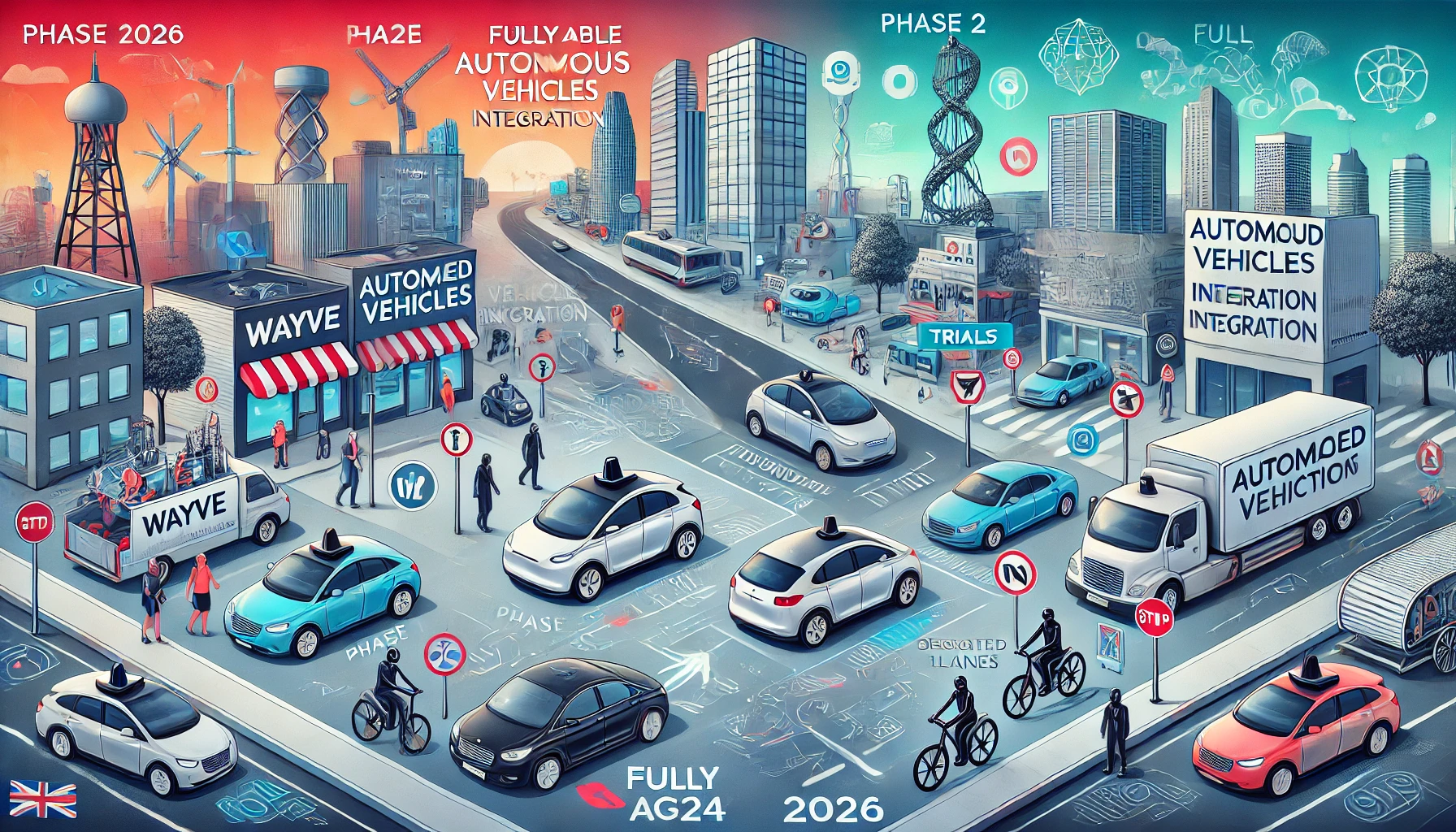
    The year 2026 is poised to be a watershed moment for the UK’s automotive landscape12, with fully driverless cars potentially hitting the roads. This acceleration, propelled by the groundbreaking Automated Vehicles Act of 2024, marks a significant leap forward in the evolution of transportation.

    A closer look at the latest industry reports and legislative developments unveils a detailed roadmap of what to expect as this technology revolutionises our roads.

    Phases of Integration: A Gradual Revolution

    Phase 1: Building Trust with Overridable Self-Driving Cars Initially, we will witness the introduction of “overridable” self-driving cars. These vehicles will empower human drivers to intervene and take control in situations where the AI system may falter. This crucial first phase serves a dual purpose: it allows the public to gradually acclimate to the technology while simultaneously gathering invaluable real-world data to refine the AI’s capabilities.

    Phase 2: Embracing Full Autonomy As confidence in the technology solidifies and overridable self-driving cars become ubiquitous, the stage will be set for the second phase: the deployment of fully autonomous, non-overridable vehicles. These cars will operate independently, ushering in a new era of transportation that promises enhanced safety, reduced congestion, and improved accessibility.

    Navigating the Transition: Addressing Human and Machine Errors

    The path to a fully autonomous future is not without its challenges. One of the most pressing concerns is the potential for both human and machine errors during this transitional period.

    Human Error:
    The Persistent Challenge Human error remains a leading cause of road accidents in the UK, contributing to a staggering 88% of collisions. Distracted driving, fatigue, and impaired driving are just a few examples of the human factors that jeopardise road safety. While self-driving cars aim to eliminate these risks, the transition period presents a unique challenge in handover scenarios, where drivers may need to suddenly resume control.

    Machine Error: The Imperfections of Technology Self-driving cars, while promising, are not infallible. Manufacturing defects and design flaws can lead to malfunctions, even in meticulously crafted vehicles. Rigorous testing and stringent quality control measures are paramount to mitigating these risks.

    The UK’s Pioneering Efforts: Trials and Regulations3

    The UK has taken a proactive stance in embracing this technological revolution. Companies like Wayve and Oxa are already conducting trials in urban environments, paving the way for a driverless future. These trials operate under a strict code of practice that mandates human supervision, ensuring safety and addressing initial concerns.

    The Way Forward: A Multifaceted Approach

    To ensure a seamless and safe transition to fully autonomous vehicles, a multifaceted approach is essential:

    Enhanced Testing and Validation: Continuous rigorous testing under diverse conditions is crucial to identify and rectify potential defects.

    Public Awareness and Education: Educating the public about the capabilities and limitations of self-driving technology will foster acceptance and responsible usage.

    Robust Regulatory Oversight: Stringent regulations must be developed and enforced to ensure high safety standards and hold manufacturers accountable.

    Infrastructure Adaptation: Upgrading road infrastructure to accommodate autonomous vehicles, including dedicated lanes and intelligent traffic systems, will be vital.

    Conclusion: A Safer, More Efficient Future Beckons

    The UK’s forward-thinking approach, exemplified by the Automated Vehicles Act, positions the nation at the forefront of the autonomous vehicle revolution. By addressing both human and machine errors head-on, the UK is paving the way for a future where fully autonomous, safe roadways are a reality. This transformation has the potential to save countless lives, revolutionise transportation, and create a more efficient and accessible society for all.

    1. https://www.gov.uk/government/news/self-driving-vehicles-set-to-be-on-roads-by-2026-as-automated-vehicles-act-becomes-law ↩︎
    2. https://www.topgear.com/car-news/tech/self-driving-cars-could-be-uk-roads-2026-after-new-law-signed ↩︎
    3. GOV.UK)​​ (Enterprise Technology News and Analysis)​​ (Top Gear)​. ↩︎

    Explore related WiBrief research

    Compare this early autonomous-vehicle roadmap with how AI agents are shifting control and accountability today in the Autonomy and AI research hub. Experience the trade-offs directly in the interactive Autonomy Atlas.