📂 Remember the days spent sifting through endless files or scouring outdated databases for that one crucial piece of information? Whether you’re a 💼 lawyer, a 🔬 researcher, a 📈 marketer, or any professional who relies on knowledge, we’ve all been there. 👋 Say goodbye to those frustratingly slow and inefficient workflows.
🚀 The game-changer is here: Retrieval-Augmented Generation (RAG). This cutting-edge AI technology is set to revolutionise how we work across various fields, giving us instant access to up-to-date and relevant knowledge right at our fingertips. It’s like strapping a jet engine onto your trusty old bicycle—suddenly, you’re not just keeping up, you’re soaring ahead of the competition. In this post, we’ll dive deep into how RAG is transforming the legal landscape, but its potential reaches far beyond.
What is RAG, and Why Should You Care?
In simple terms, Retrieval-Augmented Generation (RAG) lets AI access a vast, up-to-the-minute pool of knowledge while answering your questions. No more relying on outdated datasets! This means your legal insights are not only accurate but also reflect the latest developments—a game-changer in our fast-paced legal world.
RAG in Action: Real-World Examples
Compliance, Simplified: Ever spent hours deciphering the latest GDPR updates? With RAG, you can ask, “What’s new with GDPR?” and get an instant, digestible summary. No more scrambling to keep up with regulations – RAG’s got your back. See our example here.
Legal Research, Supercharged: Forget trawling through endless case law databases. Specialised legal AI tools like Harvey AI and CoCounsel AI, powered by RAG, let you pinpoint the most relevant precedents with pinpoint accuracy.
Strategy, Not Just Reaction: RAG isn’t just about keeping up; it’s about getting ahead. Use it to spot emerging trends, anticipate legal challenges, and craft proactive strategies that position your clients for success.
The Fine Print: RAG’s Limitations
Of course, even the most cutting-edge tech has its limits. RAG is no exception:
Knowledge Cut-Off: AI models have a ‘knowledge horizon’ and may miss the absolute latest developments, even with RAG. Always double-check crucial details.
Model Quirks: AI isn’t perfect; it can have blind spots or biases. Use your own expertise to interpret and apply its insights.
The Ethical Imperative: Using RAG Responsibly
As AI becomes more integrated into our work, human oversight and ethical considerations grow in importance. In the legal world, where upholding justice and protecting client interests are paramount, it’s crucial to ensure that AI is used responsibly and ethically. RAG can be a powerful ally, but it’s up to us to wield it with wisdom and integrity.
☘️ The Future is Bright (and RAG-Powered)
RAG is already transforming the way we work, but the best is yet to come. Imagine AI tools that seamlessly integrate with your organisation’s knowledge base, predict industry trends, and even draft customised reports or documents. The possibilities are endless.
So, are you ready to embrace the future? Dive into the world of RAG and discover how it can elevate your work to new heights. From streamlining compliance to supercharging legal research and enabling proactive strategies, RAG is poised to redefine how we access and leverage knowledge. Just remember, while RAG is a powerful tool, it’s at its best when combined with human expertise and ethical considerations.
Continue exploring practical AI
Retrieval-augmented generation is one component of useful AI systems. The wider questions include how to configure AI assistants, which tools to trust and how to keep humans accountable for decisions.
As a legal technologist at KPMG, I have witnessed the technological revolution reshaping the legal landscape. However, nothing excites me more than the potential of quantum computing to revolutionise environmental, social, and governance (ESG) issues.
Quantum Computing: A Game-Changer for ESG
Quantum computing, with its unparalleled processing capabilities, is poised to revolutionise how we approach ESG. It can analyse massive datasets and model complex scenarios, potentially uncovering hidden links between corporate actions and environmental harm. This could transform environmental litigation, empowering plaintiffs and holding companies accountable in unprecedented ways.
The Evolving Landscape of Corporate Responsibility
The impact of quantum computing extends beyond the courtroom. It is set to redefine corporate responsibility. Quantum simulations may redefine ‘duty of care,’ pushing companies to anticipate and mitigate environmental harm proactively. This shift could herald a new era of proactive corporate responsibility, where businesses are expected to take pre-emptive measures to protect the environment.
Embracing the Quantum ESG Opportunity
While the rise of quantum computing in ESG may seem daunting, it presents a unique opportunity for businesses. By harnessing this technology, companies can:
Develop Early Warning Systems: Identify and address environmental risks before they escalate into costly legal battles.
Craft Robust Legal Strategies: Navigate the evolving regulatory landscape with confidence and ensure compliance with emerging ESG standards.
Invest in Sustainability: Proactively mitigate legal risks, enhance reputation, and appeal to environmentally conscious stakeholders.
The Time to Act is Now
The quantum revolution is not a distant future; it is happening now. It is a call to action for all of us – legal professionals, business leaders, investors, and anyone concerned about the future of our planet. Embracing quantum computing in the context of ESG is not just about staying ahead of the curve; it is about shaping a more sustainable and responsible future for all.
The quantum revolution is here, and I invite you to join the conversation and explore how quantum computing can transform your ESG strategy.
For those ready to take the first step, I encourage you to:
Educate Yourself: Dive deeper into the world of quantum computing and its potential impact on ESG. There are numerous resources available, from articles and webinars to expert consultations.
Assess Your Risks: Evaluate your organisation’s current ESG practices and identify potential vulnerabilities that quantum computing could expose.
Engage with Experts: Seek guidance from legal and technology professionals specialising in quantum computing and ESG. They can offer invaluable insights and tailor solutions to your specific needs.
Explore Quantum Solutions: Investigate existing quantum computing tools and platforms that can aid in ESG risk assessment and mitigation.
Develop a Proactive Strategy: Start crafting a forward-thinking ESG strategy that integrates quantum computing into your risk management and compliance efforts.
The time to act is now. By taking these initial steps, you can position your organisation at the forefront of the quantum revolution in ESG and ensure a sustainable and prosperous future.
Algorithms and predictive computer systems are increasingly being used in our daily lives to analyse aand predict patterns that emerge from data. Improvements in the technological sophistication, accuracy and efficiency of algorithms today have naturally made the decision to automate appealing for entrepreneurs and as a result, algorithms can be found prevailing far and wide. They incapsulate almost every setting we inhabit; from formal business environments such as within HR departments, where they are used to categorise, filter and sort candidates into prospective groups. To their use in search engines, where they allow for the production of search results that are specific to each individual, and in our favourite music streaming platforms where algorithms are used to personalise playlists and suggest artists that we are yet to discover.
What are Algorithms?
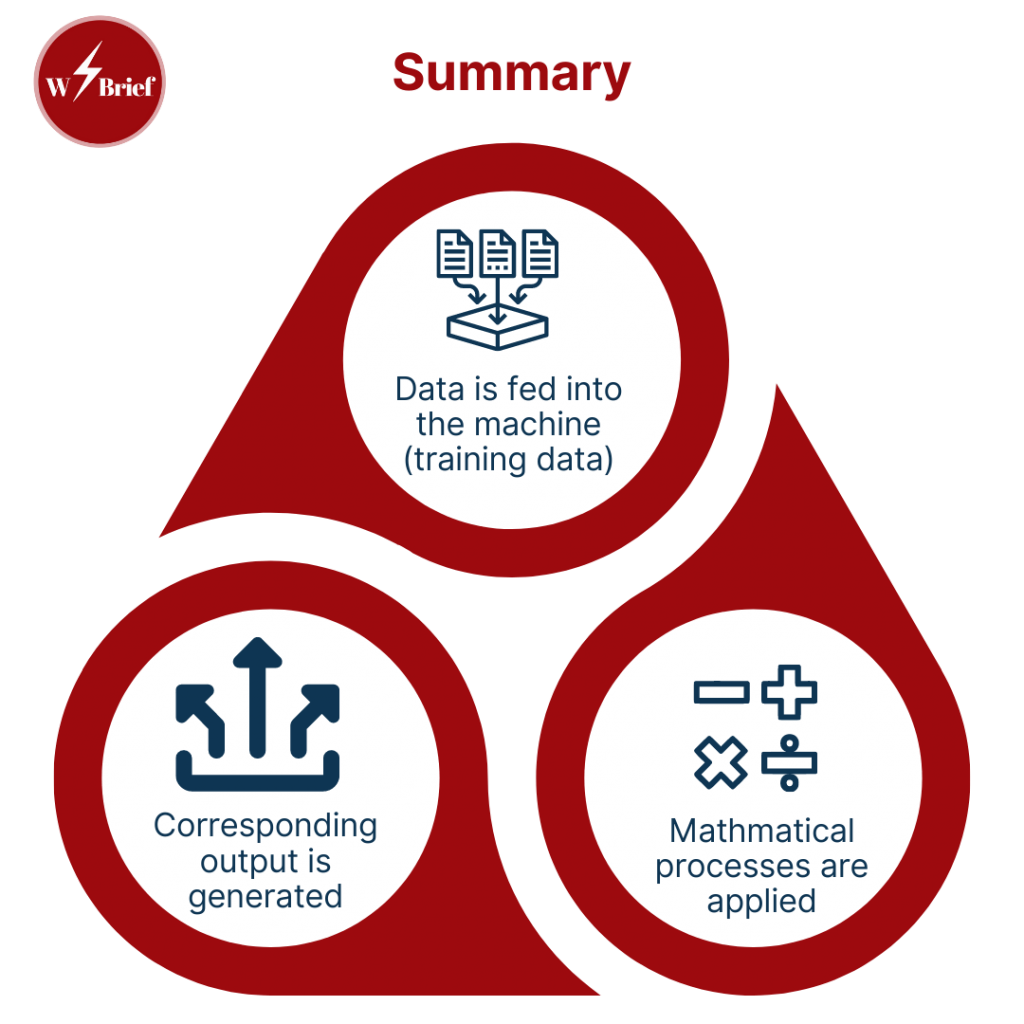
Algorithms are computerised processes that can be used to solve complex problems and predict future outcomes. More specifically, machine learning algorithms are mathematical codes that have been designed by humans to draw inferences from patterns of data and make predictions based on the available information. These are the type of algorithms that are the subject of our attention here. Put simply, data is fed into the machine (training data), mathematical processes are applied, and a corresponding output is generated.
What is an algorithm? Summary
The algorithmic problem – Systematising bias in code
Recent cases where algorithms have been applied in modern settings have put a spotlight on the fact that their effects need to be studied in greater detail. Particularly, as their uncontrolled rolllout can lead to unindented social consequences, if left unchecked by regulators and stakeholders. These examples, which are explored in further detail later on in this ‘Brief’, have revealed that as a result of how they are coded, algorithms are also capable of causing great social harms, by accentuating and systemising the negative biases and implicit assumptions that can exist within societies. This has come to be known as ‘algorithmic bias’ and is used to pick out instances in which certain groups of people are left worse off as a result of the outcomes produced by machine learning algorithms.
In recent times, a typical example of the potential injustices arising from the use of algorithms is the Correctional Offender Management Profiling for Alternative Sanctions (COMPAS). This programme is used by numerous courts in the US to guide sentencing and its purpose is to calculate the likelihood of an offender reoffending. Worryingly, ProPublica also found that the program was creating patterns that were discriminatory towards African Americans; their analysis found that, when controlling other factors, such as prior crimes, age and gender, black defendants were 45% more likely to be assigned higher risk scores relating to the probability of re-offence than their white counterparts. This example, and others like it, in which algorithms have been used to make consequential decisions by those at the decision-making-helm, highlight the vulnerabilities inherent to placing an over-reliance on automated systems.
ProPublica found that the program was creating patterns that were discriminatory towards African Americans and it was more likely to flag Black defendants as likely to re-offend.
What we’ll cover
In this article we will begin by first outlining algorithmic bias in greater detail, and in doing so, highlight two of its most common manifestations; pre-existing bias and feedback loop bias. To make sure you have a clear conception of how algorithmic bias works in the real-world, we will move on to focus our attention on Amazon’s AI recruiting tool and why the results it was producing forced Amazon to remove it. We will then move on to take a look at the relevant law surrounding algorithmic bias, as well as the social context in which it sits. Finally, our focus shifts to the future, and how we should aim to move forward with the use of algorithmic processes in light of our awareness of the possibility of negative outcomes.
Algorithmic Bias, What is it?
Recruitment Case Study
The Legal Context
The Social Context
Outlook
Takeaways
Algorithmic Bias, What is it?
Algorithmic bias refers to the systematic and repeatable errors programmed into computer systems that consequentially create unfair outcomes, e.g. privileging one group of users/customers over another. If left un-checked, this can have disastrous effects for society’s future development.
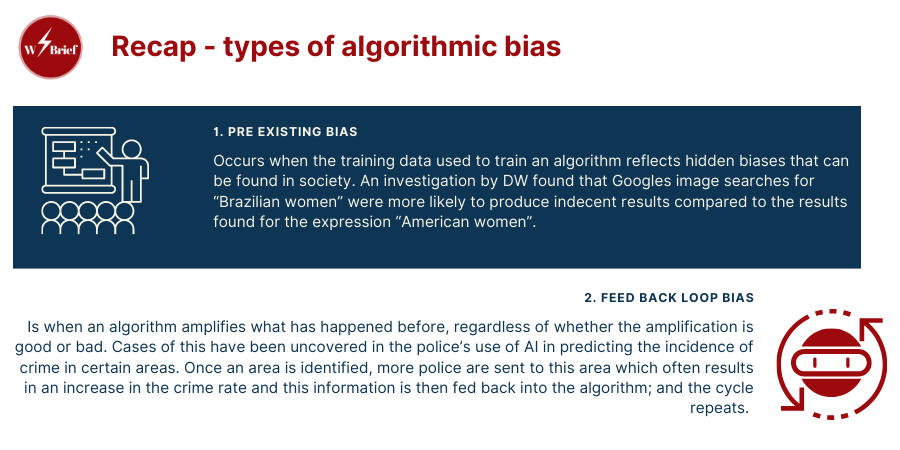
Algorithmic bias can manifest itself in many different ways, with each having a varying and unique impact on the degree of disenfranchisement and exclusion its victims will inevitably face. Below, the two most prominent types of algorithmic bias have been denoted and briefly explained:
1. Pre – Existing Bias
This occurs when the training data, which is the data that is used to train an algorithm, reflects the implicit assumptions and biases that are held in society. For example, an investigation carried out by DW, the German broadcaster, using 20,000 images and websites, uncovered hidden biases in algorithms used by the search engine Google. They showed that image searches using the expression “Brazilian women” were more likely to produce indecent results when compared to the results found for the expression “American women”.
2. Feedback Loop Bias
An algorithm is also capable of influencing the data that it receives through positive feedback loops. Simply put, this means that the algorithm amplifies what has happened previously. This is the case regardless of whether the amplification is good or bad. Cases of this have been uncovered in the police’s use of AI in predicting the incidence of crime in certain areas. Once an area is identified, more police are sent to this area which often results in an increase in the crime rate and this information is then fed back into the algorithm; and the cycle repeats.
Different types of algorithmic bias
It is important to note at this point that, despite the growing intrigue in algorithmic bias, the relevant evidence is usually difficult to obtain and this is restricting academic research into this area. The algorithms deployed in business are often proprietary and the result of large amounts of effort, investment and research. This means that the secrets behind how these algorithms work are often closely guarded. As such, most attempts made by external researchers to investigate potential bias issues are often left begging, without little cooperation from manufacturers. But with increasing social pressure and awareness of algorithmic bias, high-profile companies, such as Twitter, have recently tried to tackle this issue by holding competitions to identify and address algorithmic bias.
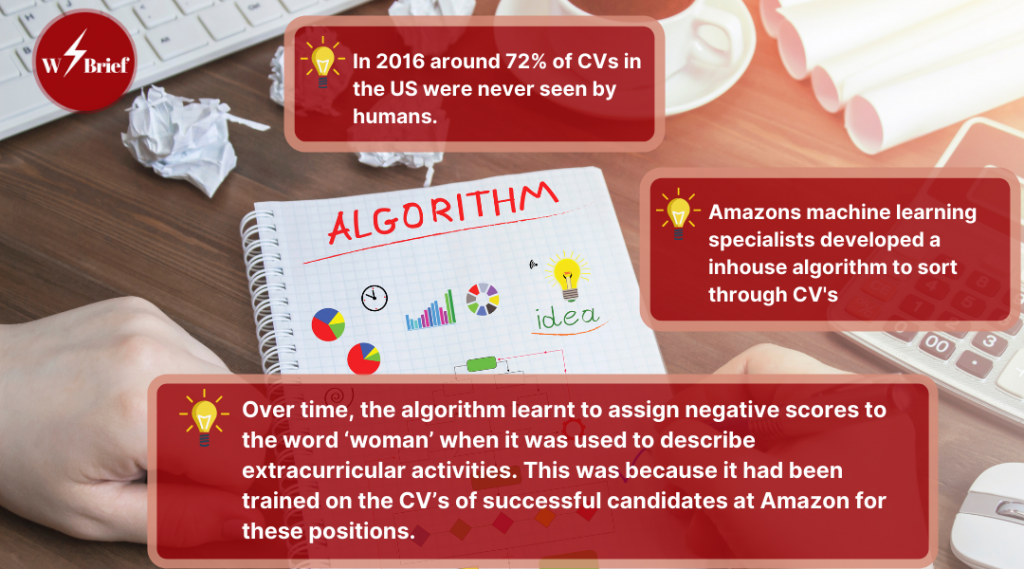
As is hopefully becoming clear, the influence of algorithms in decision making is widespread across all industries, from the financial services to local government. One particular area in which the use of algorithms is becoming increasingly prevalent is in the recruitment process; it was estimated in 2016 that around 72% of CVs in the US were never seen by humans.
Let us take a closer look at the use of algorithms in this context by analysing the somewhat recent Amazon recruitment case study. In 2014, through systems developed by AMZN.O, Amazon’s in-house machine learning specialists, the company began to use computer programs to review job applications. Automation has been a significant part of Amazon’s rise to the top of the e-commerce industry and was therefore inline with its prior course of business developments.
However, from as early as 2015 it was already becoming clear that candidates were not being rated in a gender neutral way, specifically for technical posts such as ‘software development’ positions. What quickly came to light was that the model had learnt to assign negative scores to the word ‘women(s)’ when it was used to describe extracurricular activities. The reasoning being that the model had been trained on the CV’s of historically successful candidates for these sorts of positions at Amazon, and these previously successful candidates were predominately male.
“Algorithmic Bias refers to the systematic and repeatable errors programmed in to computer systems that consequentially create unfair outcomes i.e Such as privileging one group of users over another”
Therefore, we are able to conclude, at least in part, that this is an example of pre-existing bias. This is because the model had recognised the male domination of certain job roles at amazon and made its predictions on the basis of this information. The debate that therefore ensues focuses on whether algorithmic screening can be employed to counter these biases, both explicit/conscious and implicit/unconscious, that human recruiters often fall guilty of.
Algorithmic screenining
The Legal Context
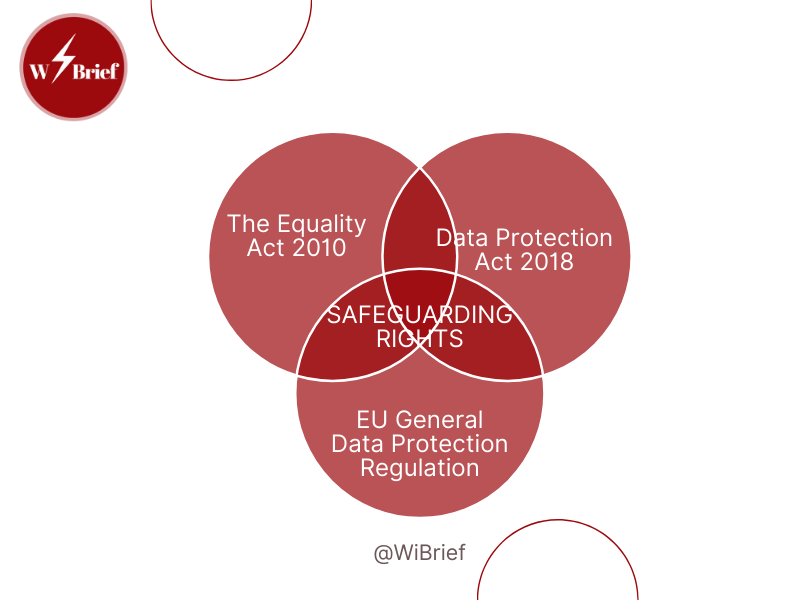
The Equality Act 2010
EU Generat Data Protection Regulation
Data Protection Act 2018
There are a few fundamental pieces of legislation in European and UK contexts of relevance to the issue of algorithmic bias. Of particular importance is the Equality Act 2010, which picks out nine ‘protected characteristics’ (see also how these human rights appear again in the European Commissions framework for trustworthy AI covered here) that demarcate illegal discrimination. These are: age, disability, gender reassignment, marriage and civil partnership, pregnancy and maternity, race, religion or belief, sex and sexual orientation.
On first impressions the Equality Act appears to present a clear cut guide for tackling algorithmic bias as we can hold humans accountable for the discriminatory decisions that they make. For an algorithm to be discriminatory in some way it must therefore have been programmed by some human to this effect; allowing accountability to be easily deduced. However, in practice things become a little hazy. For example, an algorithm can be explicitly programmed to exclude data concerning biological sex, but where this data strongly correlates with some other attribute, such as occupation, the algorithm may still end up producing sexist outcomes.
On the other hand, the risks that the uses of AI pose can be situated against some long-established legal principles and responsibility models. For instance, intention and negligence are important elements of civil and criminal cases. Considering the former, proving intent will likely require focusing on the individuals that intentionally developed and deployed a programme for malicious purposes. Furthermore, where predictions that programs make result in the causation of harm, and in those instances where a developers intent is absent, there could still be a legal question whether there was reasonable effort to foresee such harm.
Another approach that would negate the need for intention, would be to regulate algorithmic disputes through a ‘no-fault’ strict liability scheme. Under this, the very act of unfair discrimination by an algorithm would constitute enough evidence for its creators to be proven to be at fault and liable for the actions of their creation; unforeseen or otherwise. Unfortunately however, proving discrimination for the injured parties can be difficult. Especially, as we have previously covered, in situations when a CV has been unfairly filtered out by a sorting algorithm before the interview stage. In this situation affected parties will often not realise they are victims of such bias until many years later.
Finally, the EU General Data Protection Regulation (GDPR) and the Data Protection Act 2018 are pieces of legislation that include provisions aimed at providing effective legal safeguards such rights of transparency of explanation and of contestation for fully-automated decisions that process personal data.
Key legislation breakdown
The Social Context – Algorithmic discrimination
The main social implication of algorithmic bias is discrimination and the phrase ‘algorithmic bias’ is often used as a synonym for ‘algorithmic discrimination’. Discrimination is said to take place when one arbitrary group of people is, with no justified reasons, treated worse than the rest of the population.
The most significant concern for many is that not only are we seeing biases reflected in new automated decision-making processes, but that they are also being compounded. This exacerbating existing societal struggles with discrimination and inequality. Furthermore, some feel that the automation of such processes is resulting in accountability becoming blurred.
Encouragingly, NGOs are doing some very important work in order to illuminate the risks that machine learning systems present to human rights and liberties, including Amnesty International, Access Now, Human Rights Watch and Privacy International.
Outlook – The need for a standardised approach for detecting and measuring algorithmic bias
We must acknowledge the fact that the biases that we are uncovering in algorithmic decision-making processes are most likely the product of the implicit assumptions and negative associations of the past, alongside those that still exist in society today.
It seems obvious that a clear and standardised method for detecting and measuring algorithmic bias is essential at this moment. This is important as it is crucial that we develop an understanding of whether or not algorithmic bias is producing results that are worse than those biases that pre-exist them in society. It is only at this point that we may determine when and in what contexts the use of algorithms is producing a net-loss for society; to me, at this point there use would be hard to justify.
There also needs to be a focus on mitigation in the first instance which will likely be most effectively achieved through regulation. Following on from the point made above, until we deepen our understanding of what biases are at play this will be very difficult. Whether limiting the uses of algorithmic systems until this has been ironed out is the most appropriate way forward is a very contentious but important debate at present.
Article Takeaways
Algorithmic bias often reflects the negative biases and implicit assumptions that already exist in society.
The opaque nature of machine learning algorithms is limiting our ability to identify and address the potential biases.
Increased legal scrutiny will be required in order for our current legal principles to appropriately apply in the AI age.
The current trend of self-regulation should be left behind in order to prevent the sidelining of the law and legal institutions.
“The most significant concern for many is that we are not only seeing biases reflected in these new automated decision-making processes, but that they are also being compounded; exacebating discrimination and increasing inequalities.”
Algorithmic fairness is inseparable from the question of who is allowed to make consequential decisions. Read the wider context in the Autonomy and AI research hub, and investigate decision authority in the interactive Autonomy Atlas.
WiredBrief are delighted to bring to you an exciting presentation from the second edition of AI Waves, which looks at Nextbanks AI driven FinTech credit scoring solution
About this event
Krzysztof Kogutkiewicz – CEO at NextBank discusses AI and Credit Scoring
Exciting developments in Artificial intelligence (AI) are explored by AI Waves during their second instalment: “Forget scorecards and turn your credit scoring into a money-making machine”, which looks at AIs application within FinTech.
This keynote focuses on NextBanks highly sophisticated credit scoring solution which helps solve traditional problems experienced in banking, relating to credit score transparency and maintenance. The use of AI within credit scoring has allowed large amounts of data to be used to determine specific actions / factors that affect credit user scores. These factors are then used to automatically create credit scoring models, which enable more proactive decisions to be taken by both banks and private users alike.
Host Anna Gawlikowska – AI Waves
Speaker Krzysztof Kogutkiewicz – CEO at NextBank
Key Takeaways
The team’s algorithm predicted loan repayments, with a predictive accuracy of 97%.
Banks and private users can use NextBank’s solution to not just predict the likelihood of loan repayments, but to also highlight the specific factors that cause increases and decreases to credit score.
The implications of NextBank’s solution mean that loan pre – approvals can be automated by defining a cut off criteria that approves high probability applicants whilst referring riskier ones for manual review.
Banking teams can also use NextBank’s solution to pro-actively reach out to individuals with higher repayment predictive scores to offer lucrative loan terms before loan applications are made.
Credit scoring – What are the challenges? : Hard to interpret and reactive 7:16
What if credit scoring could return probability of return of a given loan they are applying for? Allows automating threshold acceptance. Only allow 80% success loan applications else manually review. 12:12
Show how a given factor affects a final result (ie credit history, private lending, demographics etc): 13:15
Can we create a system that can process 1000s of data points? 15:00
Can we create a pro active system that can recommend good burrowers?: 16:00
How was the AI system trained and what data sets were used? 18:00
Build world-class digital products with a team of design, development and strategy experts. All in one place.
Continue exploring
Financial scoring systems offer a useful case study in automated decision-making. Explore the governance and human agency implications in the Autonomy and AI research hub, and investigate decision authority in the interactive Autonomy Atlas.
Fasten your seatbelts and get ready to explore the fascinating world of self-driving cars! The Society of Automotive Engineers (SAE) has defined six distinct levels of automation, each representing a milestone on the road to a driverless future. Let’s take a closer look at what these levels mean for you and the future of transportation.
Icon
–
Description
0
No Automation: This is the familiar territory of most cars on the road today. You’re the captain of your ship, making all the decisions, from turning the steering wheel to hitting the brakes. While your car might have some helpful features like lane departure warnings or automatic emergency braking, you’re still the one in charge.
1
Driver Assistance: At Level 1, your car begins to offer a helping hand. Technologies like adaptive cruise control, which maintains a safe distance from the vehicle ahead, or lane-keeping assist, which gently nudges you back into your lane, provide limited assistance. However, you remain fully responsible for the vehicle’s operation and must stay alert and engaged.
2
Partial Automation: Level 2 takes automation a step further, allowing the car to control both steering and acceleration/deceleration simultaneously. Tesla’s Autopilot and Cadillac’s Super Cruise are prime examples of this level. While these systems offer enhanced convenience and safety, the driver must remain attentive and ready to take over at any moment.
3
Conditional Automation: This is where the magic of true self-driving begins. Level 3 vehicles can perform all driving tasks under certain conditions, such as on well-marked highways or in low-speed traffic. You can relax and let the car do the work, but you must be prepared to take control when the system requests it. Honda’s Legend, available in Japan, is the first commercially available Level 3 car.
4
High Automation: Imagine a car that can navigate busy city streets, drop you off at your destination, and then find a parking spot all on its own. Level 4 vehicles can handle most driving tasks in specific environments, like geo-fenced areas or under favorable weather conditions. Waymo’s self-driving taxis, operating in select cities, exemplify this level of autonomy.
5
Full Automation: This is the ultimate goal of the self-driving revolution. Level 5 vehicles are fully autonomous, capable of navigating any road, in any weather, without any human intervention. They won’t even have steering wheels or pedals. While this technology is still under development, companies like Cruise and Argo AI are actively working on bringing it to reality (What could possible go wrong?).
The Six stages of automation Diagram
The UK’s Autonomous Journey
The UK is at the forefront of the self-driving revolution, with the government actively supporting the development and testing of autonomous vehicles. The Automated Vehicles Act, passed in 2024, establishes a legal framework for the safe deployment of self-driving cars on UK roads. This includes provisions for insurance, liability, and safety standards.
Companies like Wayve and Oxa1 are conducting trials of self-driving vehicles in London and Oxford, paving the way for a future where autonomous taxis and delivery vehicles could become commonplace. However, public acceptance remains a key challenge, with concerns about safety and job displacement.
The Road Ahead
The journey toward fully autonomous vehicles is fraught with challenges, including technical hurdles, regulatory issues, and public acceptance. However, the potential benefits are immense, from increased safety and reduced traffic congestion to improved mobility for the elderly and disabled.
By understanding the six levels of automation, you can better appreciate the progress that has been made and the exciting possibilities that lie ahead. Whether you’re an early adopter or a cautious observer, the future of transportation is undeniably autonomous. The UK’s proactive approach to legislation and ongoing trials positions it as a leader in this transformative technology, with the potential to revolutionize how we travel and interact with our cities.