Category: AI

Original research, practical explanations and interactive experiments about artificial intelligence, AI agents, machine autonomy and their implications for people and institutions.

  • Algorithmic Bias | Towards greater Transparency, Fairness and Representation in automated systems design

    Algorithmic Bias | Towards greater Transparency, Fairness and Representation in automated systems design

    Introduction

    Algorithms and predictive computer systems are increasingly being used in our daily lives to analyse aand predict patterns that emerge from data. Improvements in the technological sophistication, accuracy and efficiency of algorithms today have naturally made the decision to automate appealing for entrepreneurs and as a result, algorithms can be found prevailing far and wide. They incapsulate almost every setting we inhabit; from formal business environments such as within HR departments, where they are used to categorise, filter and sort candidates into prospective groups. To their use in search engines, where they allow for the production of search results that are specific to each individual, and in our favourite music streaming platforms where algorithms are used to personalise playlists and suggest artists that we are yet to discover. 

    What are Algorithms?

    Algorithms are computerised processes that can be used to solve complex problems and predict future outcomes. More specifically, machine learning algorithms are mathematical codes that have been designed by humans to draw inferences from patterns of data and make predictions based on the available information. These are the type of algorithms that are the subject of our attention here. Put simply, data is fed into the machine (training data), mathematical processes are applied, and a corresponding output is generated.
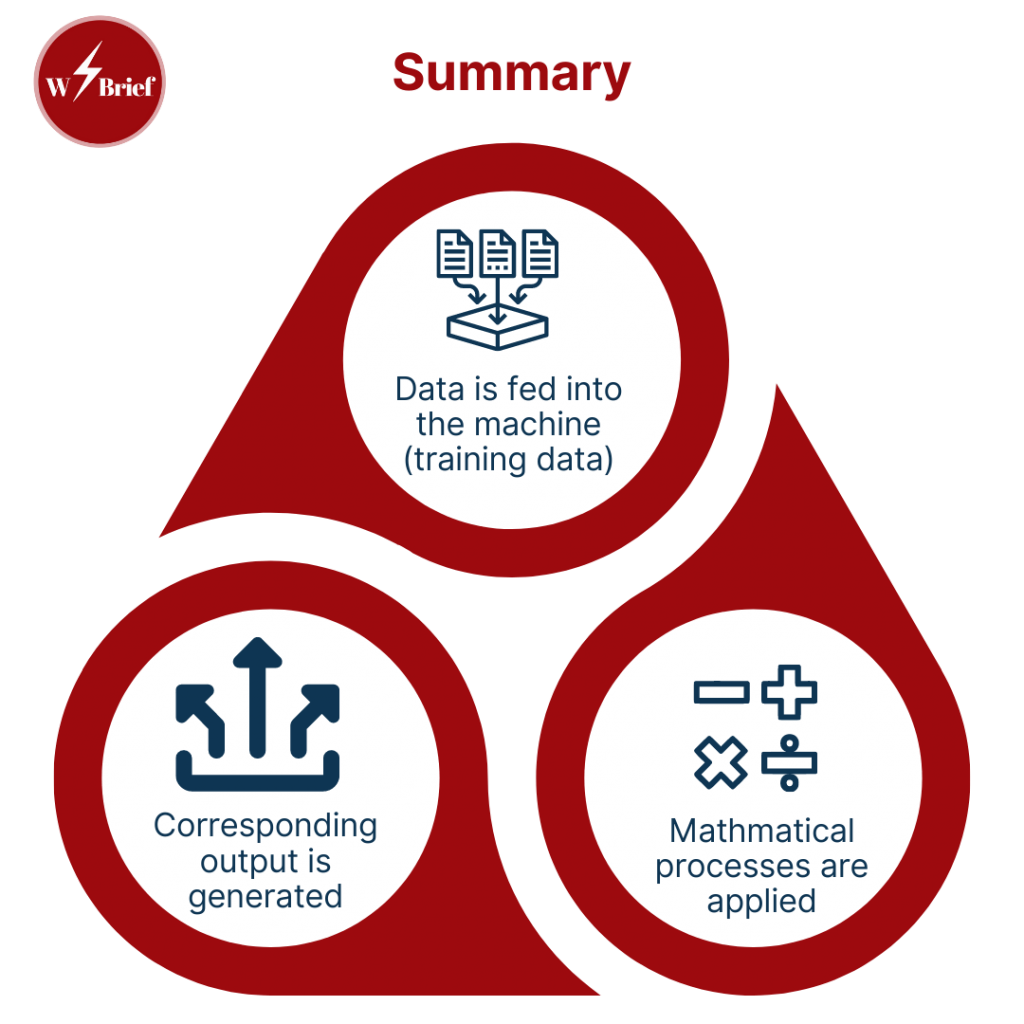
    What is an algorithm? Summary

    The algorithmic problem – Systematising bias in code

    Recent cases where algorithms have been applied in modern settings have put a spotlight on the fact that their effects need to be studied in greater detail. Particularly, as their uncontrolled rolllout can lead to unindented social consequences, if left unchecked by regulators and stakeholders. These examples, which are explored in further detail later on in this ‘Brief’, have revealed that as a result of how they are coded, algorithms are also capable of causing great social harms, by accentuating and systemising the negative biases and implicit assumptions that can exist within societies. This has come to be known as ‘algorithmic bias’ and is used to pick out instances in which certain groups of people are left worse off as a result of the outcomes produced by machine learning algorithms. 

    In recent times, a typical example of the potential injustices arising from the use of algorithms is the Correctional Offender Management Profiling for Alternative Sanctions (COMPAS). This programme is used by numerous courts in the US to guide sentencing and its purpose is to calculate the likelihood of an offender reoffending. Worryingly, ProPublica also found that the program was creating patterns that were discriminatory towards African Americans; their analysis found that, when controlling other factors, such as prior crimes, age and gender, black defendants were 45% more likely to be assigned higher risk scores relating to the probability of re-offence than their white counterparts. This example, and others like it, in which algorithms have been used to make consequential decisions by those at the decision-making-helm, highlight the vulnerabilities inherent to placing an over-reliance on automated systems.

    ProPublica found that the program was creating patterns that were discriminatory towards African Americans and it was more likely to flag Black defendants as likely to re-offend.

    What we’ll cover

    In this article we will begin by first outlining algorithmic bias in greater detail, and in doing so, highlight two of its most common manifestations; pre-existing bias and feedback loop bias. To make sure you have a clear conception of how algorithmic bias works in the real-world, we will move on to focus our attention on Amazon’s AI recruiting tool and why the results it was producing forced Amazon to remove it. We will then move on to take a look at the relevant law surrounding algorithmic bias, as well as the social context in which it sits. Finally, our focus shifts to the future, and how we should aim to move forward with the use of algorithmic processes in light of our awareness of the possibility of negative outcomes. 

    • Algorithmic Bias, What is it?
    • Recruitment Case Study
    • The Legal Context 
    • The Social Context
    • Outlook 
    • Takeaways 

    Algorithmic Bias, What is it?

    Algorithmic bias refers to the systematic and repeatable errors programmed into computer systems that consequentially create unfair outcomes, e.g. privileging one group of users/customers over another. If left un-checked, this can have disastrous effects for society’s future development.

    Algorithmic bias can manifest itself in many different ways, with each having a varying and unique impact on the degree of disenfranchisement and exclusion its victims will inevitably face. Below, the two most prominent types of algorithmic bias have been denoted and briefly explained:  

    1. Pre – Existing Bias

    This occurs when the training data, which is the data that is used to train an algorithm, reflects the implicit assumptions and biases that are held in society. For example, an investigation carried out by DW, the German broadcaster, using 20,000 images and websites, uncovered hidden biases in algorithms used by the search engine Google. They showed that image searches using the expression “Brazilian women” were more likely to produce indecent results when compared to the results found for the expression “American women”.

    2. Feedback Loop Bias

    An algorithm is also capable of influencing the data that it receives through positive feedback loops. Simply put, this means that the algorithm amplifies what has happened previously. This is the case regardless of whether the amplification is good or bad. Cases of this have been uncovered in the police’s use of AI in predicting the incidence of crime in certain areas. Once an area is identified, more police are sent to this area which often results in an increase in the crime rate and this information is then fed back into the algorithm; and the cycle repeats. 
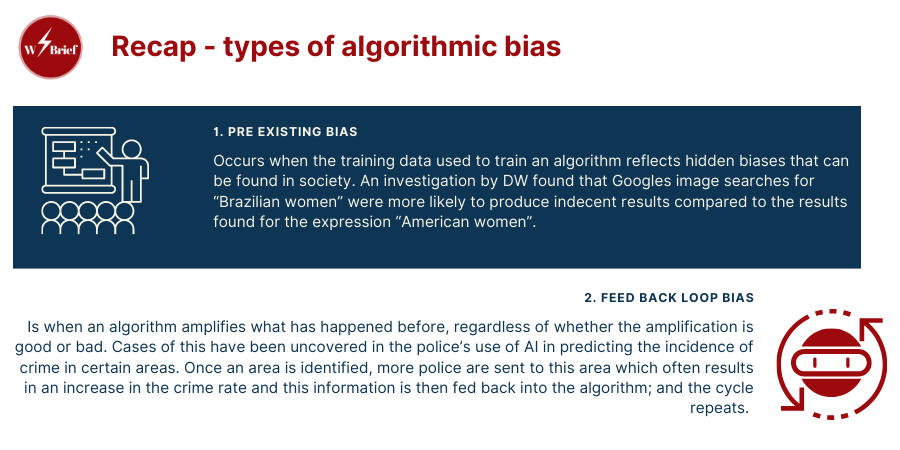
    Different types of algorithmic bias

    It is important to note at this point that, despite the growing intrigue in algorithmic bias, the relevant evidence is usually difficult to obtain and this is restricting academic research into this area. The algorithms deployed in business are often proprietary and the result of large amounts of effort, investment and research. This means that the secrets behind how these algorithms work are often closely guarded. As such, most attempts made by external researchers to investigate potential bias issues are often left begging, without little cooperation from manufacturers. But with increasing social pressure and awareness of algorithmic bias, high-profile companies, such as Twitter, have recently tried to tackle this issue by holding competitions to identify and address algorithmic bias. 

    Recruitment Case study – AMZN.O

    Amazon case study
    AMZM.O case study

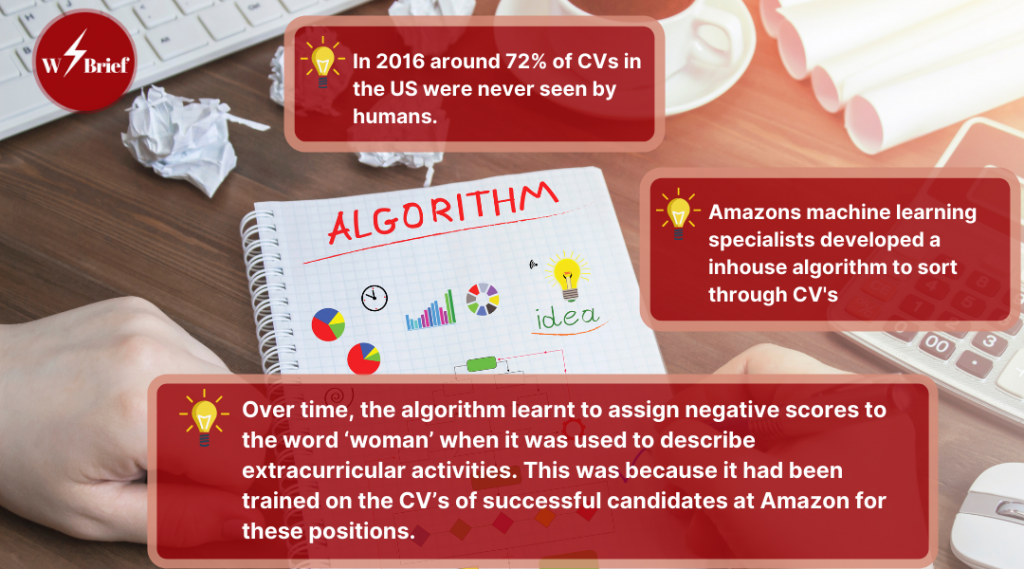
    As is hopefully becoming clear, the influence of algorithms in decision making is widespread across all industries, from the financial services to local government. One particular area in which the use of algorithms is becoming increasingly prevalent is in the recruitment process; it was estimated in 2016 that around 72% of CVs in the US were never seen by humans.  

    Let us take a closer look at the use of algorithms in this context by analysing the somewhat recent Amazon recruitment case study. In 2014, through systems developed by AMZN.O, Amazon’s in-house machine learning specialists, the company began to use computer programs to review job applications. Automation has been a significant part of Amazon’s rise to the top of the e-commerce industry and was therefore inline with its prior course of business developments. 

    However, from as early as 2015 it was already becoming clear that candidates were not being rated in a gender neutral way, specifically for technical posts such as ‘software development’ positions. What quickly came to light was that the model had learnt to assign negative scores to the word ‘women(s)’ when it was used to describe extracurricular activities. The reasoning being that the model had been trained on the CV’s of historically successful candidates for these sorts of positions at Amazon, and these previously successful candidates were predominately male. 

    “Algorithmic Bias refers to the systematic and repeatable errors programmed in to computer systems that consequentially create unfair outcomes i.e Such as privileging one group of users over another”

    Therefore, we are able to conclude, at least in part, that this is an example of pre-existing bias. This is because the model had recognised the male domination of certain job roles at amazon and made its predictions on the basis of this information. The debate that therefore ensues focuses on whether algorithmic screening can be employed to counter these biases, both explicit/conscious and implicit/unconscious, that human recruiters often fall guilty of. 
    Algorithmic screenining
    Algorithmic screenining

    The Legal Context

    • The Equality Act 2010
    • EU Generat Data Protection Regulation
    • Data Protection Act 2018

    There are a few fundamental pieces of legislation in European and UK contexts of relevance to the issue of algorithmic bias. Of particular importance is the Equality Act 2010, which picks out nine ‘protected characteristics’ (see also how these human rights appear again in the European Commissions framework for trustworthy AI covered here) that demarcate illegal discrimination. These are: age, disability, gender reassignment, marriage and civil partnership, pregnancy and maternity, race, religion or belief, sex and sexual orientation. 

    On first impressions the Equality Act appears to present a clear cut guide for tackling algorithmic bias as we can hold humans accountable for the discriminatory decisions that they make. For an algorithm to be discriminatory in some way it must therefore have been programmed by some human to this effect; allowing accountability to be easily deduced. However, in practice things become a little hazy. For example, an algorithm can be explicitly programmed to exclude data concerning biological sex, but where this data strongly correlates with some other attribute, such as occupation, the algorithm may still end up producing sexist outcomes. 

    On the other hand, the risks that the uses of AI pose can be situated against some long-established legal principles and responsibility models. For instance, intention and negligence are important elements of civil and criminal cases. Considering the former, proving intent will likely require focusing on the individuals that intentionally developed and deployed a programme for malicious purposes. Furthermore, where predictions that programs make result in the causation of harm, and in those instances where a developers intent is absent, there could still be a legal question whether there was reasonable effort to foresee such harm.

    Another approach that would negate the need for intention, would be to regulate algorithmic disputes through a ‘no-fault’ strict liability scheme. Under this, the very act of unfair discrimination by an algorithm would constitute enough evidence for its creators to be proven to be at fault and liable for the actions of their creation; unforeseen or otherwise. Unfortunately however, proving discrimination for the injured parties can be difficult. Especially, as we have previously covered, in situations when a CV has been unfairly filtered out by a sorting algorithm before the interview stage. In this situation affected parties will often not realise they are victims of such bias until many years later.

    Finally, the EU General Data Protection Regulation (GDPR) and the Data Protection Act 2018 are pieces of legislation that include provisions aimed at providing effective legal safeguards such rights of transparency of explanation and of contestation for fully-automated decisions that process personal data. 
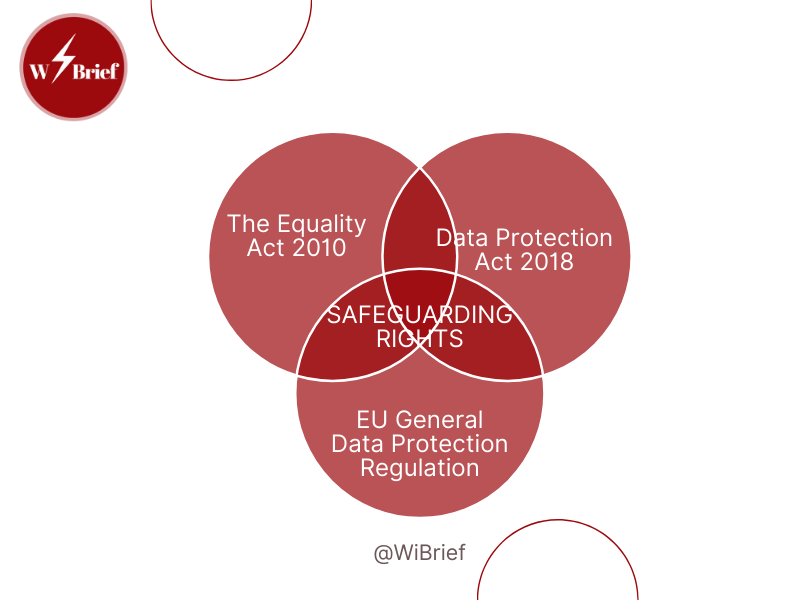
    Key legislation breakdown
    Key legislation breakdown

    The Social Context – Algorithmic discrimination

    The main social implication of algorithmic bias is discrimination and the phrase ‘algorithmic bias’ is often used as a synonym for ‘algorithmic discrimination’. Discrimination is said to take place when one arbitrary group of people is, with no justified reasons, treated worse than the rest of the population. 

    The most significant concern for many is that not only are we seeing biases reflected in new automated decision-making processes, but that they are also being compounded. This exacerbating existing societal struggles with discrimination and inequality. Furthermore, some feel that the automation of such processes is resulting in accountability becoming blurred. 

    Encouragingly, NGOs are doing some very important work in order to illuminate the risks that machine learning systems present to human rights and liberties, including Amnesty International, Access Now, Human Rights Watch and Privacy International. 

    Outlook – The need for a standardised approach for detecting and measuring algorithmic bias

    We must acknowledge the fact that the biases that we are uncovering in algorithmic decision-making processes are most likely the product of the implicit assumptions and negative associations of the past, alongside those that still exist in society today. 

    It seems obvious that a clear and standardised method for detecting and measuring algorithmic bias is essential at this moment. This is important as it is crucial that we develop an understanding of whether or not algorithmic bias is producing results that are worse than those biases that pre-exist them in society. It is only at this point that we may determine when and in what contexts the use of algorithms is producing a net-loss for society; to me, at this point there use would be hard to justify.

    There also needs to be a focus on mitigation in the first instance which will likely be most effectively achieved through regulation. Following on from the point made above, until we deepen our understanding of what biases are at play this will be very difficult. Whether limiting the uses of algorithmic systems until this has been ironed out is the most appropriate way forward is a very contentious but important debate at present.

    Article Takeaways 

    • Algorithmic bias often reflects the negative biases and implicit assumptions that already exist in society.
    • The opaque nature of machine learning algorithms is limiting our ability to identify and address the potential biases. 
    • Increased legal scrutiny will be required in order for our current legal principles to appropriately apply in the AI age.
    • The current trend of self-regulation should be left behind in order to prevent the sidelining of the law and legal institutions.

    For more on automation and algorithms, see here


    “The most significant concern for many is that we are not only seeing biases reflected in these new automated decision-making processes, but that they are also being compounded; exacebating discrimination and increasing inequalities.”

    — Aidan Nylander,
    Author

    Algorithmic bias Ad by Geofrey Banzi

    Continue exploring

    Algorithmic fairness is inseparable from the question of who is allowed to make consequential decisions. Read the wider context in the Autonomy and AI research hub, and investigate decision authority in the interactive Autonomy Atlas.


  • AI | FinTech – Forget scorecards and turn your credit scoring into a money-making machine [VIDEO]

    AI | FinTech – Forget scorecards and turn your credit scoring into a money-making machine [VIDEO]


    WiredBrief are delighted to bring to you an exciting presentation from the second edition of AI Waves, which looks at Nextbanks AI driven FinTech credit scoring solution

    About this event

    Krzysztof Kogutkiewicz – CEO at NextBank discusses AI and Credit Scoring

    Exciting developments in Artificial intelligence (AI) are explored by AI Waves during their second instalment: “Forget scorecards and turn your credit scoring into a money-making machine”, which looks at AIs application within FinTech.

    This keynote focuses on NextBanks highly sophisticated credit scoring solution which helps solve traditional problems experienced in banking, relating to credit score transparency and maintenance. The use of AI within credit scoring has allowed large amounts of data to be used to determine specific actions / factors that affect credit user scores. These factors are then used to automatically create credit scoring models, which enable more proactive decisions to be taken by both banks and private users alike.

    Host
    Anna Gawlikowska – AI Waves

    Speaker
    Krzysztof Kogutkiewicz – CEO at NextBank

     Key Takeaways

    • The team’s algorithm predicted loan repayments, with a predictive accuracy of 97%.
    • Banks and private users can use NextBank’s solution to not just predict the likelihood of loan repayments, but to also highlight the specific factors that cause increases and decreases to credit score.
    • The implications of NextBank’s solution mean that loan pre – approvals can be automated by defining a cut off criteria that approves high probability applicants whilst referring riskier ones for manual review.
    • Banking teams can also use NextBank’s solution to pro-actively reach out to individuals with higher repayment predictive scores to offer lucrative loan terms before loan applications are made.

    Machine learning Models used by NextBank:

    • Linear regression
    • LightGBM
    • XGboost

    Result metrics used by NextBank.

    • ROC
    • F1 Score (Precision and Recall)

    The following topics were covered:

    • What is Credit scoring 5:38
    • How does traditional Credit scoring work? 6:07
    • Credit scoring – What are the challenges? : Hard to interpret and reactive 7:16
    • What if credit scoring could return probability of return of a given loan they are applying for? Allows automating threshold acceptance. Only allow 80% success loan applications else manually review. 12:12
    • Show how a given factor affects a final result (ie credit history, private lending, demographics etc): 13:15
    • Can we create a system that can process 1000s of data points? 15:00
    • Can we create a pro active system that can recommend good burrowers?: 16:00
    • How was the AI system trained and what data sets were used?  18:00
    • What models were used? 20:33
    • Model goal? 22:15
    • Nextbank Credit Scoring solution and results 24:36
    • Questions: 29:00

    Interested in learning more about AI / Machine learning Services?

    Checkout: Miquido

    Miquido technology consultancy logo
    Build world-class digital products with a team of design, development and strategy experts. All in one place.

    Continue exploring

    Financial scoring systems offer a useful case study in automated decision-making. Explore the governance and human agency implications in the Autonomy and AI research hub, and investigate decision authority in the interactive Autonomy Atlas.

  • 2021 UK Drone Ownership – The Law and Best Practice Tips

    2021 UK Drone Ownership – The Law and Best Practice Tips

    Important: historical guidance (2021). Drone regulations and registration requirements have changed since this article was published, including changes in 2026. Do not rely on the rules below to plan a flight today. Check the current UK Civil Aviation Authority Drone and Model Aircraft Code for up-to-date safety and legal requirements.

    Someone has just very generously gifted you a Drone and you are excited to try it out. You and the Drone are both charged and ready to venture out on your first test flight to the smooth backdrop of Sinatra.

    Teeming with ideas you step outside. Suddenly however, you remember, that actually, you don’t really know anything about flying Drones. In the UK, their use is also highly regulated. Sinatra fades away into the sunset as reality slowly dawns in.

    As the affordability and sales of drones have gone up, so have concerns about their safety. A history of near misses and various accidents (involving aeroplanes and stadiums) have helped bring rising drone ownership to the spotlight. Unfortunately, the underlying law behind their use hasn’t been as popular.

    It’s important to know and understand your legal obligations. Having to undertake all of the research yourself however, might appear daunting, but our team at WiredBrief have taken the trouble of doing all of the legwork for for you.

    What We’ll cover

    Our breakdown of the fundamentals of Drone Ownership in the UK which also includes best practice tips for safe responsible flight, will help you quickly understand your main legal obligations. We’ll particularly be focusing on the 2021 UK drone laws (introduced 31st December 2020), and your duties under the Civilian Aviation Authority (CAA) Air Navigation Order (ANO) 2016 and the Drone code. Whether you’re a commercial or recreational user, it’s going to be important to remember that because of the new changes, the rules and regulations are the same for everyone.

    Drone Usage and affordability – Private v Commercial use

    Drones can be bought easily and cheaply both online and on the high street. They can be affordably priced and range from as low as £100 – £10000, depending on your uses and reasons for buying one. Drones can be fun and used for recreation. Alternatively, they can also have a large range of more practical, commercial business uses. You can observe some of these in the below contexts:

    The issue with Drone ownership; turbulent start and near misses

    Unfortunately, whilst obtaining a Drone might be relatively straightforward, flying one legally and safely is far more tricky. Recently, Drone owners have seen a spate of accidents, that have involved collisions and near misses with commercial airlines. As a result, the need for ensuring greater public safety has led to calls for stricter measures, ensuring Drone operators exercise sufficient caution.

    Drones being operated at high altitudes (typically over a 1000 feet), or close to airfields have been a big part of the problem. The UK AirProxBoard, who collect statistics in this area reported how in 2018 drone incidents rose by more than a third. These numbers have fallen since, possibly due to tighter regulation, but they are still above the expected range. The 2020 COVID pandemic has also meant more grounded commercial airline operations, resulting in fewer sightings.

    Small Unmanned Air System (SUAS) Assessment visualisation by the UK Airprox Board. Drone accidents peaked in 2018, but have been falling since. Possible contributing factors include greater regulation and the recent 2020 Corona Virus pandemic. To download the full report: Click Here

    Some of the most common reasons for Drone accidents and some safety precautions which you could take are outlined below:

    • Lack of Flight Training
      Solution: If you have never flown a Drone before then its important as a new user, you try to increase your understanding of Drones before going outside. Reading your Drone owners manual, watching YouTube videos and practicing are all things you can do to make your flying safer.
    • No pre – flight Check up
      Drone operators, should always do a pre flight check up, to reduce the likelihood of in air emergencies. It’s important to check things like 1.) Battery power and 2.) calibration, secure battery placement and RC antennae signal connection.
    • Flying in Poor weather
      This one goes without saying, but ALWAYS make sure weather conditions are suitable for your planned flight. Strong winds can knock your Drone out of the air, as well as rain and Ice which can cause irreparable internal and external damage to your craft!

    The Law

    The Civilian Aviation Authority (CAA) Air Navigation Order (ANO) 2016 is the main legislation governing aircrafts, including drones, in the UK. This has now been amended by the Air Navigation (Amendment) Order 2020, which attempts to streamline drone law to make the system more understandable – guidance to the updates are provided by the CAA here. The main provision you’ll need to be aware of from the ANO is Article 241 (concerning endangering the safety of any person or property). This applies to every aviation activity at all times and sets out that:

    “[a] person must not recklessly or negligently cause or permit an aircraft to endanger any person or property”.

    Before 31st December 2020, it also used to be important for the purposes of determining whether you needed a licence, to also know whether the purpose of a drone flight was commercial or non – commercial. However, this has since changed and the new focus looks at the risk that each flight represents. The greater the risk, the more rigorous the requirements will be for training and certifications. Whilst a summary of your key obligations can be found within the Drone Code here, we’ve summarised some of the key information below.

    The main risk factors that are used in the updated regulations to determine how risk is categorised and which registration requirements are needed are outlined below:

    How the updated regulations determine risk

    ImageRisk FactorsDescription
    WeightOf your drone (including accessories)
    People Proximity from peopleHow close the drone will fly near (‘uninvolved people’) people not directly involved with the flight
    Proximity from citiesHow close the drone will fly near built up areas (e.g towns, cities, industrial areas, recreational areas etc.)

    Drone operations will typically fall into one of three categories as follows: 

    The three new categories of Drone operations

    RiskCategoryDescriptionCAA Application required?
    LowOpen Category
    • Low (or no) risk to third parties. Has 3 Sub categories that have different restrictions in place regarding craft, qualifications and distance. Most uses fall within this.
    No – Operations can be carried out in accordance with basic pre-defined characteristics and not subject to further authorisation requirements from CAA
    MediumSpecific Category– Greater risk than Open category, or
    – one or more elements of the operation fall outside the boundaries of the Open category.
    Yes – Operational authorisation required from the CAA, based on a safety risk assessment.
    HighCertified Category – equivalent risk to that of manned aviation, resulting in operations falling under similar regulatory regime (i.e., certification of the aircraft, certification of the operator, licensing of the pilot)
    Examples include:
    – Passenger / transportation dangerous goods
    Yes – Equivalent requirements to manned aviation.
    See also The Drone and Model Aircraft Code


    Most uses will typically now fall under the open category and as of 31st December 2020, those who fall into this category will be able to do the following:

    Summary of where most Drone uses fall

    What about Insurance?

    Insurance is optional if you’re flying a drone under 20kg for recreation. However, you should remember that you’re responsible for your actions, which means you could be held personally liable for any injury or damage you cause while you’re flying. If your flight is for any reason other than recreation, you do need insurance. EC785/2004 compliant insurance is still required for commercial operations in both the Open and Specific categories.

    Please not that it is against the law to fly a drone or model aircraft without having the required IDs. You can also be fined for breaking the law when flying. In the most serious cases, you could be sent to prison.

    ID Registration prices

    Drone registration prices
    If you already have an operator ID and just need a flyer ID, you’ll need to add your flyer ID in the My registration area

    Strict Liability on the ground – Relaxed in the air

    Last but not least, we look at the question of Liability for Drone operators. This predominantly concerns the question of where the accident has taken place. For example, section 76 of the CAA applies strict owner or operator liability for surface damage, caused by an aircraft. This can include injury to an individual or damage to property. If you are the Drone owner or operator then you would automatically be at fault for any loss or injury.

    Unless there is contributory negligence to be alleged, the victim would be entitled compensation. Their mission would be to identify and pursue a case against you as the Drone operator. A common challenge however is finding the address of the offender and ensuring they have sufficient insurance / assets.

    In the event of an air-to-air incident, the established principle is not to apportion blame on a strict liability basis. Each incident will thus dealt with case by case and the necessary elements of fault will need to be proven.

    Drones and AI – The next frontier

    Now you know the fundamentals of Drone usage and law in the UK we hope you will join us for our next article. There, we will be examining the technologies next evolution, brought about by combining Drones with artificial intelligence in commercial contexts.

    As we move away from the need to have human operators at the helm of drone flights, we stand to benefit from greater efficiency and more complex Drone uses that can benefit future society. Unlike humans, Drones powered by AI will be able to work all year round without breaks, and in stressful environments without requiring sick days. This paves the way for many commercial opportunities, alongside potential risks. An assessment of both will be important as it will help us understand the future and fundamentally, any social effects brought about by these developments.

    Getting started toolkit:


    Article Takeaways:

    • The Civilian Aviation Authority (CAA) Air Navigation Order (ANO) 2016 govern Drone law in the UK
    • As of 31st December 2020, the same rules apply for both commercial and non commercial users.
    • Most uses fall within the Open category, but the higher the risk posed to the general public the more likely your use will fall outside of the open category. If you have any doubts, it’s important that you do your research and understand your obligations.
    • A full summary of all of the latest regulatory updates to UK drone law can be found here: Click Here
    • EC785/2004 compliant insurance is required for commercial operations in both the Open and Specific categories
    • The UK Government has removed the minimum age requirement for remote pilots operating in the Open and Specific categories. The competency requirements however are unchanged.
    • Under the ANO you must not recklessly or negligently cause or allow a Drone to endanger any person or property
    • Strict liability applies for Drone to surface damage but for Air to Air the courts will look for fault.
  • New AI Data Analytics toolkit launched by ICO

    New AI Data Analytics toolkit launched by ICO

    Top Story:

    Introduction to GDPR by the ICO

    The Information Commissioner’s Office (ICO) has recently just published a new data analytics toolkit. The toolkit is expected to help organisational users of ‘Data analytics’ better understand whether their AI and Data Analytics practises, are compliant with relevant data protection regimes. This brief looks at the ICO’s toolkit and answers some of the most pertinent questions arising from its deployment including:

    1. WHO THE NEW DATA ANALYTICS TOOLKIT is AIMED AT – USERS OF ‘DATA ANALYTICS’
    2. WHAT DOES THE TOOLKIT DO?
    3. OTHER NOTABLE CONTEXTUAL DEVELOPMENTS

    1. WHO IS THE NEW ‘DATA ANALYTICS’ TOOLKIT AIMED AT? – USERS OF ‘DATA ANALYTICS‘

    The ICO define Data analytics as: “the use of software to automatically discover patterns in data sets (where those data sets contain personal data) and use them to make predictions, classifications, or risk scores.”

    This can include but isn’t limited to:

    • Users of algorithms (‘Mathematical instructions or rules given to computer systems to complete tasks’)
    • Users of AI (‘Computer systems able to perform tasks normally requiring human intelligence’)

    2. WHAT DOES THE NEW DATA ANALYTICS TOOLKIT DO?

    The toolkit helps organisations who are at the start of a project that involves data analytics and personal data, go through important data protection points and identify risks.  On completion, respondents will obtain a customisable report that is intended to act as a starting point for guiding further discussions around compliance.

    Importantly, the toolkit covers:

    • Processing under the UK GDPR and
    • the law enforcement regime under the Data Protection Act 2018

    It also has introductory questions to determine the relevant applicable regime and further asks questions around:

    1. Lawfulness
    2. Accountability
    3. Governance
    4. The Data protection Principles
    5. Data Subjects rights

    3. OTHER NOTABLE CONTEXTUAL DEVELOPMENTS TO ALSO BE CONSIDERED

    The toolkit contributes to other works by the ICO around AI which should also be considered. These include:

    See also:

    DOES YOUR AI PASS THE EUROPEAN COMMISSION RISK-ASSESSMENT FRAMEWORK?

  • DOES YOUR AI PASS THE EUROPEAN COMMISSION RISK-ASSESSMENT FRAMEWORK?

    DOES YOUR AI PASS THE EUROPEAN COMMISSION RISK-ASSESSMENT FRAMEWORK?

    THE EUROPEAN COMMISSION RISK-ASSESSMENT – SAFEGUARDING KEY HUMAN RIGHTS AND FREEDOMS.

    The European commission has delivered a new framework for trustworthy Artificial Intelligence (AI) that can be accessed online. The new Risk-Assessment Framework importantly puts a practical spin on the Commissions earlier previously published guidelines . This brief covers the main aspects of the European Commission’s framework, outlining its key features whilst also bringing in some analysis from recent developments.

    In developing the new Risk-Assessment Framework, the European Commission have emphasised the importance of observing an AI’s overall impact on core human rights. The main elements of the Risk-Assessment framework explores this further by covering core rights, such as those relating to non-discrimination, protection of personal data and freedom of expression.

    The main areas covered by the new Risk-Assessment framework include:

    (A) Human Agency and oversight
    (B) Technical Robustness and Safety
    (C) Privacy and Data Governance
    (D) Transparency
    (E) Diversity
    (F) Societal and Environmental well being

    (G) Accountability

    EXAMINING THE EUROPEAN COMMISSION FRAMEWORK

    (B) Human Agency and oversight

    This part of the Risk-Assessment Framework covers whether the system might create over-reliance in users, or illegitimately manipulate users’ behaviour. Whilst AI won’t be capable of making ‘human’ errors, it will however still be fallible to both manufacturing and design errors, as well as ‘machine errors’, fuelled by the algorithmic system itself. This presents clear problems in areas where AI, might be used to substitute human agency in its entirety. An example of this being, stage 5-6 of self-driving cars, where the AI algorithm is said to have complete control without driver interference (for more information see SAEs 5 Stages of Automation and our previous post on self-driving car fundamentals).

    (A) Technical Robustness and Safety

    This covers the subject of security, including resilience to cyber-attacks, general safety as well as the potentially devastating effects of inaccuracy and unreliability.

    (C) Privacy and Data Governance

    This aspect questions the impact of the AI system on the rights to privacy, the right to physical, mental or moral integrity and the right to data protection, and what mechanisms are in place to minimise potential harm and deal with concerns. 

    (C) Transparency

    This covers the traceability of decisions and how, why and where data has been used. An issue with this aspect arises when looking at self-driving car “Black-boxes”, which generate specialist outputs or decisions that cannot readily be explained to users.

    (D) Diversity, Non-discrimination and fairness (AI ETHICS)

    This part of the Risk-Assessment Framework is particularly concerned with the AI designers of today, who have been spearheading recent developments. Recent events have highlighted the importance of avoiding discrimination of all forms more than ever and even more so in the context of algorithmic bias. This was recently highlighted in a recent Ted talk by the president of the Law Society ‘The Future is Biased’ , Christina Blacklwas.

    AI systems should avoid unfair bias and its important that designers not only have a diverse end user in mind, but as an employment group, are also adequately represented by a diverse class of people. Ultimately, the end system should be fair regardless of age, gender, race or other characteristics.

    (E) Societal and Environmental well being

    Naturally, as with the development of any new complex system designed to help humanity, any potential and actual adverse impacts to society and the environment should be limited, as far as possible. More-so, as we are so inextricably linked to both. Whilst its true, that initially adoption of AI in many instances has the potential to impact large areas of employment, leading to job-losses as a result of large-scale automation. This is a foreseeable result that should be accounted for in governmental contingency plans with ready measures to counter any negative effects. Ultimately and most importantly, the overall benefits to society, should outweigh any negative impact predicted to arise.

    (F) Accountability

    Last, but most importantly, its going to be crucial that any AI system developed going forwards has a system of accountability for when unjust or unfair outcomes do occur. This should also ensure an adequate system of redress. In the UK for example, this can thankfully be seen with the ‘Automated and Electric Vehicles Act 2018’ which provides the system of redress for self-driving cars under a single insurance scheme. For more details, see Driverless cars Insurance laws receive Royal assent

    Conclusion

    Now that we have a checklist and Risk-Assessment framework put in place for assessing the suitability of present and future AI systems, what remains to be seen is how developers and employers of AI systems will choose to implement its philosophy going forwards. Nonetheless, it’s certain that the principles are a great first step that works towards helping end users benefit from AI equally, without being exposed to unnecessary risk.

    Stay tuned for more great content


    Continue exploring

    This article reflects an earlier stage of Europe’s AI governance debate. Compare those ideas with today’s questions about delegated authority in our Autonomy and AI research hub, and investigate decision authority in the interactive Autonomy Atlas.

  • Generative AI and the Future of Work: A Paradigm Shift

    Generative AI and the Future of Work: A Paradigm Shift

    The future of work isn’t coming; it’s here, and generative AI is its architect. This powerful technology, capable of creating content from data inputs, is poised to reshape industries, redefine job roles, and fundamentally alter how we approach work. As we stand on the brink of this new era, it’s crucial to understand the implications and prepare for the future.

    The Rise of Generative AI: A Creative Disruption

    Generative AI isn’t just a buzzword; it’s a creative disruption. From automating mundane tasks to generating imaginative content, its applications are vast and rapidly expanding. By 2030, McKinsey predicts that 30% of hours worked today could be automated, signaling a significant shift in the labor landscape. Imagine AI-powered legal research tools that analyse vast amounts of data in seconds, a task that would take human lawyers hours. Or marketing teams collaborating with AI to craft compelling campaigns tailored to individual preferences. The possibilities are boundless​ (McKinsey & Company)​​ (McKinsey & Company)​.

    Phases of Integration: A Gradual Revolution

    Augmentation and Overridable Systems: In the initial phase, AI will primarily augment human tasks, boosting productivity and efficiency. AI-powered tools will handle repetitive tasks, freeing up human workers to focus on more complex and creative endeavors​ (Deloitte United States)​.

    Full Autonomy and Transformation: As AI matures, it will move towards full autonomy, fundamentally altering job roles and creating new career paths. While some jobs may be displaced, AI will also generate new opportunities in fields like AI ethics, data analysis, and machine learning engineering​ (IMF)​.

    Navigating the Challenges: A Human-AI Partnership

    The transition to an AI-powered workplace presents both opportunities and challenges:

    Human Error and Adaptation: Human oversight remains essential, particularly in situations requiring critical thinking and ethical judgment. Upskilling and reskilling programs will be vital to ensure workers can adapt to new roles and collaborate effectively with AI systems​ (McKinsey & Company)​.

    Machine Error and Reliability: AI systems are not foolproof. They require rigorous testing, monitoring, and continuous improvement to ensure reliability and accuracy. Organizations must establish robust governance frameworks to manage AI-related risks​ (World Economic Forum)​.

    The Future Workforce: Skills for the AI Age

    The rise of generative AI will necessitate a shift in workforce skills. Technical skills like programming and data analysis will be in high demand, but so will “soft skills” like critical thinking, creativity, and emotional intelligence. These uniquely human skills will become increasingly valuable as AI takes on routine tasks​ (McKinsey & Company)​​ (World Economic Forum)​.

    Preparing for the Future: Embracing the AI Revolution

    To thrive in the age of generative AI, individuals and organisations must embrace a growth mindset and prioritise continuous learning. Here’s what you can do:

    • Embrace Lifelong Learning: Invest in developing new skills and knowledge to stay ahead of the curve.
    • Foster Adaptability: Be open to change and willing to take on new challenges.
    • Cultivate Creativity: Focus on tasks that require human ingenuity and problem-solving skills.
    • Build Strong Interpersonal Skills: Effective communication and collaboration will be crucial in an AI-powered workplace.

    Generative AI has the potential to revolutionise the world of work, but it’s up to us to shape this future. By embracing change, investing in human capital, and prioritising ethical considerations, we can create a future where AI serves as a powerful tool for human empowerment and innovation.


    What does the future of work look like now?

    Revisit this earlier discussion alongside WiBrief’s more recent examination of AI agents and the changing responsibilities of people and organisations.

  • Redefining Liability: Navigating Tort Law in the Age of Autonomous Vehicles

    Redefining Liability: Navigating Tort Law in the Age of Autonomous Vehicles

    As autonomous vehicles (AVs) become more prevalent, the UK’s legal framework for vehicle liability is evolving rapidly. With the Automated Vehicles Act 2024 (AV Act) now in force, lawmakers are re-examining traditional tort law principles to address the complexities of self-driving technology. This transformation underscores the urgent need for a legal system that can keep pace with the rapid advancements in vehicle automation.

    A New Legal Landscape for Autonomous Vehicles

    In the UK, the “harm-based” law of torts has long governed liability for vehicle accidents, supported by legislation such as the Road Traffic Act 1988. However, as control shifts from humans to algorithms in more advanced vehicle automation, the legal landscape must adapt. The AV Act, which received Royal Assent in May 2024, introduces a comprehensive framework designed to tackle these emerging challenges.

    The AV Act clearly distinguishes between “user-in-charge” (UiC) and “no-user-in-charge” (non-UiC) scenarios, where vehicles operate independently without human intervention. This distinction is crucial, as it clarifies liability in the event of an accident—whether it falls on the driver, the manufacturer, or the software provider. The act specifically designates an “authorised self-driving entity” (ASDE) as the party responsible for ensuring that an AV meets all safety and operational standards, thereby shifting liability away from human drivers when the vehicle operates autonomously(Taylor Wessing, Bird & Bird |International Law Firm).

    The Role of the Automated Vehicles Act

    The Automated Vehicles Act 2024 marks a significant milestone in the regulation of self-driving cars in the UK. Building on previous legislation, such as the Automated and Electric Vehicles Act 2018 (AEVA), the new act goes further by addressing earlier laws’ limitations. It establishes a more rigorous safety framework, requiring AVs to meet safety standards that are equivalent to or higher than those of a competent human driver before they are permitted on public roads.

    Moreover, the AV Act sets up a new regime for the approval and ongoing monitoring of AVs. Vehicles must pass a self-driving test and remain under continuous oversight throughout their operational life. This approach ensures that they stay safe and comply with road rules, even as they undergo software updates and other modifications(GOV.UK,Law Commission).

    Balancing Innovation and Accountability

    As AV technology rapidly advances, it brings new ethical and legal concerns. For instance, when an autonomous car’s decision-making algorithm causes an accident, who bears the responsibility? The AV Act addresses this issue by making the ASDE legally accountable for the vehicle’s actions during non-UiC operations. This shift in liability from the human driver to the manufacturer or software provider represents a significant departure from traditional tort law(Bird & Bird | International Law Firm).

    The act also introduces stringent consumer protection measures, including regulations on how AVs can be marketed. These measures aim to prevent consumers from being misled about a vehicle’s capabilities, ensuring they understand the difference between fully autonomous systems and those requiring human intervention.

    Conclusion

    As the UK approaches the mainstream adoption of autonomous vehicles, its legal system must continue to evolve. The Automated Vehicles Act 2024 plays a critical role in this evolution, providing a clear framework for liability and safety in a world where self-driving cars are becoming the norm. By addressing the legal and ethical challenges posed by AV technology, the UK positions itself as a global leader in the autonomous vehicle sector, ensuring that innovation is balanced with accountability and public safety.


    Explore related WiBrief research

    The questions about responsibility raised by autonomous vehicles now appear in workplaces and software agents. Explore the wider picture in the Autonomy and AI research hub. Experience the trade-offs directly in the interactive Autonomy Atlas.

  • The 6 Stages of Autonomous Driving Explained (SAE Levels)

    The 6 Stages of Autonomous Driving Explained (SAE Levels)

    A Brief introduction

    Fasten your seatbelts and get ready to explore the fascinating world of self-driving cars! The Society of Automotive Engineers (SAE) has defined six distinct levels of automation, each representing a milestone on the road to a driverless future. Let’s take a closer look at what these levels mean for you and the future of transportation.

    Icon–Description
    Diagram introducing the six SAE levels of driving automation0No Automation: This is the familiar territory of most cars on the road today. You’re the captain of your ship, making all the decisions, from turning the steering wheel to hitting the brakes. While your car might have some helpful features like lane departure warnings or automatic emergency braking, you’re still the one in charge.
    Diagram illustrating Level 0 driving automation, where the human driver retains control1Driver Assistance: At Level 1, your car begins to offer a helping hand. Technologies like adaptive cruise control, which maintains a safe distance from the vehicle ahead, or lane-keeping assist, which gently nudges you back into your lane, provide limited assistance. However, you remain fully responsible for the vehicle’s operation and must stay alert and engaged.
    Diagram illustrating Level 1 driver assistance with human responsibility2Partial Automation: Level 2 takes automation a step further, allowing the car to control both steering and acceleration/deceleration simultaneously. Tesla’s Autopilot and Cadillac’s Super Cruise are prime examples of this level. While these systems offer enhanced convenience and safety, the driver must remain attentive and ready to take over at any moment.
    Diagram illustrating Level 2 partial driving automation and required driver attention3Conditional Automation: This is where the magic of true self-driving begins. Level 3 vehicles can perform all driving tasks under certain conditions, such as on well-marked highways or in low-speed traffic. You can relax and let the car do the work, but you must be prepared to take control when the system requests it. Honda’s Legend, available in Japan, is the first commercially available Level 3 car.
    Diagram illustrating Level 3 conditional driving automation and human takeover4High Automation: Imagine a car that can navigate busy city streets, drop you off at your destination, and then find a parking spot all on its own. Level 4 vehicles can handle most driving tasks in specific environments, like geo-fenced areas or under favorable weather conditions. Waymo’s self-driving taxis, operating in select cities, exemplify this level of autonomy.
    Diagram illustrating Level 4 high automation in defined driving conditions5Full Automation: This is the ultimate goal of the self-driving revolution. Level 5 vehicles are fully autonomous, capable of navigating any road, in any weather, without any human intervention. They won’t even have steering wheels or pedals. While this technology is still under development, companies like Cruise and Argo AI are actively working on bringing it to reality (What could possible go wrong?).
    The Six stages of automation Diagram

    The UK’s Autonomous Journey

    The UK is at the forefront of the self-driving revolution, with the government actively supporting the development and testing of autonomous vehicles. The Automated Vehicles Act, passed in 2024, establishes a legal framework for the safe deployment of self-driving cars on UK roads. This includes provisions for insurance, liability, and safety standards.

    Companies like Wayve and Oxa1 are conducting trials of self-driving vehicles in London and Oxford, paving the way for a future where autonomous taxis and delivery vehicles could become commonplace. However, public acceptance remains a key challenge, with concerns about safety and job displacement.

    The Road Ahead

    The journey toward fully autonomous vehicles is fraught with challenges, including technical hurdles, regulatory issues, and public acceptance. However, the potential benefits are immense, from increased safety and reduced traffic congestion to improved mobility for the elderly and disabled.

    By understanding the six levels of automation, you can better appreciate the progress that has been made and the exciting possibilities that lie ahead. Whether you’re an early adopter or a cautious observer, the future of transportation is undeniably autonomous. The UK’s proactive approach to legislation and ongoing trials positions it as a leader in this transformative technology, with the potential to revolutionize how we travel and interact with our cities.

    1. https://www.bbc.co.uk/news/uk-england-oxfordshire-67890403#:~:text=The%20test%20car%20travelled%20around,vehicle%20to%20be%20self%2Ddriving. ↩︎

    Explore related WiBrief research

    Autonomous driving laid the groundwork for today’s questions about AI agents. Explore the wider framework in our Autonomy and AI research hub. Experience the trade-offs directly in the interactive Autonomy Atlas.

  • A Road Map for Driverless Cars: The UK’s Accelerated Journey Towards Autonomy in 2026

    A Road Map for Driverless Cars: The UK’s Accelerated Journey Towards Autonomy in 2026

    The year 2026 is poised to be a watershed moment for the UK’s automotive landscape12, with fully driverless cars potentially hitting the roads. This acceleration, propelled by the groundbreaking Automated Vehicles Act of 2024, marks a significant leap forward in the evolution of transportation.

    A closer look at the latest industry reports and legislative developments unveils a detailed roadmap of what to expect as this technology revolutionises our roads.

    Phases of Integration: A Gradual Revolution

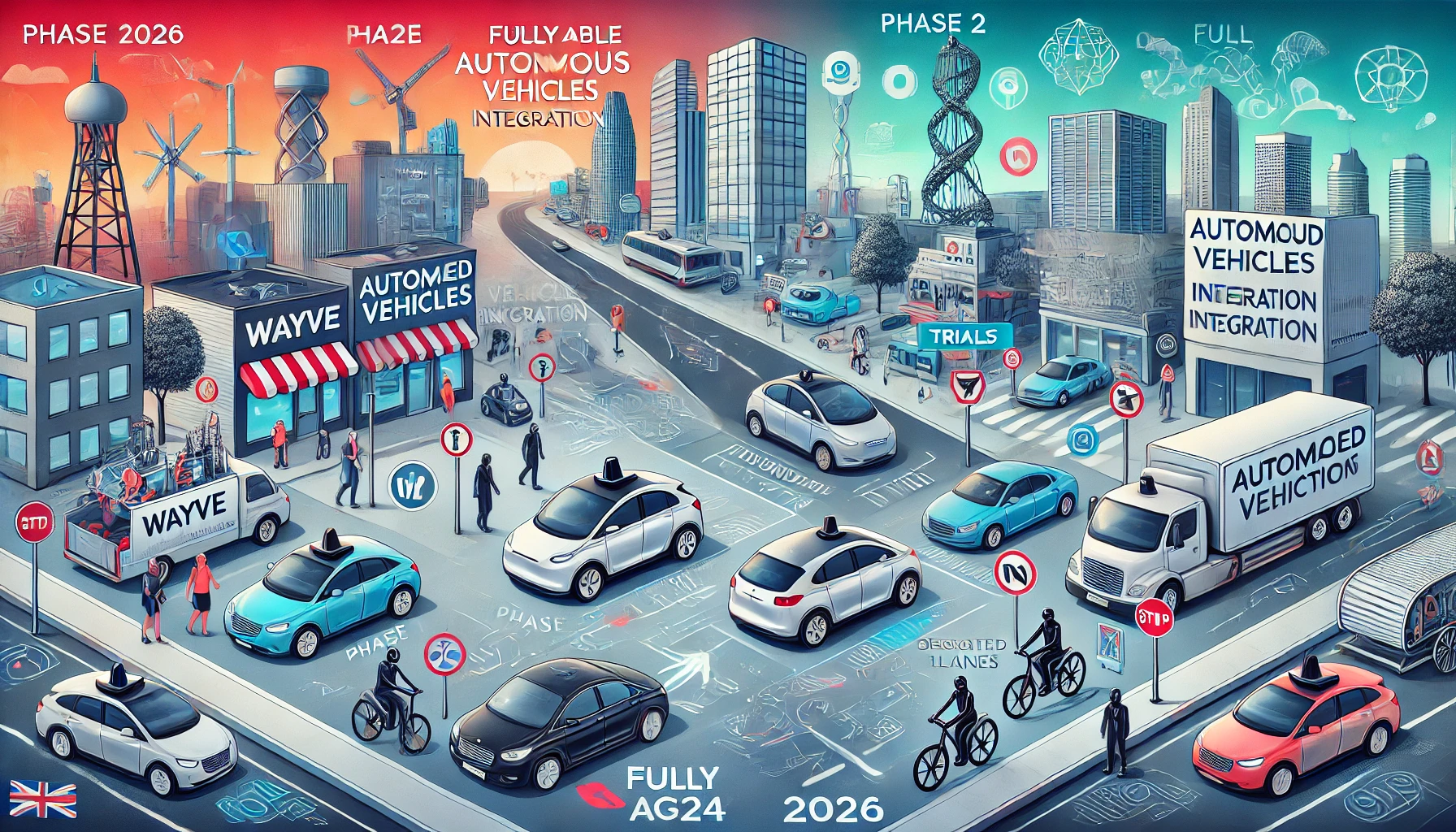
    Phase 1: Building Trust with Overridable Self-Driving Cars Initially, we will witness the introduction of “overridable” self-driving cars. These vehicles will empower human drivers to intervene and take control in situations where the AI system may falter. This crucial first phase serves a dual purpose: it allows the public to gradually acclimate to the technology while simultaneously gathering invaluable real-world data to refine the AI’s capabilities.

    Phase 2: Embracing Full Autonomy As confidence in the technology solidifies and overridable self-driving cars become ubiquitous, the stage will be set for the second phase: the deployment of fully autonomous, non-overridable vehicles. These cars will operate independently, ushering in a new era of transportation that promises enhanced safety, reduced congestion, and improved accessibility.

    Navigating the Transition: Addressing Human and Machine Errors

    The path to a fully autonomous future is not without its challenges. One of the most pressing concerns is the potential for both human and machine errors during this transitional period.

    Human Error:
    The Persistent Challenge Human error remains a leading cause of road accidents in the UK, contributing to a staggering 88% of collisions. Distracted driving, fatigue, and impaired driving are just a few examples of the human factors that jeopardise road safety. While self-driving cars aim to eliminate these risks, the transition period presents a unique challenge in handover scenarios, where drivers may need to suddenly resume control.

    Machine Error: The Imperfections of Technology Self-driving cars, while promising, are not infallible. Manufacturing defects and design flaws can lead to malfunctions, even in meticulously crafted vehicles. Rigorous testing and stringent quality control measures are paramount to mitigating these risks.

    The UK’s Pioneering Efforts: Trials and Regulations3

    The UK has taken a proactive stance in embracing this technological revolution. Companies like Wayve and Oxa are already conducting trials in urban environments, paving the way for a driverless future. These trials operate under a strict code of practice that mandates human supervision, ensuring safety and addressing initial concerns.

    The Way Forward: A Multifaceted Approach

    To ensure a seamless and safe transition to fully autonomous vehicles, a multifaceted approach is essential:

    Enhanced Testing and Validation: Continuous rigorous testing under diverse conditions is crucial to identify and rectify potential defects.

    Public Awareness and Education: Educating the public about the capabilities and limitations of self-driving technology will foster acceptance and responsible usage.

    Robust Regulatory Oversight: Stringent regulations must be developed and enforced to ensure high safety standards and hold manufacturers accountable.

    Infrastructure Adaptation: Upgrading road infrastructure to accommodate autonomous vehicles, including dedicated lanes and intelligent traffic systems, will be vital.

    Conclusion: A Safer, More Efficient Future Beckons

    The UK’s forward-thinking approach, exemplified by the Automated Vehicles Act, positions the nation at the forefront of the autonomous vehicle revolution. By addressing both human and machine errors head-on, the UK is paving the way for a future where fully autonomous, safe roadways are a reality. This transformation has the potential to save countless lives, revolutionise transportation, and create a more efficient and accessible society for all.

    1. https://www.gov.uk/government/news/self-driving-vehicles-set-to-be-on-roads-by-2026-as-automated-vehicles-act-becomes-law ↩︎
    2. https://www.topgear.com/car-news/tech/self-driving-cars-could-be-uk-roads-2026-after-new-law-signed ↩︎
    3. GOV.UK)​​ (Enterprise Technology News and Analysis)​​ (Top Gear)​. ↩︎

    Explore related WiBrief research

    Compare this early autonomous-vehicle roadmap with how AI agents are shifting control and accountability today in the Autonomy and AI research hub. Experience the trade-offs directly in the interactive Autonomy Atlas.