Category: education

  • 🦾 Empowered Leadership: Achieving Success through Confidence and Belief

    🦾 Empowered Leadership: Achieving Success through Confidence and Belief

    Confidence and belief can transform a business—and a career. This transformation transcends financial gain, fostering an environment where:

    • Innovation thrives: Teams feel confident to take risks and explore new ideas.
    • Resilience is unwavering: Challenges are met with confidence and a focus on solutions.
    • Motivation is high: Employees feel aligned with a shared vision, driving them to achieve their best.

    This power isn’t limited to the corporate world; it has been instrumental in my own career journey.

    My Journey: From Law School to Leading AI Innovation

    🌏 A Non-Traditional Path

    During law school, I was convinced that the legal world needed to embrace technology. This led me to write my LLB dissertation on the liability issues of self-driving cars.

    🌟Confidence in My Abilities

    I had confidence in my ability to bridge the gap between law and technology. This fueled my research and writing, culminating in my first published book, “Regulating Driverless RTA’s” (which is still buying me coffees today).

    ⚡️Seeking Greater Impact

    This early success reinforced my commitment to my goals. It led me to KPMG, where I could leverage my knowledge to drive change.

    🏈 Living the Values

    KPMG’s values of integrity, excellence, courage, togetherness, and “For Better” resonate deeply with me. They’ve empowered me to:

    • Build out KPMG Law’s knowledge management services alongside the esteemed Susan Hollingdale
    • Create legal tech applications using the latest cutting-edge tools i.e HighQ, Contract Express and front end code (HTML CSS and Javascript).
    • Develop AI systems to enhance prompt engeneering methodologies and ensure consistent and reliable AI outputs (more on this in another article). This led me to performing cutting-edge research into generative AI and its application to the legal field.

    This work recently culminated in the publication of a market-leading report on the transformation of legal tech which you can download ⏬ here.

    The Pillars of Confidence and belief in Business

    ⭕️ Shared Vision

    Creating a shared vision based on confidence and belief aligns teams toward common goals. For example, Google’s “10x” thinking encourages teams to believe they can achieve ten times the progress rather than just incremental improvements1. This belief has led to groundbreaking innovations like Google Maps and Google Brain.

    🏋🏾‍♀️ Employee Motivation

    A study by Deloitte found that 87% of executives believe a strong organisational culture is crucial to business success2. Employees who feel connected to their company’s culture are more likely to go above and beyond in their roles, leading to enhanced productivity and overall performance. Post-pandemic trends highlighted by the World Economic Forum show that many employees now prioritize alignment between their personal values and those of their employers over salary alone3.

     New research from LinkedIn of nearly 10,000 professionals across the globe finds that more than two-thirds (68%) of workers in the UK, France, Germany and Ireland now consider it important to work for companies that are aligned with their values. This rises to 87% for workers in the US, and 85% in Brazil. Values such as work-life balance, career growth and learning, and diversity and inclusion, are what people care about the most.

    What’s surprising is that despite the current economic climate where the higher cost of living and potential of layoffs are impacting so many people, more than half (59%) of professionals in Europe say they wouldn’t work for a company that doesn’t share their values, and not even a pay rise would change their minds (55%)4.This indicates that a confidence-driven work environment can significantly enhance employee satisfaction and retention.

    ❇️ Trust in Teams

    Confidence in the abilities of team members fosters a supportive environment where innovation can flourish. At Pixar, belief in the creative process and trust in the team have led to a string of successful movies, all while maintaining a collaborative and respectful workplace culture5.

    🚀 Innovation

    A positive organisational culture fosters an environment conducive to innovation. Companies that clearly articulate and integrate their values see higher rates of innovation as employees feel more engaged and empowered to contribute new ideas. For instance, PETRONAS achieved significant organisational success by clarifying their cultural beliefs around results and trust6. Similarly, Novelis focused on accountability and engagement, leading to remarkable improvements in employee engagement scores, return on capital employed, and profitability.

    ⚖️ Balancing Priorities

    Confidence and belief help balance long-term goals with short-term demands. Amazon’s commitment to customer obsession is rooted in the belief that if they build a great customer experience7, the financial success will follow. This guiding belief has driven Amazon’s expansion and sustained success.

    ❗️Navigating Challenges

    Facing challenges with unwavering confidence and belief can turn potential setbacks into opportunities. When SpaceX faced multiple rocket failures, Elon Musk’s belief in the mission to make space travel accessible kept the company focused and resilient, ultimately leading to successful missions8.

    The Ripple Effect

    Confidence and belief create a ripple effect throughout an organization. They foster a culture of:

    • Resilience: The ability to bounce back from setbacks.
    • Innovation: The courage to explore new ideas and take risks.
    • Motivation: A shared sense of purpose that drives everyone to achieve their best.

    👇🏾Your Turn

    Reflect on both your own beliefs and values as well as those of your team. What are you passionate about? What unique skills and perspectives do you and your employees bring to the table?

    • 🌟 Have faith in your abilities.
    • 🚀 Don’t be afraid to chart your own course.
    • ⚡️Believe in your potential to make a difference.

    You might be surprised at where your journey leads you.

    Conclusion

    Your journey of confidence and belief begins with self-reflection. What are you truly passionate about? What unique skills and perspectives can you offer? Similarly, consider the passions, skills, and perspectives of your team members. Once you’ve identified these core values, work together to pursue them relentlessly. Don’t be afraid to challenge the status quo, take calculated risks, and trust in your collective ability to make a difference. Your unwavering belief in yourself, your team, and your mission can inspire others and create a ripple effect of positive change throughout your organization.

    1. https://medium.com/@arunpandeycdac/thinking-10x-the-revolutionary-mindset-of-googles-larrie-94fc52c63c20 ↩︎
    2. https://www.deloitte.com/global/en/our-thinking/insights/topics/talent/human-capital-trends/employee-engagement-culture-human-capital-trends-2015.html ↩︎
    3. https://www.weforum.org/agenda/2023/04/why-company-values-deal-breaker-next-generation-professionals/ ↩︎
    4. ibid ↩︎
    5. https://medium.com/great-business-stories/lessons-from-pixar-2-failure-is-an-ingredient-for-creativity-b54b34abaccd#:~:text=Creating%20this%20culture%20means%20being,act%20to%20help%20solve%20it.%E2%80%9D ↩︎
    6. https://culturepartners.com/insights/understanding-organizational-culture-and-values-a-guide-for-businesses/ ↩︎
    7. https://www.inc.com/bill-murphy-jr/bezos-most-important-single-thing-focus-obsessively-on-customer.html ↩︎
    8. https://www.theguardian.com/science/article/2024/jun/06/spacex-starship-successful-test-flight ↩︎
  • 2021 UK Drone Ownership – The Law and Best Practice Tips

    2021 UK Drone Ownership – The Law and Best Practice Tips

    Important: historical guidance (2021). Drone regulations and registration requirements have changed since this article was published, including changes in 2026. Do not rely on the rules below to plan a flight today. Check the current UK Civil Aviation Authority Drone and Model Aircraft Code for up-to-date safety and legal requirements.

    Someone has just very generously gifted you a Drone and you are excited to try it out. You and the Drone are both charged and ready to venture out on your first test flight to the smooth backdrop of Sinatra.

    Teeming with ideas you step outside. Suddenly however, you remember, that actually, you don’t really know anything about flying Drones. In the UK, their use is also highly regulated. Sinatra fades away into the sunset as reality slowly dawns in.

    As the affordability and sales of drones have gone up, so have concerns about their safety. A history of near misses and various accidents (involving aeroplanes and stadiums) have helped bring rising drone ownership to the spotlight. Unfortunately, the underlying law behind their use hasn’t been as popular.

    It’s important to know and understand your legal obligations. Having to undertake all of the research yourself however, might appear daunting, but our team at WiredBrief have taken the trouble of doing all of the legwork for for you.

    What We’ll cover

    Our breakdown of the fundamentals of Drone Ownership in the UK which also includes best practice tips for safe responsible flight, will help you quickly understand your main legal obligations. We’ll particularly be focusing on the 2021 UK drone laws (introduced 31st December 2020), and your duties under the Civilian Aviation Authority (CAA) Air Navigation Order (ANO) 2016 and the Drone code. Whether you’re a commercial or recreational user, it’s going to be important to remember that because of the new changes, the rules and regulations are the same for everyone.

    Drone Usage and affordability – Private v Commercial use

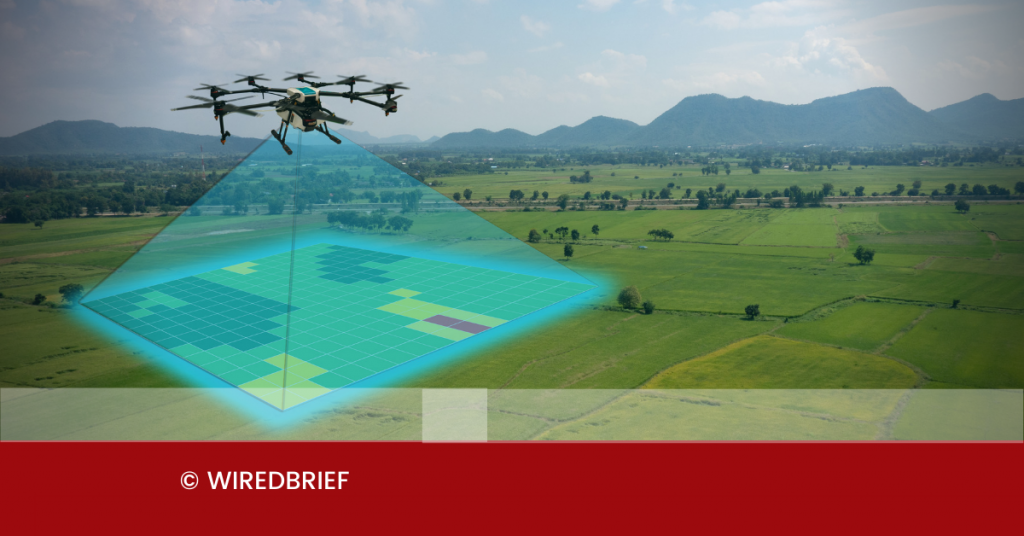
    Drones can be bought easily and cheaply both online and on the high street. They can be affordably priced and range from as low as £100 – £10000, depending on your uses and reasons for buying one. Drones can be fun and used for recreation. Alternatively, they can also have a large range of more practical, commercial business uses. You can observe some of these in the below contexts:

    The issue with Drone ownership; turbulent start and near misses

    Unfortunately, whilst obtaining a Drone might be relatively straightforward, flying one legally and safely is far more tricky. Recently, Drone owners have seen a spate of accidents, that have involved collisions and near misses with commercial airlines. As a result, the need for ensuring greater public safety has led to calls for stricter measures, ensuring Drone operators exercise sufficient caution.

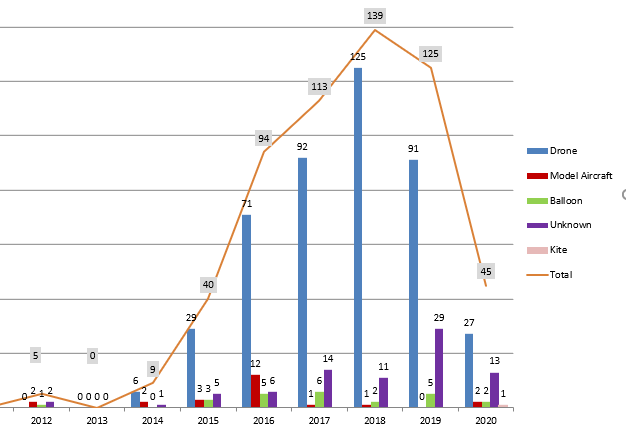
    Drones being operated at high altitudes (typically over a 1000 feet), or close to airfields have been a big part of the problem. The UK AirProxBoard, who collect statistics in this area reported how in 2018 drone incidents rose by more than a third. These numbers have fallen since, possibly due to tighter regulation, but they are still above the expected range. The 2020 COVID pandemic has also meant more grounded commercial airline operations, resulting in fewer sightings.

    Small Unmanned Air System (SUAS) Assessment visualisation by the UK Airprox Board. Drone accidents peaked in 2018, but have been falling since. Possible contributing factors include greater regulation and the recent 2020 Corona Virus pandemic. To download the full report: Click Here

    Some of the most common reasons for Drone accidents and some safety precautions which you could take are outlined below:

    • Lack of Flight Training
      Solution: If you have never flown a Drone before then its important as a new user, you try to increase your understanding of Drones before going outside. Reading your Drone owners manual, watching YouTube videos and practicing are all things you can do to make your flying safer.
    • No pre – flight Check up
      Drone operators, should always do a pre flight check up, to reduce the likelihood of in air emergencies. It’s important to check things like 1.) Battery power and 2.) calibration, secure battery placement and RC antennae signal connection.
    • Flying in Poor weather
      This one goes without saying, but ALWAYS make sure weather conditions are suitable for your planned flight. Strong winds can knock your Drone out of the air, as well as rain and Ice which can cause irreparable internal and external damage to your craft!

    The Law

    The Civilian Aviation Authority (CAA) Air Navigation Order (ANO) 2016 is the main legislation governing aircrafts, including drones, in the UK. This has now been amended by the Air Navigation (Amendment) Order 2020, which attempts to streamline drone law to make the system more understandable – guidance to the updates are provided by the CAA here. The main provision you’ll need to be aware of from the ANO is Article 241 (concerning endangering the safety of any person or property). This applies to every aviation activity at all times and sets out that:

    “[a] person must not recklessly or negligently cause or permit an aircraft to endanger any person or property”.

    Before 31st December 2020, it also used to be important for the purposes of determining whether you needed a licence, to also know whether the purpose of a drone flight was commercial or non – commercial. However, this has since changed and the new focus looks at the risk that each flight represents. The greater the risk, the more rigorous the requirements will be for training and certifications. Whilst a summary of your key obligations can be found within the Drone Code here, we’ve summarised some of the key information below.

    The main risk factors that are used in the updated regulations to determine how risk is categorised and which registration requirements are needed are outlined below:

    How the updated regulations determine risk

    ImageRisk FactorsDescription
    WeightOf your drone (including accessories)
    People Proximity from peopleHow close the drone will fly near (‘uninvolved people’) people not directly involved with the flight
    Proximity from citiesHow close the drone will fly near built up areas (e.g towns, cities, industrial areas, recreational areas etc.)

    Drone operations will typically fall into one of three categories as follows: 

    The three new categories of Drone operations

    RiskCategoryDescriptionCAA Application required?
    LowOpen Category
    • Low (or no) risk to third parties. Has 3 Sub categories that have different restrictions in place regarding craft, qualifications and distance. Most uses fall within this.
    No – Operations can be carried out in accordance with basic pre-defined characteristics and not subject to further authorisation requirements from CAA
    MediumSpecific Category– Greater risk than Open category, or
    – one or more elements of the operation fall outside the boundaries of the Open category.
    Yes – Operational authorisation required from the CAA, based on a safety risk assessment.
    HighCertified Category – equivalent risk to that of manned aviation, resulting in operations falling under similar regulatory regime (i.e., certification of the aircraft, certification of the operator, licensing of the pilot)
    Examples include:
    – Passenger / transportation dangerous goods
    Yes – Equivalent requirements to manned aviation.
    See also The Drone and Model Aircraft Code


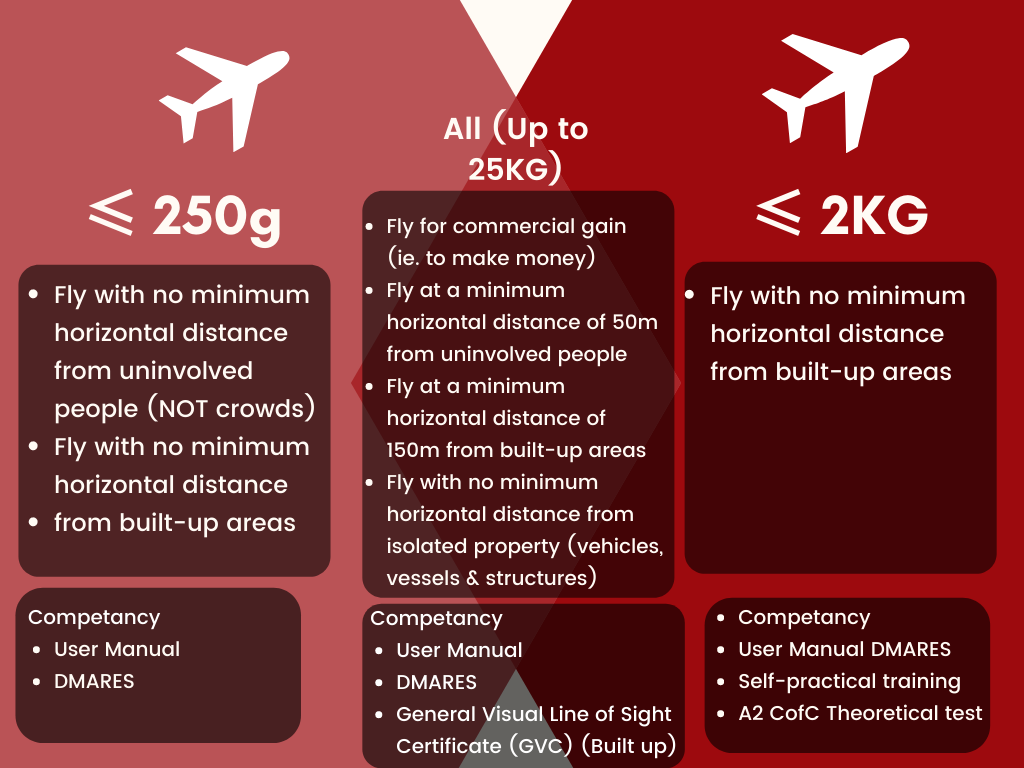
    Most uses will typically now fall under the open category and as of 31st December 2020, those who fall into this category will be able to do the following:

    Summary of where most Drone uses fall

    What about Insurance?

    Insurance is optional if you’re flying a drone under 20kg for recreation. However, you should remember that you’re responsible for your actions, which means you could be held personally liable for any injury or damage you cause while you’re flying. If your flight is for any reason other than recreation, you do need insurance. EC785/2004 compliant insurance is still required for commercial operations in both the Open and Specific categories.

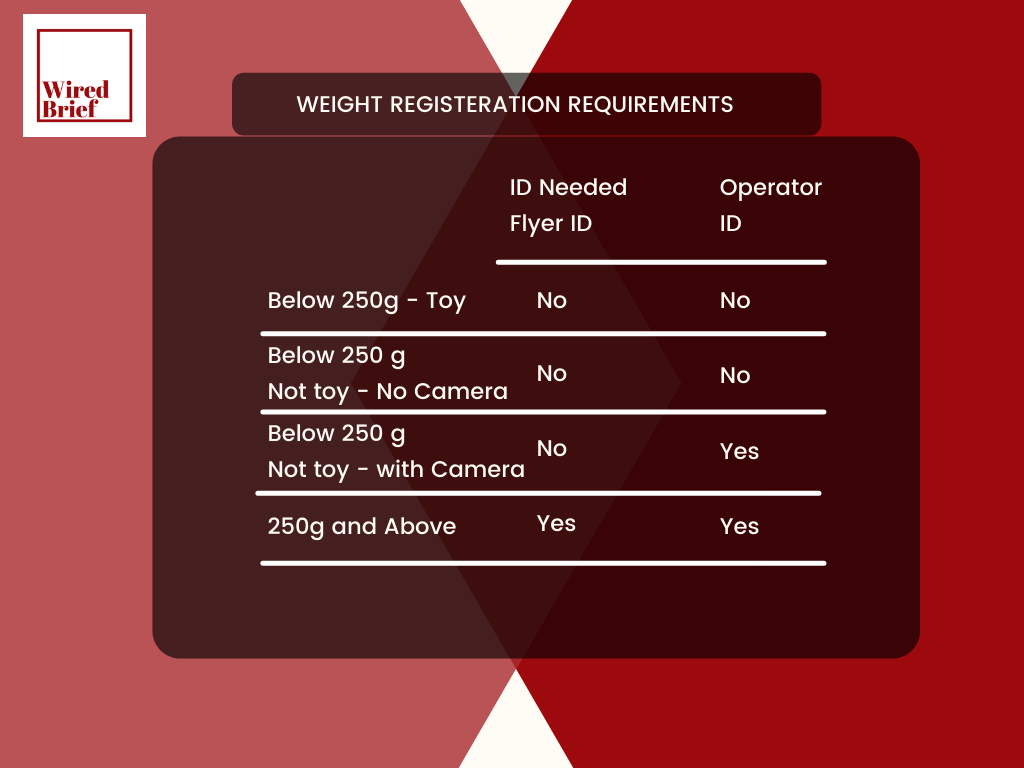
    Please not that it is against the law to fly a drone or model aircraft without having the required IDs. You can also be fined for breaking the law when flying. In the most serious cases, you could be sent to prison.

    ID Registration prices

    Drone registration prices
    If you already have an operator ID and just need a flyer ID, you’ll need to add your flyer ID in the My registration area

    Strict Liability on the ground – Relaxed in the air

    Last but not least, we look at the question of Liability for Drone operators. This predominantly concerns the question of where the accident has taken place. For example, section 76 of the CAA applies strict owner or operator liability for surface damage, caused by an aircraft. This can include injury to an individual or damage to property. If you are the Drone owner or operator then you would automatically be at fault for any loss or injury.

    Unless there is contributory negligence to be alleged, the victim would be entitled compensation. Their mission would be to identify and pursue a case against you as the Drone operator. A common challenge however is finding the address of the offender and ensuring they have sufficient insurance / assets.

    In the event of an air-to-air incident, the established principle is not to apportion blame on a strict liability basis. Each incident will thus dealt with case by case and the necessary elements of fault will need to be proven.

    Drones and AI – The next frontier

    Now you know the fundamentals of Drone usage and law in the UK we hope you will join us for our next article. There, we will be examining the technologies next evolution, brought about by combining Drones with artificial intelligence in commercial contexts.

    As we move away from the need to have human operators at the helm of drone flights, we stand to benefit from greater efficiency and more complex Drone uses that can benefit future society. Unlike humans, Drones powered by AI will be able to work all year round without breaks, and in stressful environments without requiring sick days. This paves the way for many commercial opportunities, alongside potential risks. An assessment of both will be important as it will help us understand the future and fundamentally, any social effects brought about by these developments.

    Getting started toolkit:


    Article Takeaways:

    • The Civilian Aviation Authority (CAA) Air Navigation Order (ANO) 2016 govern Drone law in the UK
    • As of 31st December 2020, the same rules apply for both commercial and non commercial users.
    • Most uses fall within the Open category, but the higher the risk posed to the general public the more likely your use will fall outside of the open category. If you have any doubts, it’s important that you do your research and understand your obligations.
    • A full summary of all of the latest regulatory updates to UK drone law can be found here: Click Here
    • EC785/2004 compliant insurance is required for commercial operations in both the Open and Specific categories
    • The UK Government has removed the minimum age requirement for remote pilots operating in the Open and Specific categories. The competency requirements however are unchanged.
    • Under the ANO you must not recklessly or negligently cause or allow a Drone to endanger any person or property
    • Strict liability applies for Drone to surface damage but for Air to Air the courts will look for fault.
  • Blockchain E – Salon: What’s all the hype around Blockchain about? [VIDEO]

    Blockchain E – Salon: What’s all the hype around Blockchain about? [VIDEO]

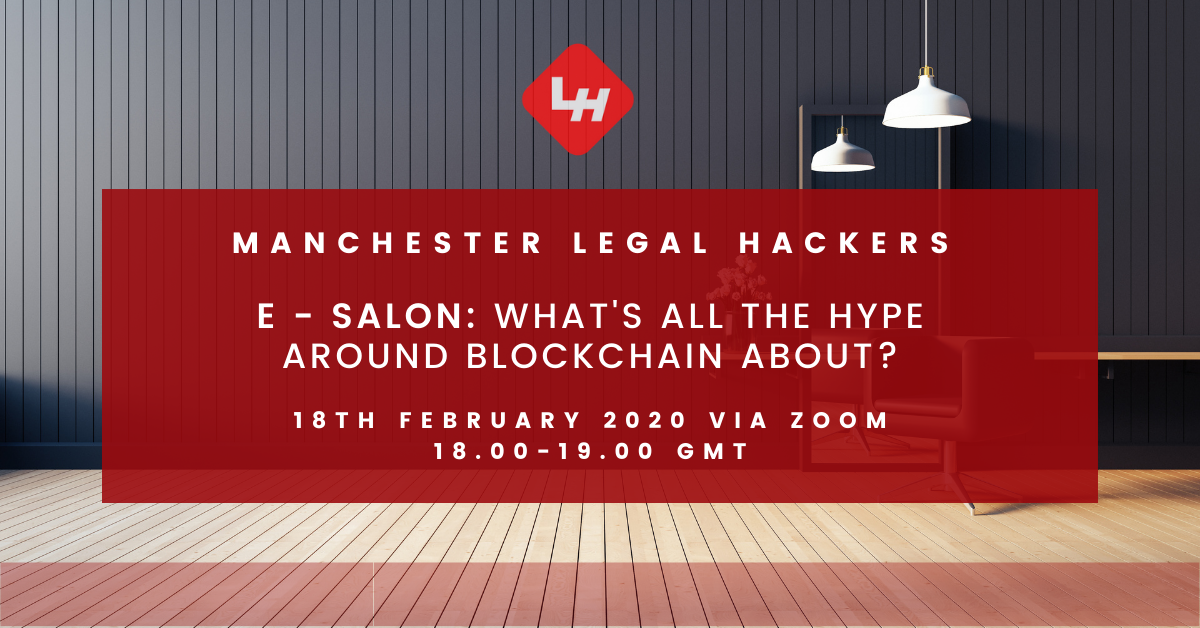
    WiredBrief are delighted to bring to you another exciting panel event hosted by Legal Hackers MCR, which looks into Blockchain and what the hype is all about.

    About this Event:

    Are you tired of seeing generic news articles about Blockchain that just talk about it in terms of Bitcoin and daily price fluctuations?

    Blockchain and decentralised ledger technology have many uses that extend past digital currencies. Their ability to create a secure trust-less, permissioned ledger is just one example of a feature, that will make the technology a crucial hallmark of the connected world and Internet of things (IOT).

    If you are looking to expand your knowledge of Blockchain and better understand its place in our connected digital future, then come to the Manchester Legal Hackers E Salon where they’ll be finding out what the fuss is all about!

    Host:

    Xuening Qu – Legal Technologist at DWF

    Co – Host:

    Abigail Holt – Barrister at Garden Court Chambers

    Event Co – Ordinator:

    Geofrey Banzi – Legal Technologist at KPMG

    Panellists

    Adi Ben-Ari

    Founder & CEO at Applied Blockchain

    Adi has over 20 years enterprise software experience, more recently leading major deliveries of production blockchain and advanced cryptography solutions. Adi is widely recognised as an independent thought leader in the industry, a noted speaker at major conferences, experienced in educating C-suite on blockchain, confidential computing and privacy-preserving technologies, and acts as an advisor for a number of startups.

    His work has been noted by the UK Government, where he was invited to present at Parliament and the House of Lords, and at University College London. Adi has contributed to the recent work of the Law Society on Blockchain, Legal and Regulatory Guidance. He has co-invented and designed a number of patents related to confidential computing, advanced cryptography, blockchain and mobile payments.

    Will Foulkes

    Senior Solicitor & Head of Blockchain at Stephenson Law Will is an experienced solicitor and specialist in distributed ledger technologies, digital assets and smart contracts, advising on multi-jurisdictional regulatory compliance and strategy for token-related fundraising. Will is an engaging and informative speaker on blockchain and has worked with the Law Commission’s Digital Asset and Smart Contract team on a number of key projects.

    Jay Smith

    Legal Engineer at Stephenson Law

    Jay advises on legaltech, operations and blockchain at Stephenson Law, a key challenger in the legal industry, with a forward-thinking approach of how law firms should operate and embrace new technologies. Jay’s expertise and consultancy fuses design and tech with an expert understanding of law.

    Andy Gray

    Co-founder of KnownOrigin Labs and BlockRocket.tech

    Founder, Blockchain Manchester

    Andy builds blockchain products and solutions, developing decentralised applications (Dapps) with Solidity smart contracts and Web 3.0 tech, and with over 20 years commercial experience developing enterprise IT systems. Andy’s recent projects include the creation of a tokenised customer loyalty platform and experiments with crypto-collectibles for BrewDog and KnownOrigin.io, a digital art marketplace. Andy will speak about crypto-collectibles, blockchain art and proof of provenance.

    The following questions were answered:

    – Can you explain what blockchain is all about in three sentences? 9.16

    – The primary value of blockchain is the fact it’s so secure. However, there must be potential breaches in blockchain, can you describe how potential breaches are dealt with? 10.56

    – What do you see as the most interesting and evolving trends in distributed ledger technology? 16.53

    – Fungible, non fungible… what does it mean? 21.59

    – Some people say that the blockchain revolution hasn’t happened yet, and most of the existing blockchain applications can be achieved through normal cloud based applications. What do you say to that? 23.59

    – What does the internet of things mean? 29.58

    – Could you give us examples of existing blockchain projects, including some you’ve worked on? 32.10

    – Who do I go to to design a system in regards blockchain? 36.14

    – Adoption of technology often lags the creation of the technology. Legal regulation can often lag behind that! One of the challenges for blockchain is that it will be dotted all over the world, which brings into question legal jurisdictions. What are your thoughts on the regulation of blockchain and how that can be done practically? 41.16

    – Can you explain what mining is? Why does it use so much electricity, and why does it pose a risk to climate change? 45.35

    – Can you explain the practical differences and challenges proposed by proof of work versus proof of stake? 49.48

    – When governments start accepting crypto as payment for taxes, that will be a tipping. How close do you think we are to this? 51.27

    – How do see the system being regulated, or do you think it will it regulate itself? 58.55

    –  Can the regulation keep up with the technology? 1.01.31

  • AN INTRODUCTION TO BLOCKCHAIN AND CRYPTO ASSETS [VIDEO]

    AN INTRODUCTION TO BLOCKCHAIN AND CRYPTO ASSETS [VIDEO]

    WiredBrief are excited to bring to you an exciting event hosted by Legal Hackers MCR, which looks at Blockchain and its applications to the real world.

    About this Event

    Have you ever wondered how Blockchain could transform the world and how companies are using its transformative power to bring about social change?

    The consequences of the recent COVID-19 pandemic have allowed Blockchain to quickly rise in prominence over the past year to become one of the most prolific technologies on the market in 2021, but little is still known about it.

    Blockchain technology however, has the power to transform millions of our lives for the better but until recently, it has only been a buzz-word and the subject of market speculation. Recent disruptions to our status quo however, have forced difficult questions of not just how we could begin rebuilding our society and financial institutions, but which tools we could start using to do this.

    Join Legal Hackers MCR

    Join Legal Hackers MCR on the 4th of February as they introduce Will Foulkes, Head of Blockchain at Stephenson Law, who will be bringing you closer to the exciting world of Blockchain.

    During his talk he will help demystify key aspects of the disruptive technology, including its uses and applications and he will also be available to take some of your questions at the end.

    If you enjoy this event and want to take an even further deep dive, we’ll also be hosting an exciting panel event on the 18th of February. This will include a number of leading specialists from the area, who will be able to give you even more insight and also answer some of your more probing questions. Stay tuned!

    What will be covered:

    1. HOW BLOCKCHAIN WORKS

    2. WHY BLOCKCHAIN HAS THE CAPACITY TO MASSIVELY DISRUPT INDUSTRY

    3. INSIGHT INTO SOME LEADING PROJECTS AND PRODUCTS IN THIS SPACE

    Keynote Speaker:

    Will Foulkes – Head of Blockchain at Stephenson Law

    LinkedIn

    Host:

    Xuening Qu – Legal Technologist at DWF

    Co – Host:

    Lisa McCLory – Legal Knowledge Director at Fractal Legal

    For more events like this visit Legal Hackers MCR on:

    LinkedIn

    Twitter

    Website

  • The ‘Notre-Dame tipping point’ – A study of key events in Biotechnology, what it means to be alive and whether things will actually ever be the same once the ‘fire’ has passed

    The ‘Notre-Dame tipping point’ – A study of key events in Biotechnology, what it means to be alive and whether things will actually ever be the same once the ‘fire’ has passed

    Introduction

    In a world grappling with cancer, climate change, and societal inequities, biotechnology is pushing the boundaries of what we consider life. Recent breakthroughs at Cornell University and Yale University have sparked both excitement and profound ethical concerns.

    Cornell’s Self-Reproducing Machines: A New Form of Life?

    Researchers at Cornell have engineered robots capable of reproducing, consuming resources, and evolving. These DNA-based machines challenge our understanding of life and raise questions about the potential rights of artificial entities. Are we on the verge of creating a new form of life? According to Cornell researchers, these biomachines exhibit lifelike properties such as metabolism, growth, and decay, positioning them at the forefront of synthetic life research​ (HotHardware)​.

    Yale’s Reanimated Pig Brains: Challenging the Definition of Death

    At Yale, scientists have restored cellular activity in pig brains hours after death. Although these brains did not achieve full consciousness, this achievement blurs the line between life and death, raising profound ethical and legal questions about the potential for human brain revival and the rights of individuals who undergo such procedures. This study highlights the need for careful consideration of the implications of reanimating neural tissues​ (IJMR)​.

    Legal and Ethical Implications: Navigating Uncharted Territory

    The implications of these biotechnological advancements are vast and complex. Could a revived human brain regain consciousness and legal personhood? How do we prevent misuse of this technology? Current international laws and ethical guidelines offer limited guidance, necessitating urgent discussions about the future of human experimentation and the potential creation of artificial life​ (EMB Blogs)​​ (Braden Kelley)​.

    Adapting Biotechnology Law for the Future

    The rapid pace of biotechnological innovation demands a legal framework that can keep up. Regulations must be carefully crafted to address ethical concerns without stifling scientific progress. As biotechnology evolves, it is essential to develop robust policies that balance innovation with ethical responsibility, ensuring that new technologies are integrated into society safely and transparently​ (DMS Blog)​​ (IJMR)​.

    Conclusion

    As biotechnology races forward, we must grapple with fundamental questions about the nature of life, death, and consciousness. The breakthroughs at Cornell and Yale offer a glimpse into a future where the boundaries of life are redefined. It is crucial to engage in thoughtful discussions now to ensure these technologies are developed and used ethically and responsibly.

    For further details on these breakthroughs, you can read more about Cornell’s lifelike biomachines here and Yale’s reanimated pig brains here.