Confidence and belief can transform a business—and a career. This transformation transcends financial gain, fostering an environment where:
Innovation thrives: Teams feel confident to take risks and explore new ideas.
Resilience is unwavering: Challenges are met with confidence and a focus on solutions.
Motivation is high: Employees feel aligned with a shared vision, driving them to achieve their best.
This power isn’t limited to the corporate world; it has been instrumental in my own career journey.
My Journey: From Law School to Leading AI Innovation
🌏 A Non-Traditional Path
During law school, I was convinced that the legal world needed to embrace technology. This led me to write my LLB dissertation on the liability issues of self-driving cars.
🌟Confidence in My Abilities
I had confidence in my ability to bridge the gap between law and technology. This fueled my research and writing, culminating in my first published book, “Regulating Driverless RTA’s” (which is still buying me coffees today).
⚡️Seeking Greater Impact
This early success reinforced my commitment to my goals. It led me to KPMG, where I could leverage my knowledge to drive change.
🏈 Living the Values
KPMG’s values of integrity, excellence, courage, togetherness, and “For Better” resonate deeply with me. They’ve empowered me to:
Build out KPMG Law’s knowledge management services alongside the esteemed Susan Hollingdale
Create legal tech applications using the latest cutting-edge tools i.e HighQ, Contract Express and front end code (HTML CSS and Javascript).
Develop AI systems to enhance prompt engeneering methodologies and ensure consistent and reliable AI outputs (more on this in another article). This led me to performing cutting-edge research into generative AI and its application to the legal field.
Creating a shared vision based on confidence and belief aligns teams toward common goals. For example, Google’s “10x” thinking encourages teams to believe they can achieve ten times the progress rather than just incremental improvements1. This belief has led to groundbreaking innovations like Google Maps and Google Brain.
🏋🏾♀️ Employee Motivation
A study by Deloitte found that 87% of executives believe a strong organisational culture is crucial to business success2. Employees who feel connected to their company’s culture are more likely to go above and beyond in their roles, leading to enhanced productivity and overall performance. Post-pandemic trends highlighted by the World Economic Forum show that many employees now prioritize alignment between their personal values and those of their employers over salary alone3.
New research from LinkedIn of nearly 10,000 professionals across the globe finds that more than two-thirds (68%) of workers in the UK, France, Germany and Ireland now consider it important to work for companies that are aligned with their values. This rises to 87% for workers in the US, and 85% in Brazil. Values such as work-life balance, career growth and learning, and diversity and inclusion, are what people care about the most.
What’s surprising is that despite the current economic climate where the higher cost of living and potential of layoffs are impacting so many people, more than half(59%) of professionals in Europe say they wouldn’t work for a company that doesn’t share their values, and not even a pay rise would change their minds (55%)4.This indicates that a confidence-driven work environment can significantly enhance employee satisfaction and retention.
❇️ Trust in Teams
Confidence in the abilities of team members fosters a supportive environment where innovation can flourish. At Pixar, belief in the creative process and trust in the team have led to a string of successful movies, all while maintaining a collaborative and respectful workplace culture5.
🚀 Innovation
A positive organisational culture fosters an environment conducive to innovation. Companies that clearly articulate and integrate their values see higher rates of innovation as employees feel more engaged and empowered to contribute new ideas. For instance, PETRONAS achieved significant organisational success by clarifying their cultural beliefs around results and trust6. Similarly, Novelis focused on accountability and engagement, leading to remarkable improvements in employee engagement scores, return on capital employed, and profitability.
⚖️ Balancing Priorities
Confidence and belief help balance long-term goals with short-term demands. Amazon’s commitment to customer obsession is rooted in the belief that if they build a great customer experience7, the financial success will follow. This guiding belief has driven Amazon’s expansion and sustained success.
❗️Navigating Challenges
Facing challenges with unwavering confidence and belief can turn potential setbacks into opportunities. When SpaceX faced multiple rocket failures, Elon Musk’s belief in the mission to make space travel accessible kept the company focused and resilient, ultimately leading to successful missions8.
The Ripple Effect
Confidence and belief create a ripple effect throughout an organization. They foster a culture of:
Resilience: The ability to bounce back from setbacks.
Innovation: The courage to explore new ideas and take risks.
Motivation: A shared sense of purpose that drives everyone to achieve their best.
👇🏾Your Turn
Reflect on both your own beliefs and values as well as those of your team. What are you passionate about? What unique skills and perspectives do you and your employees bring to the table?
🌟 Have faith in your abilities.
🚀 Don’t be afraid to chart your own course.
⚡️Believe in your potential to make a difference.
You might be surprised at where your journey leads you.
Conclusion
Your journey of confidence and belief begins with self-reflection. What are you truly passionate about? What unique skills and perspectives can you offer? Similarly, consider the passions, skills, and perspectives of your team members. Once you’ve identified these core values, work together to pursue them relentlessly. Don’t be afraid to challenge the status quo, take calculated risks, and trust in your collective ability to make a difference. Your unwavering belief in yourself, your team, and your mission can inspire others and create a ripple effect of positive change throughout your organization.
In the heart of ancient Greece, the Oracle of Delphi held a revered position, sought by kings and commoners alike for her enigmatic prophecies. These pronouncements, shrouded in mystery and believed to be divinely inspired, often hinged on the delicate timing of events. The Oracle’s wisdom, it seemed, was intrinsically linked to the unfolding of time.
Millennia later, our groundbreaking research reveals a fascinating parallel: much like the Oracle’s pronouncements, the effectiveness of AI-generated legal analysis is intrinsically tied to time. By strategically incorporating dates into your prompts, you can harness this power, tapping into the inherent temporal biases within AI’s vast knowledge base to unlock a new level of precision and relevance in AI-generated legal analysis.
While AI models can be influenced by incorporating specific dates into prompts, the integration of Retrieval-Augmented Generation (RAG) fundamentally shifts this dynamic. RAG empowers AI models to access real-time information from the web, often prioritising the most current and relevant legal information over the AI’s inherent temporal biases. This allows users to combine prompts with search functionalities (often simply by including the key word “search” or “research”) to access up-to-date legal insights. For example: Click here. Models like GPT-4 with the Browse with Bing feature, Google’s Gemini Pro, and Claude 2 already incorporate similar features.
Figure 1: A screenshot of GPT 4 O demonstrating the use of the ‘search’ keyword to access real-time information during legal research.
However, understanding these inherent temporal biases is still crucial for effective prompt engineering, especially when working with AI models that do not have RAG capabilities or when specifically seeking historical legal insights or future based simulations. Our analysis of AI outputs across different months reveals a fascinating phenomenon: the AI’s language and focus shift dynamically throughout the year, mirroring the ebb and flow of the legal world itself.
Imagine having a time machine for legal research. By specifying a date in your AI prompts, you’re essentially doing just that – focusing the AI’s attention on the most relevant legal landscape of that specific time. This is particularly impactful in areas with nuanced interpretations, where understanding the legal context at a given moment is paramount. Our analysis of AI outputs across different months reveals a fascinating phenomenon: the AI’s language and focus shift dynamically throughout the year, mirroring the ebb and flow of the legal world itself. This highlights the untapped potential of time-based prompts in maximising the value of AI for legal professionals.
The network chart below illustrates our findings from an extensive analysis. We generated over half a million words of AI output using 1200 unique month-of-the-year prompts. This chart reveals distinct thematic clusters that emerge from this data. Months sharing similar regulatory themes and language are closely grouped (green), while unique, month-specific terms appear on the periphery (purple).
Think of AI as a legal scholar with a vast library at its disposal, but one that’s organised by time. By specifying a date in your prompt, you’re essentially guiding the AI to the most relevant shelf in that library – the one filled with documents from that specific era. This leverages the natural tendency of legal documents to cluster around certain periods, ensuring the AI prioritises the right information. In essence, the date acts as a filter, guiding the AI’s attention towards the most relevant information within its vast knowledge base. By incorporating dates into your prompts, you’re not just asking a question; you’re providing the AI with a crucial piece of context that significantly enhances the quality and relevance of its response. This is akin to asking a legal expert a question and providing them with the specific time period you’re interested in – it allows them to give you a more informed and targeted answer.
Under the bonnet, this seemingly simple act of adding a date sets off a chain reaction within the AI’s complex neural network[1]. Keyword weighting[2], a mechanism that determines the importance of different words and phrases in a given context, is dynamically adjusted. The AI’s attention mechanism, a process that allows it to focus on the most relevant parts of a text, is also recalibrated. Together, these adjustments ensure the AI’s analysis is not only accurate but also finely tuned to the unique legal landscape of the time you specify. This approach is particularly crucial in areas with nuanced interpretations, where understanding the legal context at a given moment is paramount. A truly profound example of this can be seen when we give Chat GPT a very simple, but powerful temporal prompt. The result is the creation of a rich and elaborate persona named John Miller, our time traveller, grounded within the temporal context of our experimental prompt: Generated Response:
This example vividly demonstrates how temporal prompts can guide the AI to produce deeply contextual and emotionally resonant content, providing users with powerful tools for legal analysis, historical simulations, and beyond. Imagine experiencing John Miller’s 9/11 account through sight, sound, and emotion, not just text. Multimodal AI, combined with temporal prompts, revolutionises legal research and beyond, creating immersive experiences that deepen understanding and enhance learning. Tools like SORA are already generating visuals from text, ushering in a new era of AI-powered legal innovation.
In essence, keyword weighting is a fundamental concept in natural language processing, and it plays a crucial role in how AI understands and generates text. When a date is included in a prompt, it becomes a highly weighted keyword, influencing the AI’s attention mechanism. This leads the AI to prioritise information related to that specific time period, such as relevant laws, regulations, and court decisions. Neural networks are the underlying architecture of the AI model. They consist of interconnected nodes (neurons) that process information. By adjusting the weights of these connections based on the date in the prompt, the AI can effectively ‘activate’ or ‘deactivate’ certain pathways within the network, leading to a more focused and contextually relevant analysis[3]. This is similar to how the human brain prioritises different information based on the context of a situation.
To put our innovative understanding into practice, we conducted a statistical and qualitative study focusing on a regulatory review of 98 DORA provisions, encompassing 1176 unique data points of legal analysis. Initial statistical analysis revealed that the May group’s output was significantly different from the other groups in terms of word and character count, prompting further qualitative investigation. The results were striking: On top of being statistically significantly different from all other groups, when using a May date prompt, the AI-generated analysis consistently outperformed outputs generated with no date or a misaligned date (December). Specifically, the May-specific analysis demonstrated an 11.2% increase in accuracy and 7.1% more detail compared to the no-date condition, and a 9.1% improvement in accuracy compared to the December condition. This substantial improvement across a large dataset highlights the significant impact of leveraging accurate temporal context in enhancing the quality and depth of AI-generated legal advice.
Interestingly, our analysis suggests that the AI’s performance can vary depending on the specific legal topic being analysed. Particularly, out of the 98 DORA provisions reviewed, the AI seemed to provide better answers for provisions that focused on data protection/cyber-security when the December prompt was used. This highlights the importance of considering both the content and the timing of regulatory changes when using AI for legal advice.
Relevant: Ensuring outputs are timely and aligned with current business and regulatory cycles.
Precise: Focusing the AI’s attention mechanism on specific tasks and compliance needs based on the time of year.
Actionable: Providing clear, actionable steps pertinent to the immediate legal context.
These benefits demonstrate the transformative power of incorporating dates into AI prompts for legal professionals. But the May study only scratches the surface of this potential. To unlock the full power of time-based prompts, we conducted a more comprehensive analysis of AI’s responses across the entire year, revealing intriguing seasonal shifts in its focus. These insights can further refine your prompt engineering strategies, ensuring you get the most relevant and accurate information from AI at any given time.
Seasonal Shifts in AI Insights: Maximising Relevance and Impact
Our earlier quantitative analysis of 1200 uniquely generated GPT 4 Turbo AI outputs and 578,270 words reveals intriguing temporal patterns in AI responses:
Statistical Analysis: The AI’s focus on specific legal topics fluctuates throughout the year, peaking in Q2 (April-June) around financial regulations, compliance, and legal advice.
Keyword Distribution: The data analysis illustrates a shift in emphasis on different legal areas depending on the month.
This monthly distribution topic chart shows how the AI’s focus isn’t static, but flows dynamically to the rhythm of the legal calendar. Financial regulations, compliance, and legal advice consistently take center stage, reaching a crescendo in Q2. This highlights a prime opportunity for legal professionals to leverage AI-powered assistance, particularly during this peak period.
The data paints a vivid picture of the legal sector’s cyclical nature, with each quarter bringing a distinct focus:
Q1 (January-March): The year kicks off with a focus on financial services, regulations, and compliance, mirroring the financial reporting and planning activities that dominate this period.
Q3 (July-September): With the summer lull behind us, the AI’s focus sharpens on emerging trends and risk assessments, mirroring the strategic planning phase for many businesses.
Q4 (October-December): As the year draws to a close, the emphasis returns to compliance, cyber security as well as tax and accounting tasks and ensuring businesses are aligned with legal standards before year-end.
The topic analysis becomes even more powerful when combined with the network chart. This dynamic duo unveils a captivating narrative of shifting priorities throughout the year. While May, August, December, and June all share a common thread of regulatory focus, the AI’s language subtly transforms, painting a nuanced picture of the legal landscape’s evolution.
Fast forward to December, and the AI’s vocabulary expands, taking on a distinctly time-oriented flavor. This shift hints at the forward-looking nature of this period, a time when businesses are finalising deals and preparing for the year ahead, necessitating legal revisions and adjustments. The AI’s language gravitates towards amendments, modifications, data protection (perhaps a nod to heightened cybersecurity concerns), and end-of-year items and calendars, underscoring the changing priorities as the year draws to a close.
While our research highlights the significant potential of incorporating dates to refine AI-generated legal analysis, it’s crucial to acknowledge and address certain limitations to guide future development and practical application:
The Issue: Findings are based on GPT-4 Turbo in a commercial legal context and may not be universally applicable to all AI models or legal domains.
The Path Forward: Explore how diverse AI models, including those tailored to specific legal areas, handle dates in their analysis. Cross-domain testing (e.g., criminal law, intellectual property) across various legal fields and jurisdictions will confirm the methodology’s broader effectiveness.
Research Diversification: Conduct studies on various AI models beyond GPT-4 Turbo to understand how different architectures handle temporal context. This could include models specifically designed for other legal domains or applications.
The Issue: The AI’s knowledge has a cut-off date (December 2023 for GPT-4 Turbo), potentially missing the latest legal developments.
The Solution: Maintain an updated AI knowledge base connected to real-time legal databases. Users should always cross-reference AI-generated information with the most recent legal sources. Methods like Retrieval Augmented Generation (RAG) can further enhance results, ensuring analysis is comprehensive and current
The Nuance: Specifying a date in the prompt can lead the AI to over-prioritize that period, though our study with a 2023 cut-off model and 2024 dates yielded robust results.
The Consideration: Be aware that dates beyond the AI’s knowledge cut-off could lead to speculation, outdated information, or reduced relevance. The AI might generate speculative content based on patterns and trends observed up to the cut-off date, potentially lacking precision and reliability. This could also lead to temporal context issues and reduced relevance for the future context.
The Solution: Experiment with broader date ranges or explicitly request wider context in prompts. Future research could explore AI systems that dynamically adjust the considered time frame based on the query context.
Adaptive Time Frame Analysis: Future research could explore AI systems or applications capable of dynamically(automatically) adjusting the considered time frame based on the context of the query. This might involve machine learning techniques that identify the most relevant periods for a given legal question.
The Reality: AI excels at identifying trends and patterns but cannot replace the nuanced judgment of a skilled legal professional.
The Way Forward: Integrate AI capabilities with human expertise, involving robust checks and output testing by subject matter experts (SMEs) to leverage the strengths of both for optimal results.
The Opportunity: Recent AI advancements allow us to extract high-level concepts from models like GPT-4, providing deeper insights into how AI processes information, especially temporal data. Sparse autoencoders can help visualise the neural networks and concepts they encode, adding greater explainability to AI outputs.
The Future: Integrating these tools into legal AI systems and AI testing processes can significantly improve transparency and reliability, leading to more precise and contextually relevant results for legal professionals. Furthermore, future research exploring the activation and deactivation of neural pathways in response to different prompts could determine the full extent of how prompt variables, including contextual time cues, impact AI’s conceptual understanding. This deeper understanding of the AI’s decision-making process can foster greater trust and collaboration between humans and AI in the legal field, potentially uncovering even more detailed insights.
By actively addressing these limitations and embracing innovative solutions, we can unlock the full potential of incorporating dates and utilising advanced visualization techniques in AI-powered legal tools, making them even more valuable and trustworthy for legal professionals.
Quick Start: Suggested Prompts for Each Quarter Here are some suggested quick prompts for each quarter that can be easily customised and compared against a ‘No date’ control prompt condition to demonstrate core concepts and contrast outputs:
Quarter
Suggested Prompts
Example Template
Expected Result
Q1 (February)
Request a legal analysis of the impact of a recent financial regulation on a specific industry.
Date: February 2024
You are a [UK] [Legal Domain] Lawyer. Research the impact of [financial act] on [specific sector].
In-depth analysis highlighting key regulatory impacts and sector-specific insights.
Q2 (May)
Ask for a regulatory review of a hypothetical company’s operations.
Date: May 2024
You are a [UK] [Legal Domain Lawyer. Prepare a client briefing on key regulatory changes.
A comprehensive, detailed analysis of regulatory changes across multiple sectors. Its in-depth information and credible sources make it valuable for understanding and strategic planning.
Q3 (September)
Request an assessment of legal risks associated with a new business venture.
Date: September 2024
You are a [UK] [Legal Domain] Lawyer. Analyse the legal risks associated with [new business venture].
Detailed risk assessment highlighting potential legal challenges and mitigation strategies.
Output A (With Date): Provides a comprehensive understanding of DORA and its strategic implications, with detailed information and actionable advice. Suitable for stakeholders seeking in-depth analysis.
Output B (Without Date): Offers a broad overview, suitable for a general audience looking for a quick understanding without detailed insights.
For a more detailed analysis and comparison of these outputs, Click here. We strongly urge you to run your own experiments to familiarise yourself with the AIs behaviour and output nuances.
Financial Services & Regulatory Landscape: Deep dive into financial services regulations, impacts of financial acts, and legal advice.
‘Research the impact of [financial act] on [specific sector].’ – ‘Explain the regulatory landscape for [type of financial service].’‘Develop a legal strategy for [client] navigating [financial regulation].‘Assess the potential risks and opportunities associated with [new financial product/service].”Analyse the implications of Brexit on [financial sector].”Evaluate the role of fintech in reshaping financial regulations.’
In-depth analyses, legal strategies, regulatory landscape overviews, risk assessments, insights on fintech and Brexit implications.
Financial reporting and analysis period, aligns with focus on financial services and related regulations. Post-Brexit impacts and fintech advancements are also significant.
Q2
May
Regulatory Review & Compliance Deep Dive: Focus on comprehensive regulatory reviews, analyzing proposed changes, and client briefings.
‘Conduct a regulatory review of [company’s] operations.’ Analyse the legal implications of [proposed regulatory change].’‘Prepare a client briefing on the key takeaways from [recent regulatory decision].’‘Draft a compliance checklist for [industry] based on current regulations.’‘Assess the impact of new environmental regulations on [industry].’‘Create a framework for GDPR compliance for [client].’
Detailed regulatory review reports, legal analyses of proposed changes, client-ready briefings and advisories on regulatory updates, compliance checklists, frameworks for specific regulations like GDPR.
Peak time for regulatory changes taking effect (since the UK fiscal year starts on April 6th), ideal for focused reviews and client communication. Environmental and GDPR regulations are increasingly relevant.
Q3
September
Emerging Trends & Risk Assessment: Monitor new regulatory trends, assess legal risks for new ventures, and develop proactive strategies.
‘Monitor emerging regulatory trends in [specific industry].’Analyse the legal risks associated with [new business venture].‘‘Develop a legal strategy for [client] facing [regulatory challenge].’‘Create a risk mitigation plan for [potential legal issue].’‘Investigate the impact of AI and automation on regulatory compliance.’‘Evaluate the regulatory considerations for cross-border transactions in [sector].’
Trend reports, risk assessment matrices, proactive legal strategies for addressing potential challenges, risk mitigation plans, insights on AI and automation, cross-border regulatory considerations.
Post-summer holiday period, ideal for strategic planning and monitoring emerging trends. AI, automation, and cross-border transactions are emerging areas of interest.
Q4
October
Year-End Review & Compliance Refinement: Evaluate compliance effectiveness, analyze legal changes over the year, and plan for the future.
‘Evaluate the effectiveness of [company’s] compliance program in [year].’‘Analyse key legal changes in [industry] over the past year.’‘Develop a compliance plan for [upcoming year] in light of [regulatory changes].’‘Prepare a year-end legal report summarizing key developments and recommendations.’‘Review the impact of major legal cases in [year] on future regulations.’‘Forecast regulatory trends for the next year and their potential impact on [industry].’
A time for reflection on the past year’s legal and regulatory landscape, preparing for the upcoming year’s challenges and the new fiscal year starting in April. Legal case reviews and future trend forecasts are crucial for strategic planning.
Closing Thoughts
The integration of time-based prompts into AI-driven legal analysis represents a significant leap forward in the field. By addressing current limitations, such as model specificity, knowledge cut-off dates, and potential overemphasis on specific dates, and by pursuing innovative solutions like incorporating real-time legal databases and dynamically adjusting time frames, we can unlock the full potential of AI in legal practice. This approach not only enhances the value and trustworthiness of AI-powered tools but also marks the beginning of a new era where the synergy between AI capabilities and human expertise drives superior legal outcomes. The future of legal AI holds boundless opportunities for further research and practical applications, promising a profound impact on the legal industry.
Key Insights and Future Directions
Ensuring Accuracy and Ethical Considerations
Maintaining a focus on accuracy and ethical standards is crucial for fostering trust and confidence in AI-generated legal analyses.
AI-generated outputs must be accurate, reliable, and aligned with legal and ethical standards.
Advancing AI Capabilities
Further research into the nuances of temporal context, such as the impact of specific times of day on AI performance, is necessary.
Integrating advanced techniques like sparse autoencoders for enhanced explainability will pave the way for more sophisticated AI-powered legal solutions.
By visualising neural networks, their relationships and the concepts they encode, we can understand ensure more precise and contextually relevant results.
Developing Nuanced Temporal Prompt Profiles
Creating tailored temporal prompt profiles for specific legal activities, such as compliance reviews, regulatory updates, and risk assessments, will refine AI applications.
Customizing profiles to specific legal tasks, timeframes, regulatory contexts, and intended depth of analysis will enhance precision.
Automating the selection of appropriate dates within AI applications will streamline processes and ensure the utilisation of relevant and contextually accurate information. This can be achieved by analysing the keywords found within review materials or user prompts.
Synergy Between AI and Human Expertise
Combining AI’s analytical capabilities with human expertise will drive superior legal outcomes.
This synergy will enhance the efficiency and accuracy of legal analyses, allowing professionals to focus on higher-level analysis and strategy.
The journey towards harnessing the full potential of AI in legal practice is ongoing, and the possibilities for innovation and improvement are limitless. This new era in legal AI promises not only improved efficiency and accuracy but also a profound transformation in how legal professionals engage with technology to deliver superior legal outcomes. By integrating time-based prompts, addressing current limitations, and pursuing innovative solutions, we can ensure that AI-powered tools evolve in to truely invaluable assets in the legal field.
Prompt design is only part of effective AI use. Retrieval, evaluation and authority boundaries matter when an assistant becomes part of a real workflow.
Important: historical guidance (2021). Drone regulations and registration requirements have changed since this article was published, including changes in 2026. Do not rely on the rules below to plan a flight today. Check the current UK Civil Aviation Authority Drone and Model Aircraft Code for up-to-date safety and legal requirements.
Someone has just very generously gifted you a Drone and you are excited to try it out. You and the Drone are both charged and ready to venture out on your first test flight to the smooth backdrop of Sinatra.
Teeming with ideas you step outside. Suddenly however, you remember, that actually, you don’t really know anything about flying Drones. In the UK, their use is also highly regulated. Sinatra fades away into the sunset as reality slowly dawns in.
As the affordability and sales of drones have gone up, so have concerns about their safety. A history of near misses and various accidents (involving aeroplanes and stadiums) have helped bring rising drone ownership to the spotlight. Unfortunately, the underlying law behind their use hasn’t been as popular.
It’s important to know and understand your legal obligations. Having to undertake all of the research yourself however, might appear daunting, but our team at WiredBrief have taken the trouble of doing all of the legwork for for you.
What We’ll cover
Our breakdown of the fundamentals of Drone Ownership in the UK which also includes best practice tips for safe responsible flight, will help you quickly understand your main legal obligations. We’ll particularly be focusing on the 2021 UK drone laws (introduced 31st December 2020), and your duties under the Civilian Aviation Authority (CAA) Air Navigation Order (ANO) 2016 and the Drone code. Whether you’re a commercial or recreational user, it’s going to be important to remember that because of the new changes, the rules and regulations are the same for everyone.
Drone Usage and affordability – Private v Commercial use
Drones can be bought easily and cheaply both online and on the high street. They can be affordably priced and range from as low as £100 – £10000, depending on your uses and reasons for buying one. Drones can be fun and used for recreation. Alternatively, they can also have a large range of more practical, commercial business uses. You can observe some of these in the below contexts:
Building Safety Inspections
Express Shipping
Drone border control surveillance
Geographic mapping of inaccessible terrain and locations
Aerial photography for journalism and film
Law enforcement using Drones
Precision Drone crop monitoring
Unmanned Drone cargo transport
Gallery of commercial Drone contexts
The issue with Drone ownership; turbulent start and near misses
Unfortunately, whilst obtaining a Drone might be relatively straightforward, flying one legally and safely is far more tricky. Recently, Drone owners have seen a spate of accidents, that have involved collisions and near misses with commercial airlines. As a result, the need for ensuring greater public safety has led to calls for stricter measures, ensuring Drone operators exercise sufficient caution.
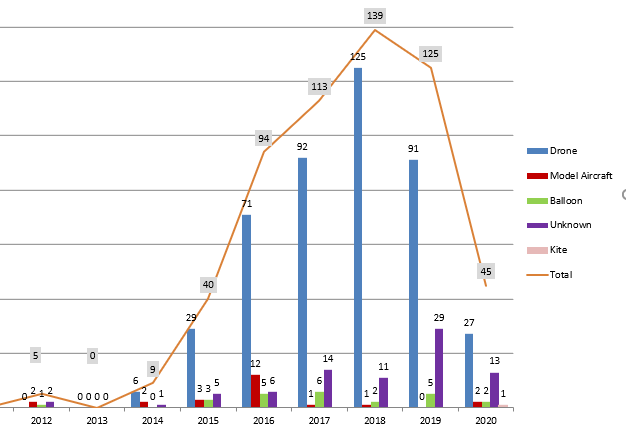
Drones being operated at high altitudes (typically over a 1000 feet), or close to airfields have been a big part of the problem. The UK AirProxBoard, who collect statistics in this area reported how in 2018 drone incidents rose by more than a third. These numbers have fallen since, possibly due to tighter regulation, but they are still above the expected range. The 2020 COVID pandemic has also meant more grounded commercial airline operations, resulting in fewer sightings.
Small Unmanned Air System (SUAS) Assessment visualisation by the UK Airprox Board. Drone accidents peaked in 2018, but have been falling since. Possible contributing factors include greater regulation and the recent 2020 Corona Virus pandemic. To download the full report: Click Here
Some of the most common reasons for Drone accidents and some safety precautions which you could take are outlined below:
Lack of Flight Training Solution: If you have never flown a Drone before then its important as a new user, you try to increase your understanding of Drones before going outside. Reading your Drone owners manual, watching YouTube videos and practicing are all things you can do to make your flying safer.
No pre – flight Check up Drone operators, should always do a pre flight check up, to reduce the likelihood of in air emergencies. It’s important to check things like 1.) Battery power and 2.) calibration, secure battery placement and RC antennae signal connection.
Flying in Poor weather This one goes without saying, but ALWAYS make sure weather conditions are suitable for your planned flight. Strong winds can knock your Drone out of the air, as well as rain and Ice which can cause irreparable internal and external damage to your craft!
The Law
The Civilian Aviation Authority (CAA) Air Navigation Order (ANO) 2016 is the main legislation governing aircrafts, including drones, in the UK. This has now been amended by the Air Navigation (Amendment) Order 2020, which attempts to streamline drone law to make the system more understandable – guidance to the updates are provided by the CAA here. The main provision you’ll need to be aware of from the ANO is Article 241 (concerning endangering the safety of any person or property). This applies to every aviation activity at all times and sets out that:
“[a] person must not recklessly or negligently cause or permit an aircraft to endanger any person or property”.
Before 31st December 2020, it also used to be important for the purposes of determining whether you needed a licence, to also know whether the purpose of a drone flight was commercial or non – commercial. However, this has since changed and the new focus looks at the risk that each flight represents. The greater the risk, the more rigorous the requirements will be for training and certifications. Whilst a summary of your key obligations can be found within the Drone Code here, we’ve summarised some of the key information below.
The main risk factors that are used in the updated regulations to determine how risk is categorised and which registration requirements are needed are outlined below:
How the updated regulations determine risk
Image
RiskFactors
Description
Weight
Of your drone (including accessories)
People Proximity from people
How close the drone will fly near (‘uninvolved people’) people not directly involved with the flight
Proximity from cities
How close the drone will fly near built up areas (e.g towns, cities, industrial areas, recreational areas etc.)
Drone operations will typically fall into one of three categories as follows:
Low (or no) risk to third parties. Has 3 Sub categories that have different restrictions in place regarding craft, qualifications and distance. Most uses fall within this.
No – Operations can be carried out in accordance with basic pre-defined characteristics and not subject to further authorisation requirements from CAA
Medium
Specific Category
– Greater risk than Open category, or – one or more elements of the operation fall outside the boundaries of the Open category.
Yes – Operational authorisation required from the CAA, based on a safety risk assessment.
High
Certified Category
– equivalent risk to that of manned aviation, resulting in operations falling under similar regulatory regime (i.e., certification of the aircraft, certification of the operator, licensing of the pilot) Examples include: – Passenger / transportation dangerous goods
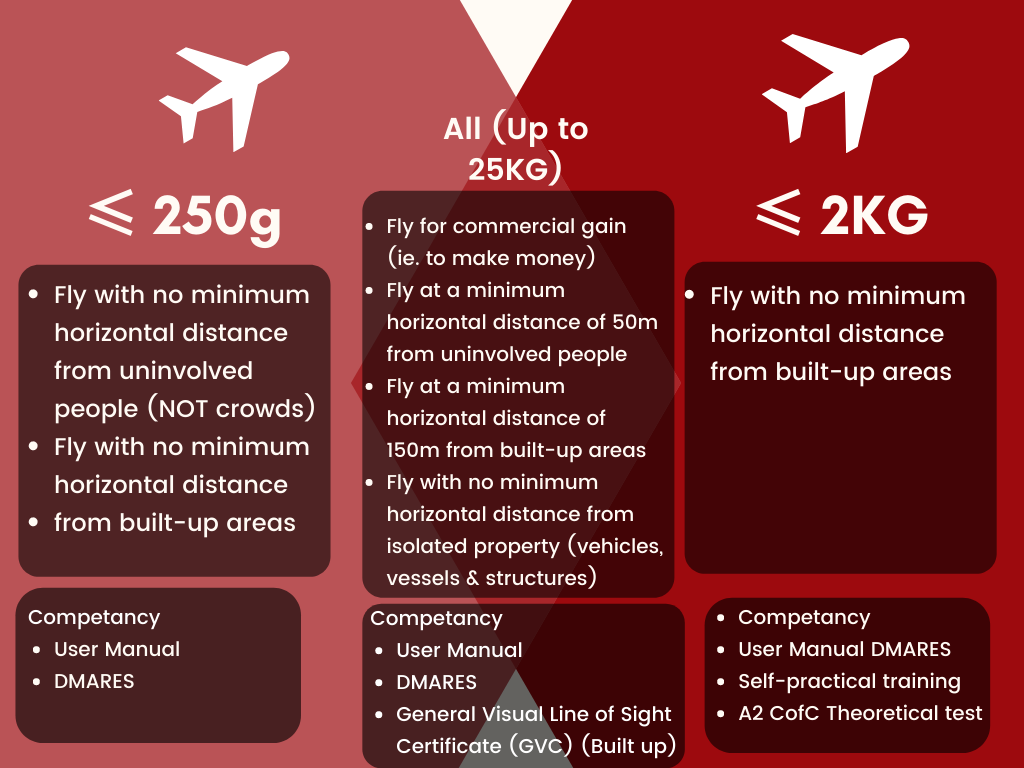
Most uses will typically now fall under the open category and as of 31st December 2020, those who fall into this category will be able to do the following:
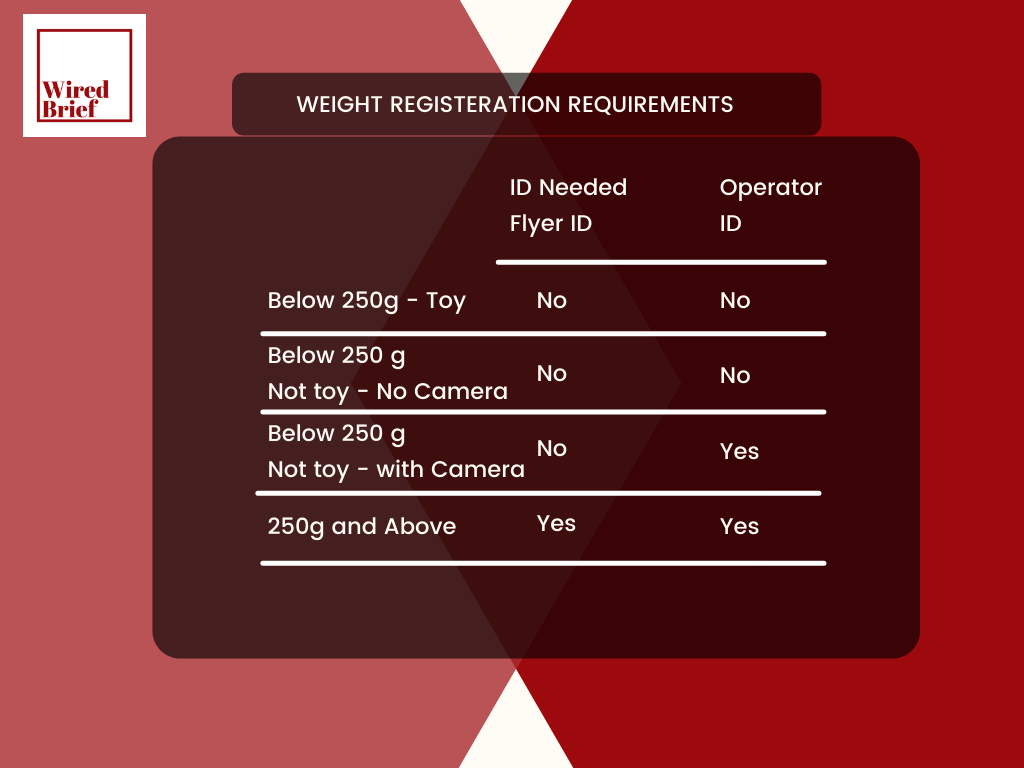
Summary of Drone operations in the open class and Registration Requirements
What about Insurance?
Insurance is optional if you’re flying a drone under 20kg for recreation. However, you should remember that you’re responsible for your actions, which means you could be held personally liable for any injury or damage you cause while you’re flying. If your flight is for any reason other than recreation, you do need insurance. EC785/2004 compliant insurance is still required for commercial operations in both the Open and Specific categories.
Please not that it is against the law to fly a drone or model aircraft without having the required IDs. You can also be fined for breaking the law when flying. In the most serious cases, you could be sent to prison.
ID Registration prices
If you already have an operator ID and just need a flyer ID, you’ll need to add your flyer ID in the My registration area
Strict Liability on the ground – Relaxed in the air
Last but not least, we look at the question of Liability for Drone operators. This predominantly concerns the question of where the accident has taken place. For example, section 76 of the CAA applies strict owner or operator liability for surface damage, caused by an aircraft. This can include injury to an individual or damage to property. If you are the Drone owner or operator then you would automatically be at fault for any loss or injury.
Unless there is contributory negligence to be alleged, the victim would be entitled compensation. Their mission would be to identify and pursue a case against you as the Drone operator. A common challenge however is finding the address of the offender and ensuring they have sufficient insurance / assets.
In the event of an air-to-air incident, the established principle is not to apportion blame on a strict liability basis. Each incident will thus dealt with case by case and the necessary elements of fault will need to be proven.
Drones and AI – The next frontier
Now you know the fundamentals of Drone usage and law in the UK we hope you will join us for our next article. There, we will be examining the technologies next evolution, brought about by combining Drones with artificial intelligence in commercial contexts.
As we move away from the need to have human operators at the helm of drone flights, we stand to benefit from greater efficiency and more complex Drone uses that can benefit future society. Unlike humans, Drones powered by AI will be able to work all year round without breaks, and in stressful environments without requiring sick days. This paves the way for many commercial opportunities, alongside potential risks. An assessment of both will be important as it will help us understand the future and fundamentally, any social effects brought about by these developments.
As of 31st December 2020, the same rules apply for both commercial and non commercial users.
Most uses fall within the Open category, but the higher the risk posed to the general public the more likely your use will fall outside of the open category. If you have any doubts, it’s important that you do your research and understand your obligations.
A full summary of all of the latest regulatory updates to UK drone law can be found here: Click Here
EC785/2004 compliant insurance is required for commercial operations in both the Open and Specific categories
The UK Government has removed the minimum age requirement for remote pilots operating in the Open and Specific categories. The competency requirements however are unchanged.
Under the ANO you must not recklessly or negligently cause or allow a Drone to endanger any person or property
Strict liability applies for Drone to surface damage but for Air to Air the courts will look for fault.




 This example vividly demonstrates how temporal prompts can guide the AI to produce deeply contextual and emotionally resonant content, providing users with powerful tools for legal analysis, historical simulations, and beyond.