Category: UK

  • 2021 UK Drone Ownership – The Law and Best Practice Tips

    2021 UK Drone Ownership – The Law and Best Practice Tips

    Important: historical guidance (2021). Drone regulations and registration requirements have changed since this article was published, including changes in 2026. Do not rely on the rules below to plan a flight today. Check the current UK Civil Aviation Authority Drone and Model Aircraft Code for up-to-date safety and legal requirements.

    Someone has just very generously gifted you a Drone and you are excited to try it out. You and the Drone are both charged and ready to venture out on your first test flight to the smooth backdrop of Sinatra.

    Teeming with ideas you step outside. Suddenly however, you remember, that actually, you don’t really know anything about flying Drones. In the UK, their use is also highly regulated. Sinatra fades away into the sunset as reality slowly dawns in.

    As the affordability and sales of drones have gone up, so have concerns about their safety. A history of near misses and various accidents (involving aeroplanes and stadiums) have helped bring rising drone ownership to the spotlight. Unfortunately, the underlying law behind their use hasn’t been as popular.

    It’s important to know and understand your legal obligations. Having to undertake all of the research yourself however, might appear daunting, but our team at WiredBrief have taken the trouble of doing all of the legwork for for you.

    What We’ll cover

    Our breakdown of the fundamentals of Drone Ownership in the UK which also includes best practice tips for safe responsible flight, will help you quickly understand your main legal obligations. We’ll particularly be focusing on the 2021 UK drone laws (introduced 31st December 2020), and your duties under the Civilian Aviation Authority (CAA) Air Navigation Order (ANO) 2016 and the Drone code. Whether you’re a commercial or recreational user, it’s going to be important to remember that because of the new changes, the rules and regulations are the same for everyone.

    Drone Usage and affordability – Private v Commercial use

    Drones can be bought easily and cheaply both online and on the high street. They can be affordably priced and range from as low as £100 – £10000, depending on your uses and reasons for buying one. Drones can be fun and used for recreation. Alternatively, they can also have a large range of more practical, commercial business uses. You can observe some of these in the below contexts:

    The issue with Drone ownership; turbulent start and near misses

    Unfortunately, whilst obtaining a Drone might be relatively straightforward, flying one legally and safely is far more tricky. Recently, Drone owners have seen a spate of accidents, that have involved collisions and near misses with commercial airlines. As a result, the need for ensuring greater public safety has led to calls for stricter measures, ensuring Drone operators exercise sufficient caution.

    Drones being operated at high altitudes (typically over a 1000 feet), or close to airfields have been a big part of the problem. The UK AirProxBoard, who collect statistics in this area reported how in 2018 drone incidents rose by more than a third. These numbers have fallen since, possibly due to tighter regulation, but they are still above the expected range. The 2020 COVID pandemic has also meant more grounded commercial airline operations, resulting in fewer sightings.

    Small Unmanned Air System (SUAS) Assessment visualisation by the UK Airprox Board. Drone accidents peaked in 2018, but have been falling since. Possible contributing factors include greater regulation and the recent 2020 Corona Virus pandemic. To download the full report: Click Here

    Some of the most common reasons for Drone accidents and some safety precautions which you could take are outlined below:

    • Lack of Flight Training
      Solution: If you have never flown a Drone before then its important as a new user, you try to increase your understanding of Drones before going outside. Reading your Drone owners manual, watching YouTube videos and practicing are all things you can do to make your flying safer.
    • No pre – flight Check up
      Drone operators, should always do a pre flight check up, to reduce the likelihood of in air emergencies. It’s important to check things like 1.) Battery power and 2.) calibration, secure battery placement and RC antennae signal connection.
    • Flying in Poor weather
      This one goes without saying, but ALWAYS make sure weather conditions are suitable for your planned flight. Strong winds can knock your Drone out of the air, as well as rain and Ice which can cause irreparable internal and external damage to your craft!

    The Law

    The Civilian Aviation Authority (CAA) Air Navigation Order (ANO) 2016 is the main legislation governing aircrafts, including drones, in the UK. This has now been amended by the Air Navigation (Amendment) Order 2020, which attempts to streamline drone law to make the system more understandable – guidance to the updates are provided by the CAA here. The main provision you’ll need to be aware of from the ANO is Article 241 (concerning endangering the safety of any person or property). This applies to every aviation activity at all times and sets out that:

    “[a] person must not recklessly or negligently cause or permit an aircraft to endanger any person or property”.

    Before 31st December 2020, it also used to be important for the purposes of determining whether you needed a licence, to also know whether the purpose of a drone flight was commercial or non – commercial. However, this has since changed and the new focus looks at the risk that each flight represents. The greater the risk, the more rigorous the requirements will be for training and certifications. Whilst a summary of your key obligations can be found within the Drone Code here, we’ve summarised some of the key information below.

    The main risk factors that are used in the updated regulations to determine how risk is categorised and which registration requirements are needed are outlined below:

    How the updated regulations determine risk

    ImageRisk FactorsDescription
    WeightOf your drone (including accessories)
    People Proximity from peopleHow close the drone will fly near (‘uninvolved people’) people not directly involved with the flight
    Proximity from citiesHow close the drone will fly near built up areas (e.g towns, cities, industrial areas, recreational areas etc.)

    Drone operations will typically fall into one of three categories as follows: 

    The three new categories of Drone operations

    RiskCategoryDescriptionCAA Application required?
    LowOpen Category
    • Low (or no) risk to third parties. Has 3 Sub categories that have different restrictions in place regarding craft, qualifications and distance. Most uses fall within this.
    No – Operations can be carried out in accordance with basic pre-defined characteristics and not subject to further authorisation requirements from CAA
    MediumSpecific Category– Greater risk than Open category, or
    – one or more elements of the operation fall outside the boundaries of the Open category.
    Yes – Operational authorisation required from the CAA, based on a safety risk assessment.
    HighCertified Category – equivalent risk to that of manned aviation, resulting in operations falling under similar regulatory regime (i.e., certification of the aircraft, certification of the operator, licensing of the pilot)
    Examples include:
    – Passenger / transportation dangerous goods
    Yes – Equivalent requirements to manned aviation.
    See also The Drone and Model Aircraft Code


    Most uses will typically now fall under the open category and as of 31st December 2020, those who fall into this category will be able to do the following:

    Summary of where most Drone uses fall

    What about Insurance?

    Insurance is optional if you’re flying a drone under 20kg for recreation. However, you should remember that you’re responsible for your actions, which means you could be held personally liable for any injury or damage you cause while you’re flying. If your flight is for any reason other than recreation, you do need insurance. EC785/2004 compliant insurance is still required for commercial operations in both the Open and Specific categories.

    Please not that it is against the law to fly a drone or model aircraft without having the required IDs. You can also be fined for breaking the law when flying. In the most serious cases, you could be sent to prison.

    ID Registration prices

    Drone registration prices
    If you already have an operator ID and just need a flyer ID, you’ll need to add your flyer ID in the My registration area

    Strict Liability on the ground – Relaxed in the air

    Last but not least, we look at the question of Liability for Drone operators. This predominantly concerns the question of where the accident has taken place. For example, section 76 of the CAA applies strict owner or operator liability for surface damage, caused by an aircraft. This can include injury to an individual or damage to property. If you are the Drone owner or operator then you would automatically be at fault for any loss or injury.

    Unless there is contributory negligence to be alleged, the victim would be entitled compensation. Their mission would be to identify and pursue a case against you as the Drone operator. A common challenge however is finding the address of the offender and ensuring they have sufficient insurance / assets.

    In the event of an air-to-air incident, the established principle is not to apportion blame on a strict liability basis. Each incident will thus dealt with case by case and the necessary elements of fault will need to be proven.

    Drones and AI – The next frontier

    Now you know the fundamentals of Drone usage and law in the UK we hope you will join us for our next article. There, we will be examining the technologies next evolution, brought about by combining Drones with artificial intelligence in commercial contexts.

    As we move away from the need to have human operators at the helm of drone flights, we stand to benefit from greater efficiency and more complex Drone uses that can benefit future society. Unlike humans, Drones powered by AI will be able to work all year round without breaks, and in stressful environments without requiring sick days. This paves the way for many commercial opportunities, alongside potential risks. An assessment of both will be important as it will help us understand the future and fundamentally, any social effects brought about by these developments.

    Getting started toolkit:


    Article Takeaways:

    • The Civilian Aviation Authority (CAA) Air Navigation Order (ANO) 2016 govern Drone law in the UK
    • As of 31st December 2020, the same rules apply for both commercial and non commercial users.
    • Most uses fall within the Open category, but the higher the risk posed to the general public the more likely your use will fall outside of the open category. If you have any doubts, it’s important that you do your research and understand your obligations.
    • A full summary of all of the latest regulatory updates to UK drone law can be found here: Click Here
    • EC785/2004 compliant insurance is required for commercial operations in both the Open and Specific categories
    • The UK Government has removed the minimum age requirement for remote pilots operating in the Open and Specific categories. The competency requirements however are unchanged.
    • Under the ANO you must not recklessly or negligently cause or allow a Drone to endanger any person or property
    • Strict liability applies for Drone to surface damage but for Air to Air the courts will look for fault.

  • Blockchain E – Salon: What’s all the hype around Blockchain about? [VIDEO]

    Blockchain E – Salon: What’s all the hype around Blockchain about? [VIDEO]

    WiredBrief are delighted to bring to you another exciting panel event hosted by Legal Hackers MCR, which looks into Blockchain and what the hype is all about.

    About this Event:

    Are you tired of seeing generic news articles about Blockchain that just talk about it in terms of Bitcoin and daily price fluctuations?

    Blockchain and decentralised ledger technology have many uses that extend past digital currencies. Their ability to create a secure trust-less, permissioned ledger is just one example of a feature, that will make the technology a crucial hallmark of the connected world and Internet of things (IOT).

    If you are looking to expand your knowledge of Blockchain and better understand its place in our connected digital future, then come to the Manchester Legal Hackers E Salon where they’ll be finding out what the fuss is all about!

    Host:

    Xuening Qu – Legal Technologist at DWF

    Co – Host:

    Abigail Holt – Barrister at Garden Court Chambers

    Event Co – Ordinator:

    Geofrey Banzi – Legal Technologist at KPMG

    Panellists

    Adi Ben-Ari

    Founder & CEO at Applied Blockchain

    Adi has over 20 years enterprise software experience, more recently leading major deliveries of production blockchain and advanced cryptography solutions. Adi is widely recognised as an independent thought leader in the industry, a noted speaker at major conferences, experienced in educating C-suite on blockchain, confidential computing and privacy-preserving technologies, and acts as an advisor for a number of startups.

    His work has been noted by the UK Government, where he was invited to present at Parliament and the House of Lords, and at University College London. Adi has contributed to the recent work of the Law Society on Blockchain, Legal and Regulatory Guidance. He has co-invented and designed a number of patents related to confidential computing, advanced cryptography, blockchain and mobile payments.

    Will Foulkes

    Senior Solicitor & Head of Blockchain at Stephenson Law Will is an experienced solicitor and specialist in distributed ledger technologies, digital assets and smart contracts, advising on multi-jurisdictional regulatory compliance and strategy for token-related fundraising. Will is an engaging and informative speaker on blockchain and has worked with the Law Commission’s Digital Asset and Smart Contract team on a number of key projects.

    Jay Smith

    Legal Engineer at Stephenson Law

    Jay advises on legaltech, operations and blockchain at Stephenson Law, a key challenger in the legal industry, with a forward-thinking approach of how law firms should operate and embrace new technologies. Jay’s expertise and consultancy fuses design and tech with an expert understanding of law.

    Andy Gray

    Co-founder of KnownOrigin Labs and BlockRocket.tech

    Founder, Blockchain Manchester

    Andy builds blockchain products and solutions, developing decentralised applications (Dapps) with Solidity smart contracts and Web 3.0 tech, and with over 20 years commercial experience developing enterprise IT systems. Andy’s recent projects include the creation of a tokenised customer loyalty platform and experiments with crypto-collectibles for BrewDog and KnownOrigin.io, a digital art marketplace. Andy will speak about crypto-collectibles, blockchain art and proof of provenance.

    The following questions were answered:

    – Can you explain what blockchain is all about in three sentences? 9.16

    – The primary value of blockchain is the fact it’s so secure. However, there must be potential breaches in blockchain, can you describe how potential breaches are dealt with? 10.56

    – What do you see as the most interesting and evolving trends in distributed ledger technology? 16.53

    – Fungible, non fungible… what does it mean? 21.59

    – Some people say that the blockchain revolution hasn’t happened yet, and most of the existing blockchain applications can be achieved through normal cloud based applications. What do you say to that? 23.59

    – What does the internet of things mean? 29.58

    – Could you give us examples of existing blockchain projects, including some you’ve worked on? 32.10

    – Who do I go to to design a system in regards blockchain? 36.14

    – Adoption of technology often lags the creation of the technology. Legal regulation can often lag behind that! One of the challenges for blockchain is that it will be dotted all over the world, which brings into question legal jurisdictions. What are your thoughts on the regulation of blockchain and how that can be done practically? 41.16

    – Can you explain what mining is? Why does it use so much electricity, and why does it pose a risk to climate change? 45.35

    – Can you explain the practical differences and challenges proposed by proof of work versus proof of stake? 49.48

    – When governments start accepting crypto as payment for taxes, that will be a tipping. How close do you think we are to this? 51.27

    – How do see the system being regulated, or do you think it will it regulate itself? 58.55

    –  Can the regulation keep up with the technology? 1.01.31

  • AN INTRODUCTION TO BLOCKCHAIN AND CRYPTO ASSETS [VIDEO]

    AN INTRODUCTION TO BLOCKCHAIN AND CRYPTO ASSETS [VIDEO]

    WiredBrief are excited to bring to you an exciting event hosted by Legal Hackers MCR, which looks at Blockchain and its applications to the real world.

    About this Event

    Have you ever wondered how Blockchain could transform the world and how companies are using its transformative power to bring about social change?

    The consequences of the recent COVID-19 pandemic have allowed Blockchain to quickly rise in prominence over the past year to become one of the most prolific technologies on the market in 2021, but little is still known about it.

    Blockchain technology however, has the power to transform millions of our lives for the better but until recently, it has only been a buzz-word and the subject of market speculation. Recent disruptions to our status quo however, have forced difficult questions of not just how we could begin rebuilding our society and financial institutions, but which tools we could start using to do this.

    Join Legal Hackers MCR

    Join Legal Hackers MCR on the 4th of February as they introduce Will Foulkes, Head of Blockchain at Stephenson Law, who will be bringing you closer to the exciting world of Blockchain.

    During his talk he will help demystify key aspects of the disruptive technology, including its uses and applications and he will also be available to take some of your questions at the end.

    If you enjoy this event and want to take an even further deep dive, we’ll also be hosting an exciting panel event on the 18th of February. This will include a number of leading specialists from the area, who will be able to give you even more insight and also answer some of your more probing questions. Stay tuned!

    What will be covered:

    1. HOW BLOCKCHAIN WORKS

    2. WHY BLOCKCHAIN HAS THE CAPACITY TO MASSIVELY DISRUPT INDUSTRY

    3. INSIGHT INTO SOME LEADING PROJECTS AND PRODUCTS IN THIS SPACE

    Keynote Speaker:

    Will Foulkes – Head of Blockchain at Stephenson Law

    LinkedIn

    Host:

    Xuening Qu – Legal Technologist at DWF

    Co – Host:

    Lisa McCLory – Legal Knowledge Director at Fractal Legal

    For more events like this visit Legal Hackers MCR on:

    LinkedIn

    Twitter

    Website

  • Legal Technology and its applications and implications for regulation and practice

    Legal Technology and its applications and implications for regulation and practice

    Are you interested in finding out more about:

    • the applications of Legal Technology to delivering social justice during the Covid 19 pandemic,
    • the ICO’s approach to the regulation of novel IT solutions, such as the UKs recently created contract tracing app, or
    • how the Manchester law and technology initiative is driving forward the integration of legal tech and innovation into the law school curriculum

    Checkout the European Circuits webinar event on Legal Technology and its applications and implications for regulation and practice, happening on the 17th June 2020 via ZOOM | 16.30-17.45 GMT, sponsored by 18 St John Street Chambers.

    Book your space now:

    https://zoom.us/webinar/register/WN_wmmYTyRsTDa2RtqWwNtvuw

    Event details:

    Chair:

    His Honour Judge Pearce, Judge in charge of the Circuit Commercial Court, Manchester

    Keynote speech:

    Sir Geoffrey Vos, Chancellor of the High Court of England and Wales

    Other speakers:

    James Moss Acting General Counsel for the ICO

    Professor Claire McGourlay, The University of Manchester

    Jonathan Patterson, Managing Director at DWF Ventures

    For more details about the event visit:

    https://www.europeancircuit.com

  • Redefining Liability: Navigating Tort Law in the Age of Autonomous Vehicles

    Redefining Liability: Navigating Tort Law in the Age of Autonomous Vehicles

    As autonomous vehicles (AVs) become more prevalent, the UK’s legal framework for vehicle liability is evolving rapidly. With the Automated Vehicles Act 2024 (AV Act) now in force, lawmakers are re-examining traditional tort law principles to address the complexities of self-driving technology. This transformation underscores the urgent need for a legal system that can keep pace with the rapid advancements in vehicle automation.

    A New Legal Landscape for Autonomous Vehicles

    In the UK, the “harm-based” law of torts has long governed liability for vehicle accidents, supported by legislation such as the Road Traffic Act 1988. However, as control shifts from humans to algorithms in more advanced vehicle automation, the legal landscape must adapt. The AV Act, which received Royal Assent in May 2024, introduces a comprehensive framework designed to tackle these emerging challenges.

    The AV Act clearly distinguishes between “user-in-charge” (UiC) and “no-user-in-charge” (non-UiC) scenarios, where vehicles operate independently without human intervention. This distinction is crucial, as it clarifies liability in the event of an accident—whether it falls on the driver, the manufacturer, or the software provider. The act specifically designates an “authorised self-driving entity” (ASDE) as the party responsible for ensuring that an AV meets all safety and operational standards, thereby shifting liability away from human drivers when the vehicle operates autonomously(Taylor Wessing, Bird & Bird |International Law Firm).

    The Role of the Automated Vehicles Act

    The Automated Vehicles Act 2024 marks a significant milestone in the regulation of self-driving cars in the UK. Building on previous legislation, such as the Automated and Electric Vehicles Act 2018 (AEVA), the new act goes further by addressing earlier laws’ limitations. It establishes a more rigorous safety framework, requiring AVs to meet safety standards that are equivalent to or higher than those of a competent human driver before they are permitted on public roads.

    Moreover, the AV Act sets up a new regime for the approval and ongoing monitoring of AVs. Vehicles must pass a self-driving test and remain under continuous oversight throughout their operational life. This approach ensures that they stay safe and comply with road rules, even as they undergo software updates and other modifications(GOV.UK,Law Commission).

    Balancing Innovation and Accountability

    As AV technology rapidly advances, it brings new ethical and legal concerns. For instance, when an autonomous car’s decision-making algorithm causes an accident, who bears the responsibility? The AV Act addresses this issue by making the ASDE legally accountable for the vehicle’s actions during non-UiC operations. This shift in liability from the human driver to the manufacturer or software provider represents a significant departure from traditional tort law(Bird & Bird | International Law Firm).

    The act also introduces stringent consumer protection measures, including regulations on how AVs can be marketed. These measures aim to prevent consumers from being misled about a vehicle’s capabilities, ensuring they understand the difference between fully autonomous systems and those requiring human intervention.

    Conclusion

    As the UK approaches the mainstream adoption of autonomous vehicles, its legal system must continue to evolve. The Automated Vehicles Act 2024 plays a critical role in this evolution, providing a clear framework for liability and safety in a world where self-driving cars are becoming the norm. By addressing the legal and ethical challenges posed by AV technology, the UK positions itself as a global leader in the autonomous vehicle sector, ensuring that innovation is balanced with accountability and public safety.


    Explore related WiBrief research

    The questions about responsibility raised by autonomous vehicles now appear in workplaces and software agents. Explore the wider picture in the Autonomy and AI research hub. Experience the trade-offs directly in the interactive Autonomy Atlas.

  • A Road Map for Driverless Cars: The UK’s Accelerated Journey Towards Autonomy in 2026

    A Road Map for Driverless Cars: The UK’s Accelerated Journey Towards Autonomy in 2026

    The year 2026 is poised to be a watershed moment for the UK’s automotive landscape12, with fully driverless cars potentially hitting the roads. This acceleration, propelled by the groundbreaking Automated Vehicles Act of 2024, marks a significant leap forward in the evolution of transportation.

    A closer look at the latest industry reports and legislative developments unveils a detailed roadmap of what to expect as this technology revolutionises our roads.

    Phases of Integration: A Gradual Revolution

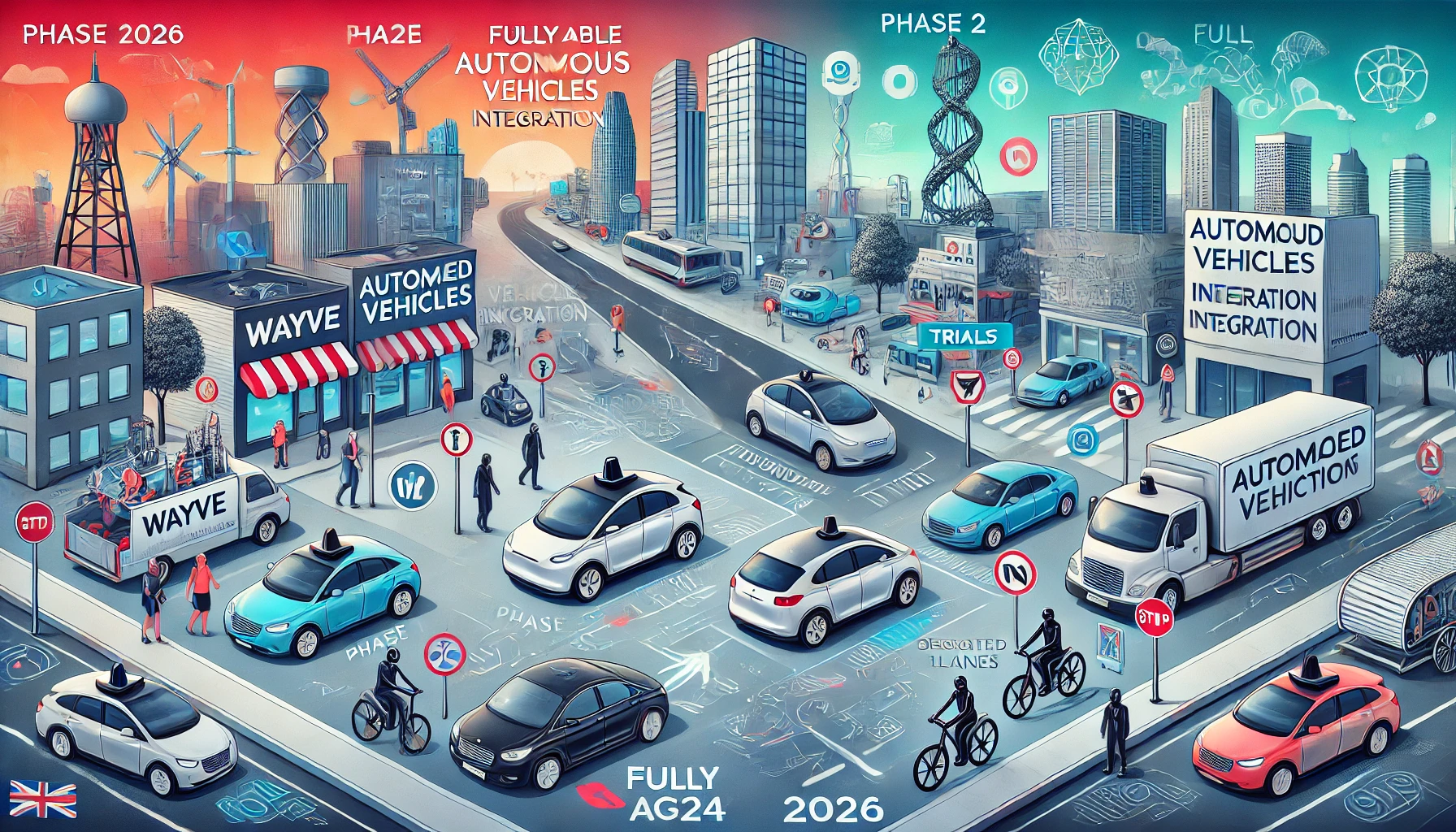
    Phase 1: Building Trust with Overridable Self-Driving Cars Initially, we will witness the introduction of “overridable” self-driving cars. These vehicles will empower human drivers to intervene and take control in situations where the AI system may falter. This crucial first phase serves a dual purpose: it allows the public to gradually acclimate to the technology while simultaneously gathering invaluable real-world data to refine the AI’s capabilities.

    Phase 2: Embracing Full Autonomy As confidence in the technology solidifies and overridable self-driving cars become ubiquitous, the stage will be set for the second phase: the deployment of fully autonomous, non-overridable vehicles. These cars will operate independently, ushering in a new era of transportation that promises enhanced safety, reduced congestion, and improved accessibility.

    Navigating the Transition: Addressing Human and Machine Errors

    The path to a fully autonomous future is not without its challenges. One of the most pressing concerns is the potential for both human and machine errors during this transitional period.

    Human Error:
    The Persistent Challenge Human error remains a leading cause of road accidents in the UK, contributing to a staggering 88% of collisions. Distracted driving, fatigue, and impaired driving are just a few examples of the human factors that jeopardise road safety. While self-driving cars aim to eliminate these risks, the transition period presents a unique challenge in handover scenarios, where drivers may need to suddenly resume control.

    Machine Error: The Imperfections of Technology Self-driving cars, while promising, are not infallible. Manufacturing defects and design flaws can lead to malfunctions, even in meticulously crafted vehicles. Rigorous testing and stringent quality control measures are paramount to mitigating these risks.

    The UK’s Pioneering Efforts: Trials and Regulations3

    The UK has taken a proactive stance in embracing this technological revolution. Companies like Wayve and Oxa are already conducting trials in urban environments, paving the way for a driverless future. These trials operate under a strict code of practice that mandates human supervision, ensuring safety and addressing initial concerns.

    The Way Forward: A Multifaceted Approach

    To ensure a seamless and safe transition to fully autonomous vehicles, a multifaceted approach is essential:

    Enhanced Testing and Validation: Continuous rigorous testing under diverse conditions is crucial to identify and rectify potential defects.

    Public Awareness and Education: Educating the public about the capabilities and limitations of self-driving technology will foster acceptance and responsible usage.

    Robust Regulatory Oversight: Stringent regulations must be developed and enforced to ensure high safety standards and hold manufacturers accountable.

    Infrastructure Adaptation: Upgrading road infrastructure to accommodate autonomous vehicles, including dedicated lanes and intelligent traffic systems, will be vital.

    Conclusion: A Safer, More Efficient Future Beckons

    The UK’s forward-thinking approach, exemplified by the Automated Vehicles Act, positions the nation at the forefront of the autonomous vehicle revolution. By addressing both human and machine errors head-on, the UK is paving the way for a future where fully autonomous, safe roadways are a reality. This transformation has the potential to save countless lives, revolutionise transportation, and create a more efficient and accessible society for all.

    1. https://www.gov.uk/government/news/self-driving-vehicles-set-to-be-on-roads-by-2026-as-automated-vehicles-act-becomes-law ↩︎
    2. https://www.topgear.com/car-news/tech/self-driving-cars-could-be-uk-roads-2026-after-new-law-signed ↩︎
    3. GOV.UK)​​ (Enterprise Technology News and Analysis)​​ (Top Gear)​. ↩︎

    Explore related WiBrief research

    Compare this early autonomous-vehicle roadmap with how AI agents are shifting control and accountability today in the Autonomy and AI research hub. Experience the trade-offs directly in the interactive Autonomy Atlas.