AI used to answer individual questions. It can increasingly carry out whole workflows. What changed is not just the quality of the answer: AI can now access knowledge, use software tools, plan a sequence of steps and work towards an outcome.
Why it matters: Businesses should stop asking only “How can staff use AI?” and start asking “Which parts of our workflows can AI reliably complete?”
The important distinction: More capability does not automatically justify more independence. Permissions and oversight still matter.
At each stage, more of the steps between an instruction and a completed task can be performed by AI.
In our guide to the six SAE levels of self-driving cars, each level showed how more of the driving task could pass from human to machine. AI presents a similar question for knowledge work: how much of the task can software now carry through itself? Unlike SAE driving levels, the six AI stages below are a WiBrief teaching framework, not an official standard.
The six stages: from prompt to completed workflow
01 — Answer
A single prompt produces a response. Human work: ask, assess, copy, act and initiate the next prompt.
Client proposal example: “Write an introduction to a client proposal.”
02 — Converse
The assistant carries context across a discussion, clarifies requirements and improves an answer over several turns. Human work: steer the conversation and execute the task.
Client proposal example: “Ask me about the client, then refine the introduction.”
03 — Retrieve
The assistant searches connected sources to ground its work in documents, facts and precedents. Human work: verify evidence and apply the result.
Client proposal example: “Find relevant previous fee proposals and use them as references.”
04 — Use tools
The system can call approved software functions, APIs and integrations, potentially via MCP. It can take specific actions rather than only recommend them. Human work: specify tasks, grant access and review consequential actions.
Client proposal example: “Retrieve approved records from SharePoint and create a working draft.”
05 — Plan and coordinate
Given a goal, an agent can select and sequence multiple tools, inspect results and revise its plan when something fails. Human work: define objectives, constraints and exceptions.
Client proposal example: “Search precedents, draft the proposal, check pricing rules and flag missing details.”
06 — Complete workflows
Within pre-agreed scope, an agent or collection of agents can run a workflow from request to defined outcome, including monitoring progress and escalating exceptions. Human work: set policy, approve high-impact decisions and supervise outcomes.
Client proposal example: “Prepare the proposal package, route it for approval and finish the internal workflow.”
The change in one picture
In the early stages: Human → AI answer → Human completes the work.
In the middle: Human → AI uses knowledge and tools → Human reviews progress.
At the advanced stages: Human sets goal and boundaries → AI plans and executes steps → Human supervises outcomes and exceptions.
This is a functional progression, not a strict historical timeline: conversation, retrieval and tool-use capabilities overlap, and autonomy depends on the system’s design and permissions.
What actually made this possible?
Model capability improved reasoning and instruction-following; longer context and retrieval helped systems work with relevant information; tool calling and MCP-style connections opened access to software; and agent architectures added loops for planning, acting, observing and correcting. None of these alone guarantees reliable autonomy.
What UK research says
The UK government’s AI Insights: Agentic AI, updated in August 2026, explains how language-model capabilities combine with agent architectures to enable systems to select and coordinate actions. The March 2026 consumer research frames the shift as moving from tools that support user decisions towards agents potentially entrusted with outcomes.
The UK’s AI Security Institute examined more than 1,000 publicly available MCP servers and reported increasing levels of autonomy among newly published finance-related tool interfaces across part of 2025. That is evidence about tooling and permissions, not proof that all deployed agents perform reliably.
The National Cyber Security Centre advised in May 2026 that organisations should start with tightly bounded, low-risk uses, maintain visibility and retain clear human responsibility. Its 20 October 2026 research problem book update asks how semi-autonomous cyber systems can be evaluated and assured.
Take one process with a clear input and outcome. Count how many steps currently require a human. Identify which steps AI can perform safely today, which need approval, and which are not ready for delegation. Measure completed outcomes, not impressive demonstrations.
The destination is not a smarter chatbot. It is a dependable system capable of completing useful work.
Editorial note: This six-stage framework is an explanatory model developed for WiBrief. It should not be confused with a regulatory classification or a validated capability benchmark. Sources checked 22 October 2026.
The Digital Revolution. When Apple introduced the iPhone, it wasn’t just about making calls. It changed how we work, learn, shop, navigate, and even how we relax. It made the internet personal.
Now, we’re on the edge of another leap forward—this time with artificial intelligence. But instead of fitting into one device, AI has the potential to fit around you. The real magic? Custom GPTs. These are AI assistants tailored to your preferences, your data, your goals.
Much like the shift from landlines to smartphones, we’re shifting from generic AI to personalised, reliable assistants that can enhance productivity in ways that feel surprisingly human.
2. What Is a Custom GPT Persona?
A GPT persona is a customised version of a general AI assistant like ChatGPT. Instead of just answering questions with whatever information it can recall, a persona is:
Aligned with your tone, style, or domain
Pre configured with your custom instructions, documents and preferences
Built to follow certain rules or avoid specific mistakes
Think of it like your own digital co-worker who already knows how you think, what you care about, and how you like things done each time you use it.
Just like Netflix recommends based on your viewing habits, a GPT persona can:
Help you prepare presentations from your notes
Answer questions from your uploaded course textbook
Provide health insights based on your fitness data
Extract the “important bits” from long contracts
Draft emails, lesson plans, or research summaries the way you would
You don’t need to be technical to shape AI. You just need to be clear about what you want it to do—and where you still want to stay in control. Because the real risk isn’t AI doing too little. It’s AI quietly making decisions for you.
🖼️ Where to Start: Build Your Own GPT Assistant Visit https://chat.openai.com/gpts and click “Explore GPTs” to browse examples or “Create a GPT” to build your own in minutes—no code required.
Use the guided builder to define its tone, purpose, and upload key documents or links. You can even give it a name and a profile picture!
3. What Powers This? Meet RAG (Without the Jargon)
Behind the scenes, many custom GPTs are supercharged with something called Retrieval-Augmented Generation (RAG). Don’t let the name scare you.
All it means is this:
You can upload your own content (a PDF, notes, slide decks)
Or, link it to web pages or online sources you trust
The AI then uses that content, not just what it was pre-trained on
So instead of generic or outdated info, the assistant pulls exactly what it needs from your sources.
🔍 Real-Life Uses of RAG + Personas
These combinations unlock powerful everyday tools:
🏋️ Fitness Coach GPT: Upload your health plan or workout logs and talk to a coach that helps you stay on track and explains your stats.
📚 Study Buddy GPT: Upload your course curriculum and textbooks—ask questions, quiz yourself, and get summaries tailored to your syllabus.
📅 Presentation Assistant GPT: Drop in your research or agenda and get a draft presentation, bullet points, or speaker notes.
🔒 Contract Navigator GPT: Upload a bunch of boilerplate contracts and get the unusual or noteworthy provisions flagged for you.
📜 Personal Researcher GPT: Paste in reports, links, or documents, and it will help summarise, compare, or explain them in your preferred format.
These are low-barrier, high-impact applications. No coding. No jargon. Just results that make sense for you.
But remember: AI sees patterns. It doesn’t feel instinct. It might catch six common risks in a document—but miss the one that’s subtly phrased, buried in boilerplate, or just feels off. That’s why your judgment still matters.
4. Multiple Personas, Working as a Team
Now imagine this: not just one assistant, but a team of them working behind the scenes.
One gathers relevant info
Another analyses and drafts
A third reviews and refines
This is already happening across industries. And it’s how professionals are getting reliable, repeatable results from AI—the kind you can trust.
But it’s just as relevant for students, retirees, freelancers, or anyone managing tasks that require judgment, organisation, or insight.
And just like a GPS uses traffic data to help you avoid delays, your personas can adapt in real time, making your work smoother, smarter, and more aligned with how you think.
5. Don’t Forget the Human Touch
AI is fast. Sometimes too fast.
It’s tempting to accept whatever it gives you—especially when it sounds confident. But speed doesn’t equal accuracy.
Think of AI like a smart intern: helpful, yes—but you still need to review its work. A model might flag six obvious red flags in a contract… but miss the one that’s subtle, strange, or completely unexpected. That’s where your judgment matters most.
So as you delegate to AI, don’t outsource your thinking. Build in moments to pause and ask: “Is this right?” “Is anything missing?” “Would I say it this way?”
That’s not friction. That’s good decision-making.
AI should amplify your instincts—not override them.
6. The Takeaway
Custom GPTs are more than cool tech. They’re a way to bring clarity, speed, and insight to your everyday work and life.
We no longer need to adapt to AI. Now, AI can adapt to us.
And the real productivity boost isn’t just from automation. It’s from intelligent delegation—handing off the repetitive parts of your work so you can focus on what matters: judgment, creativity, strategy.
Whether you’re a teacher prepping lessons, a student revising for finals, or a founder writing investor updates, the question is the same:
“Is this AI helping me think better—or just think less?”
The best custom GPTs don’t just save time. They sharpen your focus, elevate your thinking, and help you do more of what only you can do.
If the iPhone put the world in your pocket, custom GPTs put you at the centre of your digital universe.
Continue exploring
Custom AI assistants are one step along a broader spectrum of machine autonomy. See how the stages of delegation fit together in the Autonomy and AI research hub, and investigate decision authority in the interactive Autonomy Atlas.
As GenAI digital assistants—such as Microsoft Copilot, vendor-specific versions of ChatGPT, and internal firm models—embed themselves into legal workflows, the question is no longer “Should I use AI?” It’s: How do we design it to enhance—not override—judgment? The future of professional services depends not just on what AI can do, but on how we choose to think.
⚖️ From Oversight to Ownership
In professional services, our value has never been just in what we know—but in how we frame, filter, and challenge complexity. The rise of GenAI digital assistants doesn’t erase that—it raises the stakes.
Because even if:
AI proposes a new content and structure based on your parameters,
Ranks risk based on frameworks you define,
Surfaces insights drawn from analogue experience…
The question remains:
Are you still making the key decisions—or just reviewing what the system has already prioritised for you?
This is what I call judgment drift—not losing control outright, but gradually letting automated systems decide what matters most in professional decisions—without continuous, active human evaluation for real-world relevance.
🔍 A Real-World Example
AI can quickly scan hundreds of pages and flag six familiar risks—termination clauses, liability caps, change-of-control provisions. But what about the seventh? The one that doesn’t follow the usual pattern. The clause phrased just differently enough, buried in boilerplate, or introduced in passing by a counterparty. That’s the one the model might miss—and the one a sharp human spots, because it feels off.
In high-stakes negotiations, using GenAI to draft too early can give the illusion of a well-framed position—when in reality, it’s just a statistically likely one. That false confidence can lock you into assumptions on liability, pricing, or responsibility—before you’ve aligned the output with your client’s goals, strategy, or leverage.
The result? Time saved, but oversight lost.
That’s why the goal isn’t automation for its own sake. It’s intelligent delegation—with human judgment guiding what to review,when to slow down, and where to challenge the default.
✨ Story Moment: Friday Evening. 900 Pages. No Panic.
You’ve lived this.
It’s late Friday. A critical deliverable just landed—a 900-page document, a dataset, a transaction report. It needs to be reviewed, structured, and summarised by Monday.
Old world? Two team members brace for a lost weekend. New world? Your organisational GenAI assistant processes the file, extracts what matters, flags inconsistencies, and delivers a structured first-draft summary—in your specified standard format—before you even log off.
You’re not replacing expertise. You’re reclaiming it—for strategy, not survival.
🛠️ What Should Professional Services Do Next?
1. Shift from Passive Tool Use to Active Role Design
Don’t just use AI—author it. Define the assistant’s role, purpose, tone, steps to perform and boundaries. Gen AI tools perform better when shaped by clear context and intentional structure—not guesswork.
2. Preserve Cognitive Friction
Build in moments to pause, question, and challenge what the Gen AI system returns. Good judgment doesn’t come from seamless flow—but from thoughtful interruption.
3. Create Frameworks Worth Scaling
Treat every effective Gen AI setup as a blueprint—and build from there. Curate prompts that work, regardless of the platform. Adapt and improve them.Document the logic. Share the method.Build systems others can trust—and scale.
🧭 Why This Matters
GenAI is no longer speculative—it’s operational.
The professionals who will lead this shift aren’t the ones who use AI fastest. They’re the ones who ask:
What’s being missed?
Who is really in control?
Does this support or replace my judgment?
and most importantly:
Is it amplifying your expertise—or quietly eroding the very judgment your clients rely on?
Top 10 Predictions Shaping Legal, AI & Human Agency (2025–2028)
TL;DR
As GenAI remakes the legal and professional landscape, the competitive edge is shifting from mere automation to intentional, governed innovation. The winners will be those who embed robust oversight, transparent validation, and dynamic governance frameworks into the very fabric of their work—reclaiming human agency and public trust.
1. Human Oversight as a Competitive Service
By 2028, “human oversight” will be as marketable as legal expertise or technological prowess. Clients will increasingly demand visible, auditable proof of where, when, and how critical human judgment is applied—spanning from contracts to compliance reviews. “Oversight-as-a-Service” will become a selling point, with governance models showcased in RFPs and public disclosures.
2. Governance Becomes the DNA of Innovation
No longer a compliance afterthought, governance moves to centre stage—shaping not just what gets built, but how it’s built, tested, and scaled. Law firms and legal tech teams will institutionalise dynamic governance: real-time feedback loops, champion validation, transparent escalation protocols, and proactive audit trails. This enables both safe experimentation and trusted adoption.
3. Strategic Cognitive Offloading Defines Talent Value
The most valued professionals will not just use AI, but demonstrate discernment—knowing when to offload to machines and when to intervene as a human. Expect advancement frameworks to explicitly reward this judgment, codified through governance structures that track, review, and continuously recalibrate the human-AI handoff.
4. Kitemarked Outputs and Visible Validation
“Human Oversight Certified” seals and similar kitemarks will become compliance baselines in legal, audit, and high-risk advisory work. These markers, only awarded through transparent, traceable validation frameworks, will be a sign of trust—not mere decoration.
5. The Return of ‘Slow Work’—By Design, Not Default
To counteract the deskilling risks of automation, leading firms will set up deliberate slow lanes: protected time and space for deep legal analysis, mentorship, and creative reasoning. These slow work zones will be governed for quality—tracked and measured, not left to chance.
6. Outcome-Based Pricing—Driven by Transparent Process
AI-enabled productivity will accelerate the move away from the billable hour. Value-based pricing will require transparency about how work is delivered—AI, human, or hybrid—and governance documentation that clients can review.
7. Living Sensemaking Hubs Replace Static Knowledge Bases
Platforms like WiBrief will move from static content to living foresight engines, integrating scenario modeling, prediction scoring, and transparent governance of how insights are generated and validated. This continual auditability will be a marker of platform trust.
8. Public Self-Audit and Transparent Reflection
Annual self-audits, open prediction scoring, and reflective learning cycles will become professional norms. Firms will publicise both successes and misses—anchoring trust in governed humility, not just glossy marketing.
9. Bias Exposure Drives Radical Transparency in Legal Advice
AI will illuminate unseen biases in both algorithmic and human outputs. The most trusted organisations will not just acknowledge this risk, but embed bias detection and remediation in their governance models, making correction and learning as visible as outcomes.
10. Leadership Redefined: From Command to Coherence
The new leaders will not be those who control more AI, but those who engineer coherence—integrating ethical frameworks, oversight rituals, and transparent governance into every layer of decision-making. Strategic enablement sprints, champion-driven reviews, and participatory governance will distinguish cultures that thrive.
The Golden Thread:
In every prediction above, robust governance is not a box to tick—it is the architecture of trust. The firms and professionals who make their frameworks visible, participatory, and continuously evolving will shape the next decade—not just by what they predict, but by how they keep themselves accountable to those predictions.
🧭 Ready to benchmark your own approach? Explore the WiBrief GenAI Governance Compass — a practical, self-assessment framework to help leaders, teams, and organisations navigate responsible GenAI adoption and innovation.
Big Question for 2025–2028:
Are you just adopting GenAI—or are you building a living system where innovation, judgment, and governance rise together?
📂 Remember the days spent sifting through endless files or scouring outdated databases for that one crucial piece of information? Whether you’re a 💼 lawyer, a 🔬 researcher, a 📈 marketer, or any professional who relies on knowledge, we’ve all been there. 👋 Say goodbye to those frustratingly slow and inefficient workflows.
🚀 The game-changer is here: Retrieval-Augmented Generation (RAG). This cutting-edge AI technology is set to revolutionise how we work across various fields, giving us instant access to up-to-date and relevant knowledge right at our fingertips. It’s like strapping a jet engine onto your trusty old bicycle—suddenly, you’re not just keeping up, you’re soaring ahead of the competition. In this post, we’ll dive deep into how RAG is transforming the legal landscape, but its potential reaches far beyond.
What is RAG, and Why Should You Care?
In simple terms, Retrieval-Augmented Generation (RAG) lets AI access a vast, up-to-the-minute pool of knowledge while answering your questions. No more relying on outdated datasets! This means your legal insights are not only accurate but also reflect the latest developments—a game-changer in our fast-paced legal world.
RAG in Action: Real-World Examples
Compliance, Simplified: Ever spent hours deciphering the latest GDPR updates? With RAG, you can ask, “What’s new with GDPR?” and get an instant, digestible summary. No more scrambling to keep up with regulations – RAG’s got your back. See our example here.
Legal Research, Supercharged: Forget trawling through endless case law databases. Specialised legal AI tools like Harvey AI and CoCounsel AI, powered by RAG, let you pinpoint the most relevant precedents with pinpoint accuracy.
Strategy, Not Just Reaction: RAG isn’t just about keeping up; it’s about getting ahead. Use it to spot emerging trends, anticipate legal challenges, and craft proactive strategies that position your clients for success.
The Fine Print: RAG’s Limitations
Of course, even the most cutting-edge tech has its limits. RAG is no exception:
Knowledge Cut-Off: AI models have a ‘knowledge horizon’ and may miss the absolute latest developments, even with RAG. Always double-check crucial details.
Model Quirks: AI isn’t perfect; it can have blind spots or biases. Use your own expertise to interpret and apply its insights.
The Ethical Imperative: Using RAG Responsibly
As AI becomes more integrated into our work, human oversight and ethical considerations grow in importance. In the legal world, where upholding justice and protecting client interests are paramount, it’s crucial to ensure that AI is used responsibly and ethically. RAG can be a powerful ally, but it’s up to us to wield it with wisdom and integrity.
☘️ The Future is Bright (and RAG-Powered)
RAG is already transforming the way we work, but the best is yet to come. Imagine AI tools that seamlessly integrate with your organisation’s knowledge base, predict industry trends, and even draft customised reports or documents. The possibilities are endless.
So, are you ready to embrace the future? Dive into the world of RAG and discover how it can elevate your work to new heights. From streamlining compliance to supercharging legal research and enabling proactive strategies, RAG is poised to redefine how we access and leverage knowledge. Just remember, while RAG is a powerful tool, it’s at its best when combined with human expertise and ethical considerations.
Continue exploring practical AI
Retrieval-augmented generation is one component of useful AI systems. The wider questions include how to configure AI assistants, which tools to trust and how to keep humans accountable for decisions.
Algorithms and predictive computer systems are increasingly being used in our daily lives to analyse aand predict patterns that emerge from data. Improvements in the technological sophistication, accuracy and efficiency of algorithms today have naturally made the decision to automate appealing for entrepreneurs and as a result, algorithms can be found prevailing far and wide. They incapsulate almost every setting we inhabit; from formal business environments such as within HR departments, where they are used to categorise, filter and sort candidates into prospective groups. To their use in search engines, where they allow for the production of search results that are specific to each individual, and in our favourite music streaming platforms where algorithms are used to personalise playlists and suggest artists that we are yet to discover.
What are Algorithms?
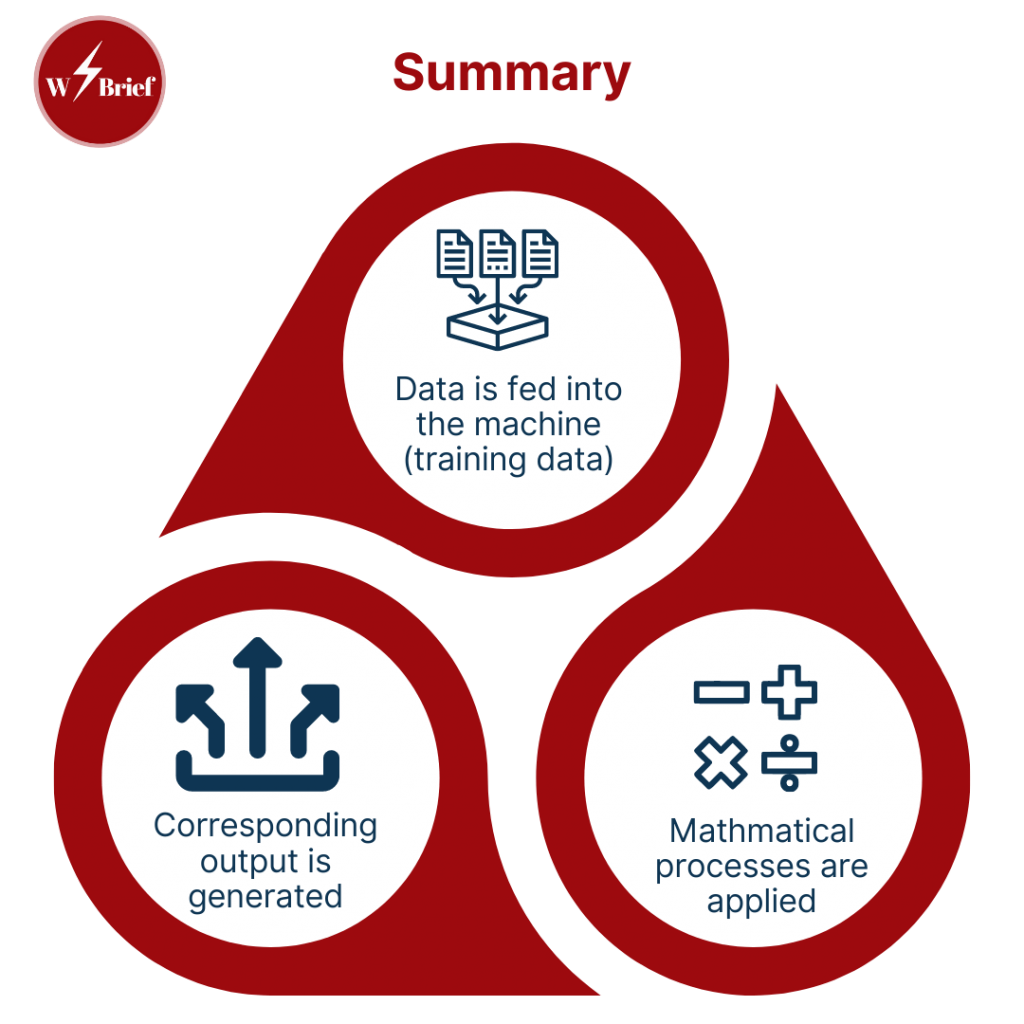
Algorithms are computerised processes that can be used to solve complex problems and predict future outcomes. More specifically, machine learning algorithms are mathematical codes that have been designed by humans to draw inferences from patterns of data and make predictions based on the available information. These are the type of algorithms that are the subject of our attention here. Put simply, data is fed into the machine (training data), mathematical processes are applied, and a corresponding output is generated.
What is an algorithm? Summary
The algorithmic problem – Systematising bias in code
Recent cases where algorithms have been applied in modern settings have put a spotlight on the fact that their effects need to be studied in greater detail. Particularly, as their uncontrolled rolllout can lead to unindented social consequences, if left unchecked by regulators and stakeholders. These examples, which are explored in further detail later on in this ‘Brief’, have revealed that as a result of how they are coded, algorithms are also capable of causing great social harms, by accentuating and systemising the negative biases and implicit assumptions that can exist within societies. This has come to be known as ‘algorithmic bias’ and is used to pick out instances in which certain groups of people are left worse off as a result of the outcomes produced by machine learning algorithms.
In recent times, a typical example of the potential injustices arising from the use of algorithms is the Correctional Offender Management Profiling for Alternative Sanctions (COMPAS). This programme is used by numerous courts in the US to guide sentencing and its purpose is to calculate the likelihood of an offender reoffending. Worryingly, ProPublica also found that the program was creating patterns that were discriminatory towards African Americans; their analysis found that, when controlling other factors, such as prior crimes, age and gender, black defendants were 45% more likely to be assigned higher risk scores relating to the probability of re-offence than their white counterparts. This example, and others like it, in which algorithms have been used to make consequential decisions by those at the decision-making-helm, highlight the vulnerabilities inherent to placing an over-reliance on automated systems.
ProPublica found that the program was creating patterns that were discriminatory towards African Americans and it was more likely to flag Black defendants as likely to re-offend.
What we’ll cover
In this article we will begin by first outlining algorithmic bias in greater detail, and in doing so, highlight two of its most common manifestations; pre-existing bias and feedback loop bias. To make sure you have a clear conception of how algorithmic bias works in the real-world, we will move on to focus our attention on Amazon’s AI recruiting tool and why the results it was producing forced Amazon to remove it. We will then move on to take a look at the relevant law surrounding algorithmic bias, as well as the social context in which it sits. Finally, our focus shifts to the future, and how we should aim to move forward with the use of algorithmic processes in light of our awareness of the possibility of negative outcomes.
Algorithmic Bias, What is it?
Recruitment Case Study
The Legal Context
The Social Context
Outlook
Takeaways
Algorithmic Bias, What is it?
Algorithmic bias refers to the systematic and repeatable errors programmed into computer systems that consequentially create unfair outcomes, e.g. privileging one group of users/customers over another. If left un-checked, this can have disastrous effects for society’s future development.
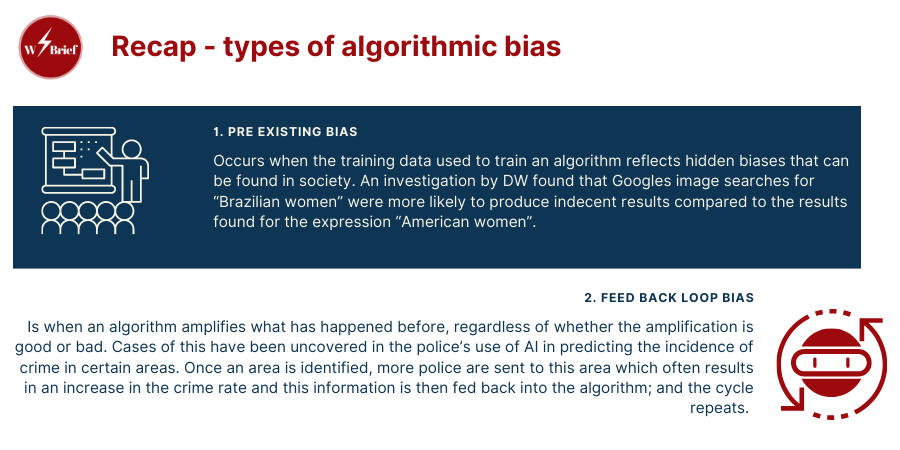
Algorithmic bias can manifest itself in many different ways, with each having a varying and unique impact on the degree of disenfranchisement and exclusion its victims will inevitably face. Below, the two most prominent types of algorithmic bias have been denoted and briefly explained:
1. Pre – Existing Bias
This occurs when the training data, which is the data that is used to train an algorithm, reflects the implicit assumptions and biases that are held in society. For example, an investigation carried out by DW, the German broadcaster, using 20,000 images and websites, uncovered hidden biases in algorithms used by the search engine Google. They showed that image searches using the expression “Brazilian women” were more likely to produce indecent results when compared to the results found for the expression “American women”.
2. Feedback Loop Bias
An algorithm is also capable of influencing the data that it receives through positive feedback loops. Simply put, this means that the algorithm amplifies what has happened previously. This is the case regardless of whether the amplification is good or bad. Cases of this have been uncovered in the police’s use of AI in predicting the incidence of crime in certain areas. Once an area is identified, more police are sent to this area which often results in an increase in the crime rate and this information is then fed back into the algorithm; and the cycle repeats.
Different types of algorithmic bias
It is important to note at this point that, despite the growing intrigue in algorithmic bias, the relevant evidence is usually difficult to obtain and this is restricting academic research into this area. The algorithms deployed in business are often proprietary and the result of large amounts of effort, investment and research. This means that the secrets behind how these algorithms work are often closely guarded. As such, most attempts made by external researchers to investigate potential bias issues are often left begging, without little cooperation from manufacturers. But with increasing social pressure and awareness of algorithmic bias, high-profile companies, such as Twitter, have recently tried to tackle this issue by holding competitions to identify and address algorithmic bias.
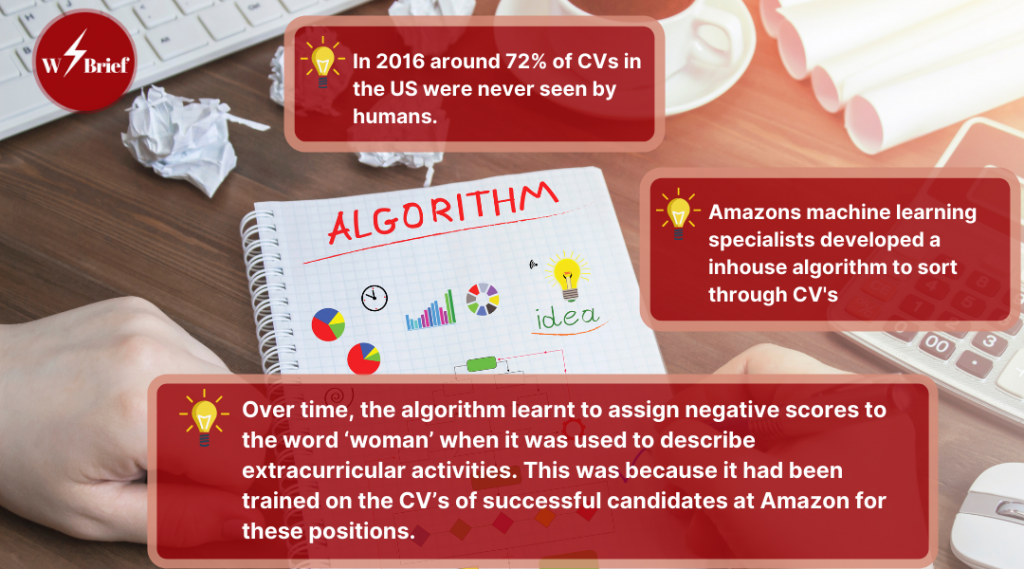
As is hopefully becoming clear, the influence of algorithms in decision making is widespread across all industries, from the financial services to local government. One particular area in which the use of algorithms is becoming increasingly prevalent is in the recruitment process; it was estimated in 2016 that around 72% of CVs in the US were never seen by humans.
Let us take a closer look at the use of algorithms in this context by analysing the somewhat recent Amazon recruitment case study. In 2014, through systems developed by AMZN.O, Amazon’s in-house machine learning specialists, the company began to use computer programs to review job applications. Automation has been a significant part of Amazon’s rise to the top of the e-commerce industry and was therefore inline with its prior course of business developments.
However, from as early as 2015 it was already becoming clear that candidates were not being rated in a gender neutral way, specifically for technical posts such as ‘software development’ positions. What quickly came to light was that the model had learnt to assign negative scores to the word ‘women(s)’ when it was used to describe extracurricular activities. The reasoning being that the model had been trained on the CV’s of historically successful candidates for these sorts of positions at Amazon, and these previously successful candidates were predominately male.
“Algorithmic Bias refers to the systematic and repeatable errors programmed in to computer systems that consequentially create unfair outcomes i.e Such as privileging one group of users over another”
Therefore, we are able to conclude, at least in part, that this is an example of pre-existing bias. This is because the model had recognised the male domination of certain job roles at amazon and made its predictions on the basis of this information. The debate that therefore ensues focuses on whether algorithmic screening can be employed to counter these biases, both explicit/conscious and implicit/unconscious, that human recruiters often fall guilty of.
Algorithmic screenining
The Legal Context
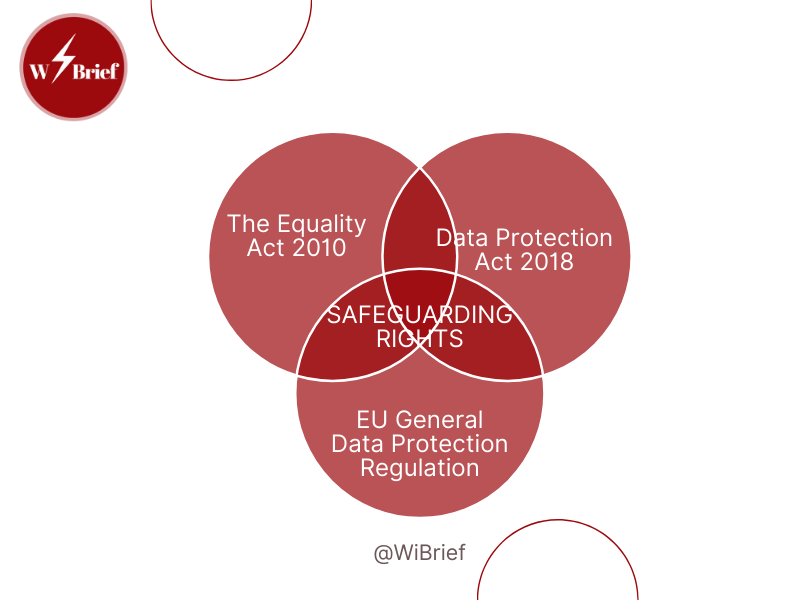
The Equality Act 2010
EU Generat Data Protection Regulation
Data Protection Act 2018
There are a few fundamental pieces of legislation in European and UK contexts of relevance to the issue of algorithmic bias. Of particular importance is the Equality Act 2010, which picks out nine ‘protected characteristics’ (see also how these human rights appear again in the European Commissions framework for trustworthy AI covered here) that demarcate illegal discrimination. These are: age, disability, gender reassignment, marriage and civil partnership, pregnancy and maternity, race, religion or belief, sex and sexual orientation.
On first impressions the Equality Act appears to present a clear cut guide for tackling algorithmic bias as we can hold humans accountable for the discriminatory decisions that they make. For an algorithm to be discriminatory in some way it must therefore have been programmed by some human to this effect; allowing accountability to be easily deduced. However, in practice things become a little hazy. For example, an algorithm can be explicitly programmed to exclude data concerning biological sex, but where this data strongly correlates with some other attribute, such as occupation, the algorithm may still end up producing sexist outcomes.
On the other hand, the risks that the uses of AI pose can be situated against some long-established legal principles and responsibility models. For instance, intention and negligence are important elements of civil and criminal cases. Considering the former, proving intent will likely require focusing on the individuals that intentionally developed and deployed a programme for malicious purposes. Furthermore, where predictions that programs make result in the causation of harm, and in those instances where a developers intent is absent, there could still be a legal question whether there was reasonable effort to foresee such harm.
Another approach that would negate the need for intention, would be to regulate algorithmic disputes through a ‘no-fault’ strict liability scheme. Under this, the very act of unfair discrimination by an algorithm would constitute enough evidence for its creators to be proven to be at fault and liable for the actions of their creation; unforeseen or otherwise. Unfortunately however, proving discrimination for the injured parties can be difficult. Especially, as we have previously covered, in situations when a CV has been unfairly filtered out by a sorting algorithm before the interview stage. In this situation affected parties will often not realise they are victims of such bias until many years later.
Finally, the EU General Data Protection Regulation (GDPR) and the Data Protection Act 2018 are pieces of legislation that include provisions aimed at providing effective legal safeguards such rights of transparency of explanation and of contestation for fully-automated decisions that process personal data.
Key legislation breakdown
The Social Context – Algorithmic discrimination
The main social implication of algorithmic bias is discrimination and the phrase ‘algorithmic bias’ is often used as a synonym for ‘algorithmic discrimination’. Discrimination is said to take place when one arbitrary group of people is, with no justified reasons, treated worse than the rest of the population.
The most significant concern for many is that not only are we seeing biases reflected in new automated decision-making processes, but that they are also being compounded. This exacerbating existing societal struggles with discrimination and inequality. Furthermore, some feel that the automation of such processes is resulting in accountability becoming blurred.
Encouragingly, NGOs are doing some very important work in order to illuminate the risks that machine learning systems present to human rights and liberties, including Amnesty International, Access Now, Human Rights Watch and Privacy International.
Outlook – The need for a standardised approach for detecting and measuring algorithmic bias
We must acknowledge the fact that the biases that we are uncovering in algorithmic decision-making processes are most likely the product of the implicit assumptions and negative associations of the past, alongside those that still exist in society today.
It seems obvious that a clear and standardised method for detecting and measuring algorithmic bias is essential at this moment. This is important as it is crucial that we develop an understanding of whether or not algorithmic bias is producing results that are worse than those biases that pre-exist them in society. It is only at this point that we may determine when and in what contexts the use of algorithms is producing a net-loss for society; to me, at this point there use would be hard to justify.
There also needs to be a focus on mitigation in the first instance which will likely be most effectively achieved through regulation. Following on from the point made above, until we deepen our understanding of what biases are at play this will be very difficult. Whether limiting the uses of algorithmic systems until this has been ironed out is the most appropriate way forward is a very contentious but important debate at present.
Article Takeaways
Algorithmic bias often reflects the negative biases and implicit assumptions that already exist in society.
The opaque nature of machine learning algorithms is limiting our ability to identify and address the potential biases.
Increased legal scrutiny will be required in order for our current legal principles to appropriately apply in the AI age.
The current trend of self-regulation should be left behind in order to prevent the sidelining of the law and legal institutions.
“The most significant concern for many is that we are not only seeing biases reflected in these new automated decision-making processes, but that they are also being compounded; exacebating discrimination and increasing inequalities.”
Algorithmic fairness is inseparable from the question of who is allowed to make consequential decisions. Read the wider context in the Autonomy and AI research hub, and investigate decision authority in the interactive Autonomy Atlas.